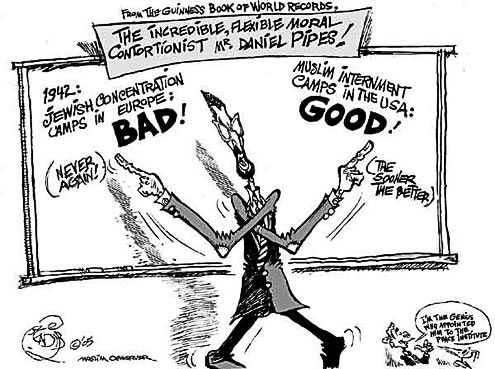
Pipes favors concentration camps … for Muslims

Pipes concentration camps

“That the Revisionist-Zionist extremist Daniel Pipes has fond visions of rounding up Muslim Americans and putting them in concentration camps isn’t a big surprise. That a mainstream American newspaper would publish this David-Dukeian evil is. Of course, this is also a man that President Bush appointed to a temporary vacancy at the United States Institute of Peace, after the Senate understandably balked at a regular appointment for him.”

Juan Cole on Pipes’ plans for incarcerating Muslims.

Informed Comment, 31 December 2004

Read Pipes’ article here.

The AWL and Tariq Ramadan: A case history in left-wing Islamophobia

In October 2004, Alliance for Workers’ Liberty supporter Alan Clarke persuaded the national executive committee of the National Union of Students to adopt a resolution calling for leading Muslim scholar Tariq Ramadan to be banned from speaking at the European Social Forum, which was to be held in London later that month. It quickly became clear that the motion had been based on an entirely false account of Professor Ramadan’s views.

Documented by Bob Pitt on the What Next? journal website

Qaradawi is welcome

“Ever since Dr Yusuf al-Qaradawi was welcomed to London’s City Hall by Ken Livingstone last July, Peter Tatchell and the gay rights organisation Outrage! have waged an obsessive campaign against this respected Muslim scholar. Unfortunately, their obsession is not matched by an equivalent concern for accuracy. The picture of Dr al-Qaradawi presented by Tatchell in the November issue of Labour Left Briefing (‘‘Qaradawi Not Welcome’) is nothing but an Islamophobic caricature which he uses as the basis for a more general attack on Muslims, their beliefs and their organisations.”

Peter Roberts on the What Next? journal website

Plan for Muslim cemetery met with fear

SOMERVILLE, Tenn. — Muslims planned to turn an old sod farm near Memphis into a cemetery, but angry neighbors protested, complaining that the burial ground could become a staging ground for terrorists or spread disease from unembalmed bodies.

It was not the first time a group faced opposition when trying to build a cemetery or a mosque, but the dispute stood out for the clarity of its anti-Muslim rhetoric.

“We know for a fact that Muslim mosques have been used as terrorist hideouts and centers for terrorist activities,” farmer John Wilson told members of a planning commission last month.

Similar disputes have arisen elsewhere when Muslim groups sought to develop mosques or cemeteries, which are often the first Islamic institutions in some communities.

Rabiah Ahmed of the Council on American-Islamic Relations said she noticed more protests of Muslim building proposals after the Sept. 11, 2001, terrorist attacks, so she was not surprised by the cemetery critics near Memphis. “It’s not shocking, but it is discouraging,” Ahmed said from the council’s headquarters in Washington.

Opponents told the Fayette County planning commission in November that power lines would be prime targets for terrorists in the region about 20 miles east of Memphis.

“Ladies and gentlemen, you may think this is far-fetched, but that is what the Jewish people thought when the Nazis started taking a small foothold, a little at a time, in their community,” Wilson said.

Belinda Ghosheh, owner of the five-acre plot being considered for the cemetery, said a meeting of planning officials drew such a hostile crowd she feared for her safety. One woman yelled, “We don’t need bin Laden’s cousins in our neighborhood.”

Associated Press, 27 December 2004

My fight against American phantoms – Tariq Ramadan

“Over the last four years, I have visited the United States more than 20 times. I have lectured on philosophy and Islam at numerous academic institutions from Dartmouth to Stanford and at organizations from the Brookings Institution to the United States Institute of Peace. I was invited to a meeting organized by former President Clinton, and I spoke before officials of the CIA.”

Tariq Ramadan in the Los Angeles Times, 21 December 2004

‘Academic freedom threatened’ over Muslim scholar’s visa

The Mayor of London’s human rights adviser Yasmin Qureshi has expressed concern about the treatment of respected Islamic scholar Tariq Ramadan by the US authorities, after Mr Ramadan resigned his professorship at an American university following the withdrawal of his visa. Swiss-born Professor Ramadan is one of the most respected philosophers of religion and conflict resolution. He was named by “Time” magazine as one of the world’s top 100 influential thinkers this year.

Mr Ramadan spoke at City Hall this year in favour of a woman’s right to choose to wear the Muslim headscarf (hijab). In July his American visa was revoked under the Patriot Act, adopted after the terrorist attacks on September 11, thus preventing him from taking up his post at the University of Notre Dame in Indiana. He has so far been refused a new visa.

The failure of the US authorities to issue him with a visa has led him to announce his resignation of two professorships at the university – professor of Islamic studies in the classics department and professor of religion, conflict, and peace-building – and he has accused the American authorities of attacking academic freedom.

Yasmin Qureshi said: “The withdrawal of Tariq Ramadan’s visa is a de facto attack on academic freedom in the U.S.A and it appears to send a signal to Muslims all over the world that their respected academics and scholars are not welcome in the US. The US authorities have so far failed to provide an explanation for the withdrawal of Tariq Ramadan’s visa. If this can happen to a mainstream figure such as Professor Ramadan then Muslims everywhere will feel that it could happen to them. The Muslim population in London will have every right to feel uncertain about whether they are now welcome visitors to the USA. As we have already seen, London resident Yusuf Islam was ejected from the USA earlier this year, again with no reason given. There is a very real danger that exclusions and bans of such mainstream figures will play into the hands of extremists.”

The mayor of London announced the appointment of Yasmin Qureshi as his human rights adviser earlier this week, asking her to address the problem of Islamophobia as one her responsibilities.

GLA press release, 17 December 2004

London mayor picks Muslim woman human rights adviser

Ken Livingstone, Mayor of London, has appointed a Muslim woman as his new human rights advisor, a decision welcomed by the sizable Muslim community in Britain.

Yasmin Qureshi, a barrister whose experience includes heading the Criminal Legal Section of the UN Mission in Kosovo (UNMIK) and the Department of Judicial Administration in Kosovo, will replace Graham Tope, who held the unpaid post during the mayor’s first term, said a press release posted on the official website for the Mayor of London.

“I am impressed with Yasmin’s serious approach to human rights, both in terms of the issues she has taken up and also her professional experience. She will bring an extra dimension to the work of my office in this field,” Livingstone said.

He asked Qureshi to include the issue of religious rights and freedoms as part of her work and to reflect the views of London communities who have concerns about the new French law banning religious symbols in state schools.

“I am pleased to have a Muslim woman advising me and carrying this work forward at a time when many Muslims feel that their rights around the world are not being addressed, and I am sure that she will take up these issues, such as a woman’s right to choose to wear the hijab, with vigor.”

Islam Online, 16 December 2004

Social Discrimination: Across the Muslim Divide

‘Social Discrimination: Across the Muslim Divide’ – A report by Saied R. Ameli, Manzur Elahi, and Arzu Merali for the Islamic Human Rights Commission.

The report is the second in the series British Muslims’ Expectations of the Government. It aims to chart the key areas of concern for Muslims and what they as participants in the social order expect the government’s engagement with them to be. The report looks at the nature and extent of general discrimination experienced by Muslims in their day to day life. Following the event of 9/11 there has been sudden upsurge of negative behaviour towards Muslims in Britain. In an attempt to find out the causes and the extent of general discrimination it employs theories of social psychology and communication; at the empirical level it employs both the results of a nationwide survey of nearly 1200 Muslims, qualitative answers of 40 Muslims and a number of case studies.

Islamic Human Rights Commission press release, 16 December 2004

Seumas Milne takes on the militant secularists

“For the left not to have stood with Muslims would have been a real betrayal. But for showing solidarity and working with Muslim organisations – whether in the anti-war movement or in campaigns against Islamophobia – leftwing groups and politicians such as the London mayor, Ken Livingstone, are now routinely damned by liberal secularists (many of whom have been keen supporters of the war in Iraq) for ‘betraying the enlightenment’ and making common cause with ‘Islamofascists’, homophobes and misogynists.”

Seumas Milne in Guardian, 16 December 2004