EDL calls for ban on veil – and on construction of mosques

“The ‘English Defence League’ will now be calling for a total ban on the wearing of the Burkha, We view the Burkha as a significant threat to the national security of the UK as anyone can be wearing it without being identified, British people cannot wear balaclava’s into a bank so muslim women shouldnt be permitted to wear a Burkha either, The same rules should apply to all. We will continue to protest against the implementation of Sharia Law in the UK and Militant Islamists operating within our shores. We also call for the immediate halting of all construction on new mosques based on the fact our government has no idea who is living in this country and 80% of imams running these mosques cannot speak our language, We urge our government to launch an urgent investigation into the source of funding for all new mosques in the UK as we beleive Saudi sponsorship is funding the extreme wahhabi form of islam which is spreading around the UK, We shall never surrender!”

English Defence League statement, 27 January 2010

Spelling and grammar as in original.

Danish government urges use of existing rules to suppress veil

Denmark’s government said Thursday that face-covering Muslim veils don’t belong in Danish society but no ban is needed because their use can be limited under existing rules.

The center-right government said the burqa – an all-covering dress – and the niqab face veil are “diametrically opposed” to the values on which Danish society is built. It called for the full use of existing rules that allow schools, as well as both public and private employers, to demand that students, teachers and workers show their faces.

“The use of the burqa or niqab … deprives women of the right to interact in the Danish society on equal footing with men and women who do not wear the burqa or niqab,” the government said.

The statement followed months of discussion about whether Denmark should ban burqas and niqabs – a debate also taking place elsewhere in Europe. While the debate in Europe is widespread, use of the veils is not. A report commissioned by the Danish government found that only two or three women in the country wear burqas, and perhaps 200 wear niqabs.

The nationalist Danish People’s Party – a key ally of the minority government – criticized the government’s stance and said stronger action was needed to curb the use of face-covering veils. “It is a pity that the government won’t do anything about it,” deputy party leader Peter Skaarup said.

Associated Press, 28 January 2010

Media and politicians responsible for rise in hate crimes against Muslims in London, study finds

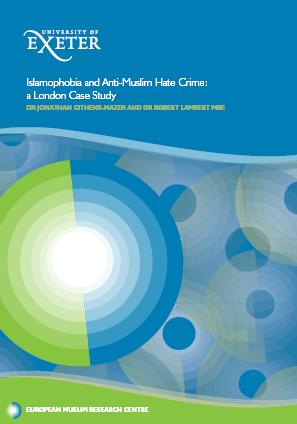
Islamophobia and Anti-Muslim Hate CrimeA rise in the number of hate crimes against Muslims in London is being encouraged by mainstream politicians and sections of the media, a study written by a former Scotland Yard counter-terrorism officer, published yesterday, says. Attacks ranging from death threats and murder to persistent low-level assaults, such as spitting and name-calling, are in part whipped up by extremists and sections of mainstream society, the study says.

The document – from the University of Exeter’s European Muslim research centre – was written by Dr Jonathan Githens-Mazer and former special branch detective Dr Robert Lambert.

“The report provides prima facie and empirical evidence to demonstrate that assailants of Muslims are invariably motivated by a negative view of Muslims they have acquired from either mainstream or extremist nationalist reports or commentaries in the media,” it says. “Islamophobic, negative and unwarranted portrayals of Muslim London as Londonistan and Muslim Londoners as terrorists, sympathisers and subversives in sections of the media appear to provide the motivation for a significant number of anti-Muslim hate crimes.”

In his foreword, the rightwing journalist Peter Oborne writes: “The constant assault on Muslims from certain politicians, and above all in the mainstream media, has created an atmosphere where hate crimes, ranging from casual abuse to arson and even murder, are bound to occur and are even in a sense encouraged by mainstream society.”

The report is based on interviews with witnesses to and victims of hate crimes, as well as police officers and former members of extremist organisations such as the British National Party. It says: “An experienced BNP activist in London explains that he believes that most BNP supporters simply followed the lead set by their favourite tabloid commentators that they read every day. When these commentators singled out Muslims as threats to security and social cohesion, he says that it was perfectly natural for BNP supporters to adopt the same thinking.”

The report says the extreme right are directing their violence more against Muslims than black or Asian Britons. “Interviewees with long experience of extremist nationalist street violence in London are unequivocal in their assessment that Muslim Londoners are now a prime target for serious violence and intimidation in the way that Londoners from minority ethnic communities once were,” it says.

The study focuses on anti-Muslim violence in London, with its authors saying they will produce one covering the whole of the UK by this summer.

Guardian, 28 January 2010

The report, Islamophobia and Anti-Muslim Hate-Crimes: a London Case Study, is available online from the European Muslim Research Centre website.

Update:  See Jonathan Githens-Mazer and Robert Lambert, “Muslims in the UK: beyond the hype”, Comment is Free, 28 January 2010

Objectors will have another chance to stop new mosque in Camberley

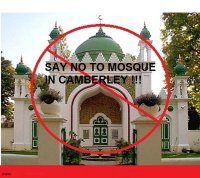
No to mosque in CamberleyObjectors to Camberley’s mosque have a final chance to sway a planning decision that apparently allowed the controversial plans to go ahead.
Surrey Heath Borough Council apologised for the “confusion” on Tuesday, but pointed out that the mosque plan had not yet been agreed and would need a second hearing before a decision could be reached.

The announcement will come as a major embarrassment for the council after it appeared to many people at Monday’s planning meeting that the mosque plans had already been formally agreed.

The apparent decision to allow the mosque to be built, against the recommendation of Surrey Heath’s planning experts, led to a massive public outcry from people opposing it, many of whom had assumed the plans would be blocked.

Get Surrey, 26 January 2010

See also BBC Surrey, 28 January 2010

For an example of objections to the new mosque see the Facebook page “Say NO to mosque in Camberley!!!

Posted in UK

Canada: Tories and Liberals reject veil ban, Muslim Canadian Congress supports it

The Conservative government will not follow France’s lead to consider banning the burka. “In an open and democratic society like Canada, individuals are free to make their own decisions regarding their personal apparel and to adhere to their own customs or traditions of their faith and/or beliefs,” said a spokesperson for Justice Minister Rob Nicholson. “We have no plans to introduce justice legislation in this matter.”

The Muslim Canadian Congress is calling on the feds to impose limits on the wearing of the full veil, suggesting “political correctness” is preventing politicians from tackling the sensitive subject. “It’s a control thing, identifying with Muslim brotherhood,” said senior VP Salma Siddiqui. “Basically it is a subservient tool.” Her group plans to lobby politicians from all parties in May.

Liberal MP Marlene Jennings said Canada’s charter rights protect religious freedom, and the Supreme Court has consistently ruled not to impose any limits. “Canadian women have the right, if they want, to wear a burka,” she said.

The controversy comes after France issued a report proposing a partial ban on the burka and niqab. The report called the wearing of full veil a “challenge” to the republic and a symbol of enslavement of women and extremist fundamentalism.

Nathalie Des Rosiers, general counsel for the Canadian Civil Liberties Association, said Canada must send strong messages about equality of women but reject calls to follow France’s lead. “It goes without saying they should not be subjected to pressures from their communities, but neither from their government,” she said. “It’s not the place of the government to dictate how women should dress.”

Toronto Sun, 27 January 2010

Government criticised over failure to tackle anti-Islamic hostility

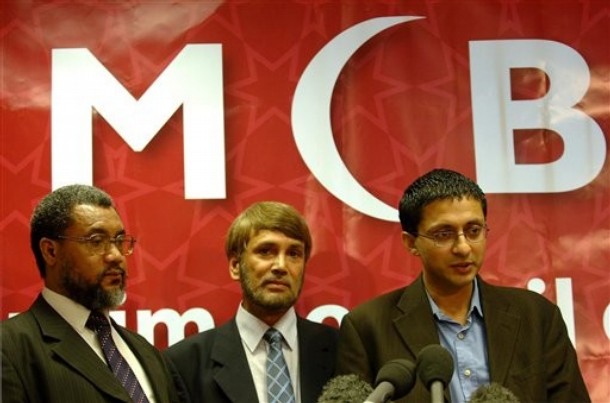
Daud Abdullah, Muhammad Abdul Bari, Inayat BunglawalaThere is growing disenchantment at the government’s “lacklustre response” to rising anti-Islamic hostility, the Muslim Council of Britain has said.

The council wrote to the home secretary on the “growing problem” after a march by the English Defence League (EDL).

Dr Muhammad Abdul Bari, secretary general of the Muslim Council of Britain (MCB), said there was a “growing disenchantment at the lacklustre response from our political leaders to speak out against anti-Muslim hatred” among many British Muslim communities.

His letter said: “Whether this exists in explicit form through the actions of far-right groups, or implicitly with hysterical headlines in our media, the policy response to any of these has been far from satisfactory. We ask you to take leadership in this matter, especially in a year where divisive elements may well flourish in the run-up to the next general election.”

The MCB accused political leaders of staying silent on the issue and said they had “ridden the wave of this disturbing trend” but failed to challenge hostility.

It hosted a meeting of Muslim groups at the weekend to discuss what it called “the growing trend of anti-Muslim hatred and violence”.

BBC News, 27 January 2010

See also MCB press release, 26 January 2010

Swiss basketball player fails to overturn headscarf ban

Sura Al-ShawkA Swiss basketball player has failed in her bid to have a court overturn a headscarf ban when she plays in league games.

A local court in the canton of Lucerne said in a ruling published Wednesday that the ban doesn’t breach the rights of the player, who is Muslim.

Sura Al-Shawk, a 19-year-old Swiss citizen of Iraqi origin who plays for STV Luzern, sought permission from the Swiss basketball association to wear a scarf. ProBasket said in August she can’t because it could increase the risk of injury and the sport has to be religiously neutral.

ProBasket said it followed the rules of FIBA, basketball’s world governing body.

Associated Press, 27 January 2010

UK poll: 66 per cent back ban on niqab in public places

Most people in Britain hold a critical opinion on the veils worn by some Muslim women, according to a poll by Angus Reid Public Opinion. 67 per cent of respondents say that garments that conceal a woman’s face represent an affront to British values, while 25 per cent disagree with this notion. However, 58 per cent of respondents believe the government should not be allowed to tell individuals what they can and cannot wear.

Angus Reid Global Monitor, 27 January 2010

Full poll here.

Unfortunately, the apparently reassuring opposition to state interference didn’t prevent 66% of respondents backing a ban on the niqab in public places, 75% a ban in schools and universities, and 85% a ban at airports.

Parliamentary inquiry condemns veil as ‘un-French’

The Islamic full-body veil should be banned from French public offices, hospitals, trains and buses, according to a parliamentary investigation which reported yesterday. In a bad-tempered final session, the committee of inquiry angered many members of President Nicolas Sarkozy’s ruling centre-right party by rejecting their demands for an outright ban on the burka or niqab. After a muddled and heated six-month investigation, the committee decided that such a ban might be declared unconstitutional under French and European law.

Instead, a narrow majority of the 32 members accepted a compromise suggested by Mr Sarkozy and the Prime Minister, François Fillon. They called for a solemn, but unenforceable, parliamentary motion declaring the full-length veil – a marginal but growing phenomenon in France – to be “un-French”. They said that this should be followed soon by a law forbidding people to cover their faces in “official” public spaces, from hospitals to post offices.

The committee’s recommendation split the ruling Union pour un Mouvement Populaire (UMP) down the middle. The party’s parliamentary leader, Jean-François Cope, immediately announced that he would push ahead with his own draft law calling for an outright ban. Officially, Socialist MPs boycotted the final meeting of the inquiry, alleging that it had been “polluted” by party politics and hijacked by “faction fighting” within the UMP. Several leading socialist politicians defied the boycott, however, and support an outright ban.

The possibility of a law against the full-length veil was first raised last summer by a Communist MP.

Independent, 16 January 2010

Cf. Raphaël Liogier, “France’s attack on the veil is a huge blunder”, Comment is Free, 26 January 2010