Close ‘extremist’ schools – Kelly

Islamic schools that promote “isolationism” and extremism should be closed, Communities Secretary Ruth Kelly has said. She said the government had to “stamp out” Muslim schools which were trying to change British society to fit Islamic values. “They should be shut down,” she said. “Different institutions are open to abuse and where we find abuse we have got to stamp it out and prevent that happening.”

BBC News, 27 August 2006


No doubt schools whose objective is to change British society to fit Catholic values will also be threatened with closure. Or, then again, perhaps not.

MPACUK alert: Muslims thrown off plane for acting ‘suspiciously’!

The Muslim Public Affairs Committee has issued a call for complaints to be made in response to the case of Sohail Ashraf and Khurram Zeb, the two innocent Asian students who were marched off a Monarch  jet at gunpoint because other passengers feared they were terrorists:

We request you to make your feelings known to Monarch airline as well as the Department of Transport using the following contact details, calling for an apology by the airline and stating clearly that you object to the victimisation of particularly Muslim passengers because of their appearance and creed.

MOREOVER should the airline decline to make an official apology we will be calling for a complete boycott of all travel with the airline.

Copy all of these organisations in your email!

Monarch Airlines

  • Geoff Atkinson – Monarch Group Lawyer and Company Secretary
  • Tel: 01582 398 043
  • Send your complaints by clicking here.

Copy the message to:

  • Department for Transport Aviation Team – responsible for all aviation policy!
  • David McMillan (Director of Aviation) david.mcmillan@dft.gsi.gov.uk

‘We need a political solution’

“The fundamental mistake made after 9/11 was that any stirrings of a debate addressing the root causes of the terror were ruthlessly suppressed…. Rather than addressing the known political causes, the terrorist attacks were portrayed as a religious struggle: radical Islam v the west.

“Al-Qaida was supposed to have conducted the 9/11 attacks because it deplores western values – its freedom, its democracy – and desires the establishment of a global empire of Islamic emirates. But as Robert Fisk makes clear in his book, The Great War for Civilisation, Osama bin Laden’s rage against the US arose from its support for Israel, the Saudi monarchy, and the garrisoning of US troops in the land of Islam’s holiest sites.

“The very deliberate policy of converting political struggles into religious ones had a very specific purpose: to induce fear of an impending threat to western way of life from encroaching radical Islam so that the population of the west would fall in line behind Bush and his neocon policies. Radical Muslims – and now ‘Islamic fascists’ – were as deadly as communism and Nazism. Unless the American public blindly supported every Bush policy in countering terrorism, the whole of western civilisation was imperilled.”

Imran Khan at the Guardian’s Comment is Free, 26 August 2006

Tiptoeing around the truth

“The plain fact is, in a diverse, multi-faith society such as ours, it would be foolish to believe that we can continue to unleash devastation upon peoples abroad while expecting there to be no social consequences back at home.”

Inayat Bunglawala points out that Ruth Kelly’s call for an “honest debate” on the causes of extremism rings a little hollow when the terms of reference of the new Commission on Integration and Cohesion explicitly exclude”foreign policy’s relationship to radical Islamism”.

Comment is Free, 25 August 2006

Multiculturalism and ‘the British way of life’

Ruth KellyIn today’s Daily Express Mark Palmer writes: “Yesterday Ruth Kelly, Labour’s Communities Secretary, warned in her own, typically fuzzy way that multiculturalism might not be such a brilliant idea after all. Well, not at the minute, at least, when there are Muslim extremists waiting for every opportunity to stir the racial-religious pot…. ‘We’ve moved from a period of near uniform consensus on the value of multiculturalism to one where we can encourage that debate by questioning whether it is encouraging separateness’, she said.”

Palmer broadly welcomes Kelly’s intervention. But he has his criticisms: “For starters, we have not moved from a ‘period of near consensus on the value of multiculturalism’ because for many of us it has never existed. Indeed, I would hazard to guess that the majority of tax-paying Britons have always regarded multiculturalism as a bad thing, increasingly so in a world where young men are prepared to drive aeroplanes into buildings and take bombs onto buses and Tube trains.”

He also raises another objection: “Kelly wants us to look at faith schools. She says Muslim parents should not be denied opportunities offered to Christians in sending their children to faith schools. But it is disingenuous to pretend that that all such schools serve the same purpose. Church and Jewish schools instil discipline and a moral framework. But unlike their Islamic counterparts they do not seek to keep children separate from British society.”

Palmer has his own recommendations as to how we should learn to live together: “Multicultural harmony will only be achieved when those from other cultures are prepared to accept the British way of life. And, lest we forget, Britain is a Christian country. The Church of England remains an institution worthy of respect – it’s a part of our heritage and has our sovereign as its supreme governor.”

Terrorism – blame the parents

Ginny Dougary is unimpressed by “all the sympathetic coverage in the liberal press about the poor, puzzled Muslims who feel that they are being picked on in airports and flights. If the parents of the young men who are attracted to this murderous martyrdom have lost control of their sons, then they must shoulder part of the blame. If the Muslims who choose to live in our society, with all its so-called tempting freedoms, do not protest against those who wish to destroy it, then how can they expect our tolerance?”

Times, 25 August 2006

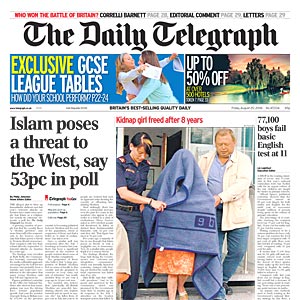
Islam poses a threat to the West, say 53% in poll

Telegraph Islam threat to westThe alleged plot to blow up transatlantic airliners and last year’s terrorist attacks on London have made more people fear Islam as a religion, not merely its extremist elements, a poll for The Daily Telegraph has found.

A growing number of people fear that the country faces “a Muslim problem” and more than half of the respondents to the YouGov survey said that Islam posed a threat to Western liberal democracy. That compares with less than a third after the September 11 terrorist attacks on America five years ago.

The findings were revealed as Ruth Kelly, the Communities Secretary, conceded that the multi-culturalist approach encouraged by the Left for two decades had probably been a mistake and could have contributed to the alienation that many young Muslims said they felt and experienced.

The YouGov survey confirms ministers’ fears that the country is becoming polarised between Muslims and the rest of the population, which is suspicious of them, and that a belief in “a clash of civilisations” has taken root.

Since a similar poll was conducted after the July 7 bombings in London last year, there has been a significant increase in the number of people worried about some of their Muslim compatriots.

The proportion of those who believe that “a large proportion of British Muslims feel no sense of loyalty to this country and are prepared to condone or even carry out acts of terrorism” has nearly doubled from 10 per cent a year ago to 18 per cent now.

The number who believe that “practically all British Muslims are peaceful, law-abiding citizens who deplore terrorist acts as much as any- one else” has fallen from 23 per cent in July last year to 16 per cent. However, there remains strong opposition to the security profiling of airline passengers based on their ethnicity or religion.

A higher proportion than last year now feels that the police and MI5 should focus their counter-terrorism efforts on Muslims and far fewer people are worried that such an approach risks dividing the country or offending law-abiding Muslims.

Most strikingly, there has been a substantial increase over the past five years in the numbers who appear to subscribe to a belief in a clash of civilisations. When YouGov asked in 2001 whether people felt threatened by Islam, as distinct from fundamentalist Islamists, only 32 per cent said they did. That figure has risen to 53 per cent.

Five years ago, a majority of two to one thought that Islam posed no threat, or only a negligible one, to democracy. Now, by a similar ratio, people think it is a serious threat.

Daily Telegraph, 25 August 2006