Boos for Archbishop of Canterbury at church

The Archbishop of Canterbury was heckled yesterday as he attended a memorial service. A few people in the small crowd which had gathered booed and one man called for him to resign over his controversial comments about accepting aspects of Muslim Sharia law in Britain.

Although Dr Rowan Williams didn’t respond to the hecklers outside a church in Cambridge, he posted a statement on his website in an bid to defuse the row. He said he “certainly did not call for its introduction as some kind of parallel jurisdiction to the civil law”.

Meanwhile police in Kent said the Archbishop had been offered round-the-clock protection, but had turned it down.

Sunday Mirror, 10 February 2008

No blanket niqab ban: Holland

THE HAGUE — In a retreat from the previous cabinet’s plan for a general ban, the Dutch government has said it would now impose a partial ban on niqab in the western European country. “Face coverings are undesirable in an open society, they hinder communication between people and undermine equal chances for men and women,” Dutch Prime Minister Jan Peter Balkenende said in statements cited Saturday, February 9, by Reuters.

He says the government will impose a face veil ban on its civil servants and in schools, and it will enter talks with public transport companies on adding a ban to their terms and conditions for passengers. The government wants clauses to the contracts of public employees forbidding them from wearing face-covering garments.

The cabinet has decided against a broad ban on niqab in public as that would violate the principle of freedom of religion. “Wearing Islamic face-covering veils is an expression of religion and freedom of religion can only be infringed in very special and specific circumstances,” Internal Affairs Minister Guusje ter Horst said in a statement cited by Agence France-Presse (AFP).

If the talks with other bodies like private transport companies fail, the cabinet can always introduce enforcement regulations, the minister said.

Shortly before being voted out of office, the previous centre-right Dutch government proposed a complete ban on niqab in public, citing security concerns. A new centrist coalition government of Christian Democrats, Labour and the Christian Union came into power in February 2007 and has taken a more conciliatory line on immigration.

Right-wing lawmaker Geert Wilders — who has angered Muslims with his fierce criticism of Islam — called the government’s reported retreat “very disappointing and cowardly”, according to the Dutch news agency ANP. Wilders sent a bill to parliament last July proposing a ban on niqab in public.

Islam Online, 9 February 2008

Minister warns of ‘inbred’ Muslims

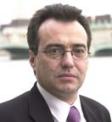
Phil WoolasA government minister has warned that inbreeding among immigrants is causing a surge in birth defects – comments likely to spark a new row over the place of Muslims in British society. Phil Woolas, an environment minister, said the culture of arranged marriages between first cousins was the “elephant in the room”. Woolas, a former race relations minister, said: “If you have a child with your cousin the likelihood is there’ll be a genetic problem.”
Woolas was supported by Ann Cryer, Labour MP for Keighley, who called for the NHS to do more to warn parents of the dangers of inbreeding. “This is to do with a medieval culture where you keep wealth within the family,” she said. “I have encountered cases of blindness and deafness. There was one poor girl who had to have an oxygen tank on her back and breathe from a hole in the front of her neck. The parents were warned they should not have any more children. But when the husband returned again from Pakistan, within months they had another child with exactly the same condition.”

Sunday Times, 10 February 2008

In the Observer Jo Revill points out that “his claims don’t appear to be supported by medical evidence. The risk of a child having birth defects if the parents are cousins is double that of other children, which means the risk rises from about 3 per cent in the general population to about 6 per cent when there is consanguinity (when the parents are closely related).”

Archbishop of Canterbury wants to introduce torture and beheadings (according to Torygraph)

Sandy Mitchell has terrifying first-hand experience of being on the wrong side of sharia law. Mr Mitchell, 52, was falsely accused of being involved in a car bombing in Saudi Arabia in 2000 when he was working there as an anaesthetic technician. He was held in prison for three years and tortured until he eventually signed a confession, which he later had to read out on Saudi television.

A sharia court sentenced him to having his head partially severed, followed by public crucifixion. The sentence was later reduced to beheading, before the Saudi authorities finally conceded that al-Qa’eda terrorists had planted the bomb and let Mr Mitchell return home to Halifax, West Yorks.

Yesterday he accused the Archbishop of Canterbury of “betraying” Christians with his comments on Islamic law. He said Dr Rowan Williams clearly had “absolutely no concept of what sharia law is”, because if he did, “he wouldn’t have made such a foolish statement”.

Mr Mitchell, a practising Christian, added: “I would like to see Dr Williams apologise to the people he is supposed to represent – the Christians in this country. His job is to serve the Christian community, and most of the Christian community will feel offended and betrayed by his comments. Sharia law is completely incompatible with a civilised society and I’m sure if Dr Williams had time to study it properly he wouldn’t have been so stupid as to make the statements he has.”

Daily Telegraph, 9 February 2008

Common sense from the FT on ‘sharia law’

The Archbishop of Canterbury’s comments have triggered widespread confusion about the current status of the Islamic legal system.

In Britain, Muslims can already choose to have disputes settled privately under Sharia law. The government also recognises some Sharia-compliant investment and banking products, such as mortgages, and allows meat to be slaughtered according to strict Islamic practices.

The government has not, however, authorised the establishment of formal Sharia courts to deal with criminal law proceedings

Under the Archbishop’s proposals, Muslim groups would be expected to follow the precedent set by Beth Din, the Jewish court, which legally arbitrates marital and financial disputes between Orthodox Jews.

Family lawyers said this might mean establishment of local Sharia councils, which could deal with Muslim marriages and divorces, among other civil matters. It would not allow for the creation of a “parallel” legal system.

Financial Times, 9 February 2008

See also Clare Dyer in the Guardian and Deborah Orr in the Independent.

And Salma Yaqoob, as reported in the Birmingham Mail. Also Yahya Birt.

Archbishop ‘gives heart to Muslim terrorists plotting our destruction’

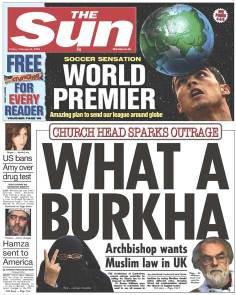
What A BurkhaThe Archbishop of Canterbury sparked outrage today by saying the introduction of Sharia law in Britain is inevitable. In an explosive outburst Dr Rowan Williams, the country’s top Anglican, said there should be one set of rules for Muslims – and another for everyone else.

He maintained it was WRONG for followers of Islam to be forced to choose between “the stark alternatives of cultural loyalty or state loyalty”. Instead he said the country must “face the fact” that some Muslims do not relate to the law in Britain.

The 57-year-old insisted we accept aspects of Sharia law with a “constructive accommodation” in areas like marriage so Muslim women would not have to use British divorce courts. He added: “It seems unavoidable.”

Dr Williams’ extraordinary claim is a huge propaganda coup for extremists plotting to end centuries of the British way of life. And it was roundly condemned from all quarters last night.

Paul Dadge, famously pictured helping masked 7/7 victim Davina Turrell, 24, was left stunned. The 31-year-old former fireman, of Cannock, Staffs, said: “The Archbishop’s remarks are unhelpful. I am proud to be British and find the idea that Sharia law would ever become part of British law incredible.”

Mary Burke, 50 – who survived the King’s Cross bomb on July 7 2005 – said: “Britain is a Christian country and should stay a Christian country. I don’t want Islamic law here and I believe most of the British public agree with me.”

Sun, 8 February 2008


And the Sun’s leader opines: “It’s easy to dismiss Archbishop of Canterbury Rowan Williams as a silly old goat. In fact he’s a dangerous threat to our nation. He says the adoption in Britain of parts of Islamic Sharia law is ‘unavoidable’. If he believes that, he is unfit for his job….He also gives heart to Muslim terrorists plotting our destruction. They will see his foolish ramblings as a sign that our resolve against extremism is weakening.”

Racism still exists in Greater Manchester Police

An atmosphere which “tolerates anti-Muslim feelings” exists within Greater Manchester Police, says a high-ranking Asian officer.

Inspector Asrar Ul-Haq made the claim during a race discrimination tribunal against GMP where he alleged he had been overlooked for promotion. After two days of evidence, the force settled and agreed to pay him compensation. But the M.E.N. can reveal there are at least three other officers currently pursuing race discrimination cases.

Charles Crichlow, the chairman of the Black and Asian Police Association (BAPA), said after the case the issue of institutional racism “remains largely unresolved”. It is almost ten years since former Chief Constable David Wilmot publicly acknowledged GMP had a problem with “institutionalised racism”.

Insp Ul-Haq, who has been a police officer for 23 years, took GMP to a tribunal claiming he was repeatedly passed over for promotion. He said he had passed all the necessary exams but had been rejected at the final interview stage three times while promotion opportunities were given to other officers who had not passed the exams.

Yousef Dar, chairman of the Greater Manchester Muslim Police Association, said: “It is disappointing that any officer or staff member has to resort to such measures in tackling inequality and discrimination.” Mr Crichlow added: “This case draws attention to the issue of institutional racism in the police service which, as the number of tribunals and complaints to BAPA suggest, remains largely unresolved.”

Manchester Evening News, 8 February 2008

‘We need a thoughtful discourse, not hysterical discord’ says MCB

MCB bannerThe Muslim Council of Britain is grateful for the thoughtful intervention of the Archbishop of Canterbury on the discussion of the place of Islam and Muslims in Britain today.

The MCB observes, with some sadness, the hysterical misrepresentations of his speech which serves only to drive a wedge between British people.

“The Archbishop is not advocating implementation of the Islamic penal system in Britain. His recommendation is confined to the civil system of Shariah Law and that only in accordance with English law and agreeable to established notions of human rights”, said Dr Muhammad Abdul Bari, Secretary General of the MCB.

British Muslims are not calling for creation of different legal systems, nor is the Archbishop. We do not wish to see a parallel system or a separate system of judiciary for Muslims. The Archbishop sought in his speech to explore the possibilities of an accommodation between English law and some aspects of Islamic personal law.

British Muslims would wish to seek parity with other faiths in particular the followers of the Jewish faith in the United Kingdom in facilitating choices for those who wish, as Muslims, for their personal relationships to be governed by a Shariah civil code. This legitimate aspiration requires full discussion in an atmosphere of understanding and tolerance. It is worthy of note that already enshrined in English law are provisions for Islamic Shariah compliant finance which have become very popular and now enable billions of pounds of fresh investment to come into the UK.

“Our common mission to live in cohesion and harmony is better served when men of conscience and authority speak out for justice and equal opportunity. Silence is much more likely to engender prejudice, injustice and inequality. On the issue of giving individuals choice of law but only in private and personal matters, we call, as does the Archbishop, for a mature debate in an environment that reflects mutual respect.” said Dr Bari.

Muslim Council of Britain press release, 8 February 2008