
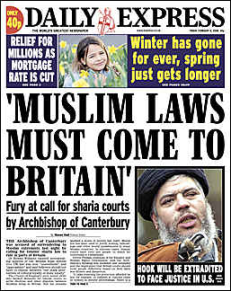
 The Archbishop of Canterbury was accused of surrendering to Muslim extremists last night by calling for Islamic sharia law to rule in parts of Britain.
Dr Rowan Williams claimed incorporating aspects of the Muslim legal system into UK law was now “unavoidable” and “appropriate” and said believers should not have to choose between “the stark alternatives of cultural loyalty or state loyalty”.
The Church of England’s most senior cleric also backed demands for Islamic courts to settle divorces and other disputes between Muslims living in Britain.
But his remarks sparked a storm of protest. Sharia law has been used to justify stoning, beheadings and other brutal punishments in many Muslim countries. In extreme cases, Islamic courts have even put people to death for converting to Christianity.
Tory MP Mark Pritchard called the Archbishop’s remarks naive and shocking. “He may want to run up the white flag of surrender over Lambeth Palace, but there are many who do not.”
Mike Judge, of the Christian Institute, said: “The fact that we all obey the same law, whatever our religion, is an important principle of the British way of life.”
And Stephen Green, national director of Christian Voice said: “This is a Christian country with Christian laws. If Muslims want to live under sharia law then they are free to emigrate to a country where sharia law is already in operation.”
 The government has been criticised by moderate Muslim groups for banning a controversial Muslim scholar from entering Britain and branding him an extremist.
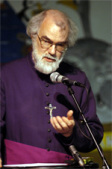 The Archbishop of Canterbury sparked controversy today when he said the introduction of sharia law for British Muslims was “unavoidable”. Rowan Williams told BBC Radio 4’s World at One that Muslims should be able to choose whether to have matters such as marital disputes dealt with under sharia law or the British legal system. His comments were strongly criticised by the National Secular Society but welcomed by the Muslim Council of Britain (MCB), which stressed it did not back the introduction of sharia criminal law. Williams said his proposal would only work if sharia law was properly understood, rather than seen through the eyes of biased media reports.
 Maryam Namazie of the Worker-Communist Party of Iran offers her thoughts (we use the word in its loosest possible sense) on the death sentence imposed on Parwiz Kambakhsh in Afghanistan. She writes: