
Muslim students lay the blame on No.10

Muslim anger over British foreign policy, particularly the war against Iraq, resurfaced yesterday in a survey of Muslim students.

Almost all of the students who took part in the research said that they were unhappy with Tony Blair’s policy in the Middle East and two thirds said that they felt it had contributed to the London bombings. Half of the respondents in the poll, which was organised by the Federation of Student Islamic Societies, said they had experienced Islamophobia and nine out of 10 objected to the way they were portrayed in the media.

The preliminary results of the survey were revealed at a conference in London’s City Hall addressed by a panel including Ken Livingstone, the London Mayor, Government ministers and commentators.

Wakkas Khan, the president of the federation, which represents 90,000 Muslim students, said: “The Prime Minister’s continuing refusal to accept that his decisions could have led to such extreme consequences does nothing to appease the Muslim community, and on the contrary, seems to be causing more resentment amongst young Muslims. It is important now for Mr Blair to accept that foreign policy is a serious concern and to start to do something about it rather than being seen to brush it aside.”

Mr Livingstone said: “Anti-terrorist measures must be directed against those carrying out, planning or supporting such terrorist attacks and not against those who are our allies in dealing with the terrorists. Attempts to criminalise legitimate political views, for example on Israel’s treatment of the Palestinians, would destroy the trust, which is essential to isolate and deal with real terrorists.” He told Muslim students that it was their duty to challenge a “rising tide of Islamaphobia” in the media.
Daily Telegraph, 1 September 2005

UK Muslims reject Al-Qaeda justification for attacks

The Muslim minority in Britain condemned Al-Qaeda claiming responsibility for the London attacks, rejecting its justification for carrying out the terrorist attacks by linking them to the atrocities committed in Iraq and the occupied Palestinian territories.

“Nothing can ever justify committing acts of terrorism against innocent civilians,” Inayat Bunglawala, a spokesman for the Muslim Council of Britain, told the BBC News Online Friday, September 2. “Holding all British people responsible for the Iraq war is just plain wrong – this country was bitterly divided and many millions, perhaps the majority, clearly opposed the war.”

In a footage aired on the Doha-based Al-Jazeera Thursday, Mohamed Sidique Khan, one of the alleged four bombers of the London attacks, said atrocities committed by the western countries against Muslims around the world drove him to bomb the London transport system.

“Your democratically elected governments continue to commit atrocities against my people over the world,” Khan, 30, said in English, Agence France Presse (AFP) said.

“Their support makes you directly responsible just as I am directly responsible for protecting and avenging my Muslim bothers and sisters. Until we feel security you will be our targets. Until you stop the bombing the gassing, the imprisonment and torture of my people we will not stop this fight.”

The video, accompanied by a separate message by Al-Qaeda’s number two Ayman Al-Zawahiri, was the first time the one of the bombers has been heard explaining the rationale for Britain’s worst terrorist atrocity.

Islam Online, 2 September 2005

See also BBC News, 2 September 2005 and IHRC press release, 1 September 2005

Posted in UK

Muslim students ‘speak on terror’

A conference in London is hoping to forge bonds between Muslim students, police and other public authorities, organisers say. The event has been organised in response to last month’s terror attacks.

Student Wakkas Khan said it was a chance for the UK’s 90,000 Muslim students to be heard. “We want to hear what they believe needs changing and where the solutions lie,” he said.

“Following the attacks in London we have seen Muslim youth thrust into the spotlight. Through this conference we ask them directly about their concerns and give them an opportunity to state openly and frankly their views,” added Mr Khan, president of the Federation of Student Islamic Societies (Fosis).

BBC News, 31 August 2005 

Blair backs banned Muslim scholar

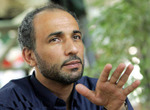
tariq_ramadan (1)A Muslim scholar accused by critics of sympathising with violence has been appointed to a government taskforce attempting to root out Islamic extremism in Britain, the Guardian has learned.

Professor Tariq Ramadan has been banned from entering the United States and France because of his alleged views supporting violence, allegations he strongly denies. He faced a campaign of vilification from rightwing British newspapers, and last night some saw his inclusion on the group as evidence of the government’s willingness to stand up to the tabloids.

Guardian, 31 August 2005

See also Islam Online, 31 August 2005

Mike Whine, spokesman for the Jewish Community Security Trust which monitors alleged Muslim extremists, said: “It’s a strange choice given his past statements which some have viewed as being anti-Jewish. Some of our community view him as extreme. He speaks with two voices, one for his European audience which appears moderate, and one for his Arab hinterland where he voices many of the demands of Islamists. He is at the soft end of the Islamist extreme spectrum.”

That would be the same Mike Whine who signed up to the anti-Qaradawi “Community Coalition”, would it?

Posted in UK

You can’t believe in everything (certainly not if it’s written by Andrew Anthony)

Yusuf al-Qaradawi says that “it is OK to kill Jewish foetuses”, that homosexuals should be put to death and that suicide bombing in Palestine and Iraq is a duty for Muslims, and he is directly comparable to British Nazi leader Nick Griffin.

Guardian, 31 August 2005

Yes, it’s another informed article by Andrew Anthony, the main who enthusiastically applauded John Ware’s bigoted Panorama attack on the MCB.

Muslim media image ‘must change’

A “rising tide of Islamophobia” in the media must be challenged by Muslim students, the Mayor of London has said.
Some newspapers depicted refugees as bringing crime and disease into the UK, Ken Livingstone told a Federation of Student Islamic Societies conference.

Fosis said about 90% of the 250 UK Muslim students it asked thought the media image of Muslims needs to change. Its survey also found 95% were unhappy with British foreign policy, with Iraq being the main reason mentioned.

Mr Livingstone compared the reporting of Muslims in contemporary Britain to the way the flight of Jews from Russia had been covered 100 years ago. He said both had been attacked, despite coming from “areas of conflict or places of oppression”.

Some newspapers, he said, have decided that in order to sell copies “it doesn’t matter what the origin of your victim is, so long as you can stir up fear in the host country”.

BBC News, 31 August 2005

Creating Islamist phantoms

“Modern Islamism is a complex political movement with a history that goes back more than 50 years…. It is only a tiny minority in the Islamist movement who have developed … a politics that advocates terrorism against the west…. We must be aware of this distinction so as to avoid a witch-hunt against the whole Islamist movement.”

Adam Curtis (who wrote and produced BBC2 documentary The Power of Nightmares) writing in the Guardian, 30 August 2005

A bit confused, to be frank. Contrary to Curtis’s claim, not all Islamists are Qutbists, or indeed revolutionaries. Yusuf al-Qaradawi, for example, has condemned Sayyid Qutb’s later writings for promoting an extremist ideology “which justified the takfir (excommunication) of (whole) societies … and the announcement of a destructive jihad against the whole of mankind”. The “New Islamist” current in Egypt of which Qaradawi is part are democratic reformists. Rachid Al-Ghannouchi of the Tunisian Renaissance party is another prominent representative of democratic Islamism.

However, Curtis does at least recognise that there are different tendencies within the social and political movements that fall into the broad category of “Islamism”. (Which is more than can be said for most liberal commentators – or for that matter certain self-styled Marxists such as the Worker Communist Parties of Iran and Iraq.)

Continue reading

No ‘faith solution’ to extremism claims Rushdie

Tony Blair’s reliance on faith-based groups in fighting extremism is a “very bad mistake”, Salman Rushdie has said.
The prime minister’s belief that “more religion is going to solve the problem” was “seriously out of step with the country”, the novelist told BBC News. He criticised support for faith-based schools and said UK Islamic groups were failing to represent most Muslims.

The Muslim Council of Britain said Mr Rushdie had “lost his faith” and was “enraged” that most UK Muslims had not. MCB spokesman Inayat Bunglawala told BBC News: “Salman Rushdie’s call amounts to an appeal to Muslims to apostasise from their faith. He has been doing so at regular intervals since The Satanic Verses was published and has miserably failed every time.”

BBC News, 29 August 2005