Representing Islam

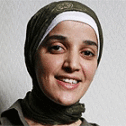
Naima Bouteldja“Timothy Garton-Ash is obviously right in his assertion that ‘what has characterised the Muslim world throughout history is the great diversity of what Muslims say and do under the banner of Islam’. One could even afford a smile, if it was not so worrying, that this idea, considered self-evident for any other ethnic or religious group, is proclaimed as if a groundbreaking discovery. What it shows, yet again, is that when it comes to issues related to Islam and Muslims, the world has gone slightly mad.

“Take the word ‘Islamism’, which represents a political momentum that emerged in the Muslim world within the context of western colonial expansion during the 19th and 20th centuries. Islamism, when used by politicians or media pundits, is rarely defined and is often rashly substituted for terrorism. Yet, most in-depth research on political Islam illustrates that Islamism is not a monolithic, static, insular movement but one with multiple threads and tendencies that varies from country to country, depending on internal political and economic characteristics, as well as the wider, regional and international geopolitical environment….

“The question of who represents the true version of Islam is not as interesting as the answers indirectly supplied by the mass media and what they reveal about the ‘us’, as opposed to the ‘them’. For instance, it would be naive to attribute the dizzying ascension of a figure like Ayaan Hirsi Ali in politics and the media solely to her talent or the popularity of her struggle. Today, like yesterday, the ruling elites choose from the side of the Other the pawns best-positioned to support their own visions of the world and their interests.”

Naima Bouteldja at Comment is Free, 16 March 2007
Muslim schools ‘help integration’

Muslim schools could be a positive addition to the educational system and an effective way of integrating religious minorities into British citizenship, a Bristol University study found.

Muslims in Britain are currently subject to attention that has often focused upon citizenship and integration, with Muslim schools often seen as an obstacle to social cohesion.

The study, by Nasar Meer, research assistant in the Department of Sociology and the Centre for the Study of Ethnicity and Citizenship at the university, said there were only seven state-funded Muslim schools compared to over 4,700 Church of England schools, 2,100 Catholic schools, 37 Jewish and 28 Methodist schools.

Muslim parents want more Muslim schools so that more aspects of Islamic culture are feature within the teaching and ethos of the school their children attend.

Muslim educators argue that one of the most effective ways to pass on knowledge about different people is through teaching. And Nasar Meer said: “Contrary to the current movements seeking a ‘retreat’ from multiculturalism, more multicultural accommodations of this kind will be beneficial.”

Western Daily Press, 17 March 2007

See also “Muslim schools make a positive contribution”, University of Bristol press release, 16 March 2007

Inayat Bunglawala on Muslim-Jewish relations

Inayat Bunglawala of the Muslim Council of Britain calls for better understanding between Muslim and Jewish communities: “… both communities are concerned that antisemitism and Islamophobia are on the rise. Some Jewish groups believe that anti-Jewish prejudice is being incited by Muslim extremists, while some Muslim groups believe that some Jewish columnists and editors have been deliberately trying to foster an anti-Muslim climate in the UK. Muslim communities must take more responsibility to ensure that criticism of Israel’s policies does not slide into casual antisemitism. The best way to encourage this is to ensure that grassroots ties prosper between our communities.”

Continue reading

Three little piggies win a reprieve

The Telegraph reports that organisers of a children’s performance have given the Three Little Pigs a reprieve after they were originally ditched from the show “for fear they may offend Muslims”.

The article appears to be lifted largely from yesterday’s Daily Mail which, unlike the Torygraph, did at least have the honesty to include a lengthy quote from Shaykh Ibrahim Mogra of the MCB, who described the original ban as “bizarre”. He said:

“The vast majority of Muslims have no problem whatsoever with the Three Little Pigs. It’s always been the traditional way of telling the story and I don’t see why that should be changed. There’s an issue about the eating of pork, which is forbidden, but there is no prohibition about reading stories about pigs. This is an unnecessary step.”

Islamophobia comes to Driffield

A Wolds vicar has penned a controversial column warning local Christians about the rise of Islam. The Rev Tony Kidd, vicar of the Beacon Benefice which includes Burton Agnes with Harpham, Lowthorpe and Ruston Parva, has spoken out in the latest issue of The Parish Magazine which is circulated throughout the Driffield area.

Vicars from all the area’s churches contribute to the magazine and tend to use it as a way of keeping parishioners up-to-date with church news and upcoming events. However, Mr Kidd has used his column to record his feelings on Islam and to try and rally local Christians.

Mr Kidd said he is concerned that the UK has abandoned Christianity and the gap that has been left is being filled by Islam. He writes:

“We are sleep-walking into problems through our own carelessness. There can be no justification for blind tolerance of a faith which sees itself as divinely inspired, righteous and true, namely Islam, when too often its expression of that belief conflicts directly with the hopes and aspirations of the majority of the population.

“But equally we can not be surprised by the progress that Islam is making. Our lack of national standards, beliefs and convictions give rise to a host of social problems, unsafe streets and increasing inequality. As a result the clear-sighted objectives of militant Islam are thriving and no appeal to moderation is likely to succeed while our own decadence is so obvious.”

He adds: “Is it not time for us, as Christians, to put our own house in order by making clear what we believe and why?”

Continue reading

Tatchell complains he has been ‘smeared as anti-Muslim’

Outrage“Allegations of ‘Islamophobia’ and ‘racism’ are increasingly manufactured and manipulated to stop debate, silence critics and discredit opponents. I have been on the receiving end of this mud-slinging by the Mayor of London and his Socialist Action apparatchiks, the National Assembly Against Racism, the Muslim Council of Britain and the notorious Islamophobia Watch website.

“The unprincipled, sectarian ‘left’ colludes with right-wing Islamists, such as the sexist, homophobic and anti-Semitic fundamentalist cleric, Dr Yusuf al-Qaradawi. When I, and others, dared condemn Qaradawi’s support for suicide bombing and female genital mutilation, we were denounced as ‘Islamophobes.’ The idea was to marginalise our critique by smearing us as anti-Muslim. These dirty tricks are the copy-book tactics of the far right. They have nothing in common with humanitarian or socialist values.”

Poor picked-on Peter Tatchell has a whinge in Democratiya, Spring 2007

For a recent critique of Tatchell on the notorious Islamophobia Watch website, see here.

For an example of the support Tatchell has attracted in the right-wing blogoshere see here.

Why not invite the BNP to write for the Grauniad?

Picking up on an almost equally stupid piece by Sunny Hundal, David T asks why the Guardian doesn’t publish articles by fascists like BNP leader Nick Griffin: “It cannot be that the Guardian has an objection to far right sectarians, as it runs pieces by Muslim Brotherhood supporting Faisal Bodi, Anas Altikriti, Ismail Patel and Soumaya Ghannoushi.”

Harry’s Place, 14 March 2007

Comment is Free recently posted an interesting piece by Marc Lynch (of Abu Aardvark fame), reporting sympathetically on Muslim Brotherhood bloggers. Is Lynch a “far right sectarian” too, then? Nah, in David T’s hall of mirrors he’s probably categorised as a fascist fellow-traveller.

Attack on Central Scotland Islamic Centre

Thugs threw bottles of Buckfast through the windows of a mosque while worshippers prayed inside, it emerged yesterday. Five panes were broken at the Central Scotland Islamic Centre in Stirling at about 8.30pm on Sunday. The imam, Mohammed Arif, said: “Those who were praying were frightened and alarmed at what happened.” About 30 people were inside the mosque at the time. Three men in their early 20s were seen running away.

Daily Record, 13 March 2007

In 1993 the center was targeted in an arson attack.

Johann Hari reviews Mark Steyn

In the current issue of the New Statesman Johann Hari reviews Mark Steyn’s Islamophobic fantasy America Alone: The End of the World as We Know It. Hari writes: “… if Steyn’s ‘warnings’ have a historical precedent, it is the hysteria among even liberal Americans such as Jack London in the early 20th century that anticipated Chinese immigrants would outbreed white Americans and take over the US. London’s solution was extermination; what is Steyn’s?” A fair point, except that Steyn’s book does in fact provide a clear indication of where he stands on this issue.

Hari’s review repeats the basic error of an earlier article in the Independent – namely that, while he’s excellent at demolishing the paranoid delusions of anti-Muslim racists like Steyn and Bat Ye’or, he has swallowed quite a bit of Islamophobic mythology himself, specifically over the issue of Islamism.

In the Independent piece, Hari wrote that Islamists fall into two categories: “the people who will lash and stone gays after winning at the ballot box and the people who will lash and stone gays after seizing power in a coup”. In the Steyn review, Hari describes Islamism as “a fascistic menace”. This is a wilfully ignorant attitude that does Hari no credit. He doesn’t even attempt to define Islamism. However, if you accept Graham Fuller’s definition of an Islamist – “one who believes that Islam as a body of faith has something important to say about how politics and society should be ordered … and who seeks to implement this idea in some fashion” – it can be seen that the term covers a wide variety of political views.

For example, according to Fuller’s definition, Tariq Ramadan is an Islamist. Does Hari categorise Professor Ramdan as a fascistic menace? Some people do. But it is difficult to see how this differs in any respect from the ravings of Mark Steyn.

As Soumaya Ghannoushi has pointed out: “Islamism, like socialism, is not a uniform entity. It is a colourful sociopolitical phenomenon with many strategies and discourses. This enormously diverse movement ranges from liberal to conservative, from modern to traditional, from moderate to radical, from democratic to theocratic, and from peaceful to violent. What these trends have in common is that they derive their source of legitimacy from Islam.”

Politically engaged Christians encompass a similar range of tendencies, from representatives of the evangelical Right such as Pat Robertson to anti-war activists like Bruce Kent. As Tariq Ramadan has observed, in the case of Christianity people are prepared to recognise these political distinctions. However: “In the case of Islam, engaging in the defence of the poor or carrying the most reactionary ideas does not make any difference. Judgement here falls like a chopper: ‘fundamentalists’.”