
Common sense from the FT on ‘sharia law’

The Archbishop of Canterbury’s comments have triggered widespread confusion about the current status of the Islamic legal system.

In Britain, Muslims can already choose to have disputes settled privately under Sharia law. The government also recognises some Sharia-compliant investment and banking products, such as mortgages, and allows meat to be slaughtered according to strict Islamic practices.

The government has not, however, authorised the establishment of formal Sharia courts to deal with criminal law proceedings

Under the Archbishop’s proposals, Muslim groups would be expected to follow the precedent set by Beth Din, the Jewish court, which legally arbitrates marital and financial disputes between Orthodox Jews.

Family lawyers said this might mean establishment of local Sharia councils, which could deal with Muslim marriages and divorces, among other civil matters. It would not allow for the creation of a “parallel” legal system.

Financial Times, 9 February 2008

See also Clare Dyer in the Guardian and Deborah Orr in the Independent.

And Salma Yaqoob, as reported in the Birmingham Mail. Also Yahya Birt.
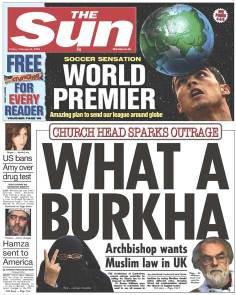
Archbishop ‘gives heart to Muslim terrorists plotting our destruction’

What A BurkhaThe Archbishop of Canterbury sparked outrage today by saying the introduction of Sharia law in Britain is inevitable. In an explosive outburst Dr Rowan Williams, the country’s top Anglican, said there should be one set of rules for Muslims – and another for everyone else.

He maintained it was WRONG for followers of Islam to be forced to choose between “the stark alternatives of cultural loyalty or state loyalty”. Instead he said the country must “face the fact” that some Muslims do not relate to the law in Britain.

The 57-year-old insisted we accept aspects of Sharia law with a “constructive accommodation” in areas like marriage so Muslim women would not have to use British divorce courts. He added: “It seems unavoidable.”

Dr Williams’ extraordinary claim is a huge propaganda coup for extremists plotting to end centuries of the British way of life. And it was roundly condemned from all quarters last night.

Paul Dadge, famously pictured helping masked 7/7 victim Davina Turrell, 24, was left stunned. The 31-year-old former fireman, of Cannock, Staffs, said: “The Archbishop’s remarks are unhelpful. I am proud to be British and find the idea that Sharia law would ever become part of British law incredible.”

Mary Burke, 50 – who survived the King’s Cross bomb on July 7 2005 – said: “Britain is a Christian country and should stay a Christian country. I don’t want Islamic law here and I believe most of the British public agree with me.”

Sun, 8 February 2008


And the Sun’s leader opines: “It’s easy to dismiss Archbishop of Canterbury Rowan Williams as a silly old goat. In fact he’s a dangerous threat to our nation. He says the adoption in Britain of parts of Islamic Sharia law is ‘unavoidable’. If he believes that, he is unfit for his job….He also gives heart to Muslim terrorists plotting our destruction. They will see his foolish ramblings as a sign that our resolve against extremism is weakening.”

Racism still exists in Greater Manchester Police

An atmosphere which “tolerates anti-Muslim feelings” exists within Greater Manchester Police, says a high-ranking Asian officer.

Inspector Asrar Ul-Haq made the claim during a race discrimination tribunal against GMP where he alleged he had been overlooked for promotion. After two days of evidence, the force settled and agreed to pay him compensation. But the M.E.N. can reveal there are at least three other officers currently pursuing race discrimination cases.

Charles Crichlow, the chairman of the Black and Asian Police Association (BAPA), said after the case the issue of institutional racism “remains largely unresolved”. It is almost ten years since former Chief Constable David Wilmot publicly acknowledged GMP had a problem with “institutionalised racism”.

Insp Ul-Haq, who has been a police officer for 23 years, took GMP to a tribunal claiming he was repeatedly passed over for promotion. He said he had passed all the necessary exams but had been rejected at the final interview stage three times while promotion opportunities were given to other officers who had not passed the exams.

Yousef Dar, chairman of the Greater Manchester Muslim Police Association, said: “It is disappointing that any officer or staff member has to resort to such measures in tackling inequality and discrimination.” Mr Crichlow added: “This case draws attention to the issue of institutional racism in the police service which, as the number of tribunals and complaints to BAPA suggest, remains largely unresolved.”

Manchester Evening News, 8 February 2008

‘We need a thoughtful discourse, not hysterical discord’ says MCB

MCB bannerThe Muslim Council of Britain is grateful for the thoughtful intervention of the Archbishop of Canterbury on the discussion of the place of Islam and Muslims in Britain today.
The MCB observes, with some sadness, the hysterical misrepresentations of his speech which serves only to drive a wedge between British people.

“The Archbishop is not advocating implementation of the Islamic penal system in Britain. His recommendation is confined to the civil system of Shariah Law and that only in accordance with English law and agreeable to established notions of human rights”, said Dr Muhammad Abdul Bari, Secretary General of the MCB.

British Muslims are not calling for creation of different legal systems, nor is the Archbishop. We do not wish to see a parallel system or a separate system of judiciary for Muslims. The Archbishop sought in his speech to explore the possibilities of an accommodation between English law and some aspects of Islamic personal law.

British Muslims would wish to seek parity with other faiths in particular the followers of the Jewish faith in the United Kingdom in facilitating choices for those who wish, as Muslims, for their personal relationships to be governed by a Shariah civil code. This legitimate aspiration requires full discussion in an atmosphere of understanding and tolerance. It is worthy of note that already enshrined in English law are provisions for Islamic Shariah compliant finance which have become very popular and now enable billions of pounds of fresh investment to come into the UK.

“Our common mission to live in cohesion and harmony is better served when men of conscience and authority speak out for justice and equal opportunity. Silence is much more likely to engender prejudice, injustice and inequality. On the issue of giving individuals choice of law but only in private and personal matters, we call, as does the Archbishop, for a mature debate in an environment that reflects mutual respect.” said Dr Bari.

Muslim Council of Britain press release, 8 February 2008

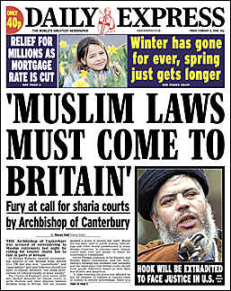
‘Muslim laws must come to Britain’ – Express whips up hysteria over Rowan Williams’ speech

Muslim Laws Must Come to BritainThe Archbishop of Canterbury was accused of surrendering to Muslim extremists last night by calling for Islamic sharia law to rule in parts of Britain.

Dr Rowan Williams claimed incorporating aspects of the Muslim legal system into UK law was now “unavoidable” and “appropriate” and said believers should not have to choose between “the stark alternatives of cultural loyalty or state loyalty”.

The Church of England’s most senior cleric also backed demands for Islamic courts to settle divorces and other disputes between Muslims living in Britain.

But his remarks sparked a storm of protest. Sharia law has been used to justify stoning, beheadings and other brutal punishments in many Muslim countries. In extreme cases, Islamic courts have even put people to death for converting to Christianity.

Tory MP Mark Pritchard called the Archbishop’s remarks naive and shocking. “He may want to run up the white flag of surrender over Lambeth Palace, but there are many who do not.”

Mike Judge, of the Christian Institute, said: “The fact that we all obey the same law, whatever our religion, is an important principle of the British way of life.”

And Stephen Green, national director of Christian Voice said: “This is a Christian country with Christian laws. If Muslims want to live under sharia law then they are free to emigrate to a country where sharia law is already in operation.”

Daily Express, 8 February 2008

Government bans Qaradawi

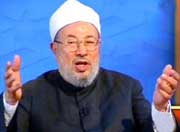
YusufalQaradawiThe government has been criticised by moderate Muslim groups for banning a controversial Muslim scholar from entering Britain and branding him an extremist.
The government confirmed to the Guardian that Yusuf al-Qaradawi had applied to come to the UK but had been refused.

The decision could hand the Tories a small political victory as the Conservative leader, David Cameron, last week called for his exclusion from the UK, saying Qaradawi was a “dangerous and divisive” preacher of hate.

But moderate British Muslim groups, including the Muslim Council of Britain (MCB), are upset with the ban. Muhammad Abdul Bari, the secretary-general of the MCB, condemned the ban. He said the UK government had bowed to Zionist and neo-con pressure and pointed out that a Tory government had allowed Qaradawi to enter Britain several times.

Bari said Qaradawi was respected as a scholar throughout the Muslim world: “It is regrettable that the government has finally given way to these unreasonable demands spearheaded by the Tory leader whose government had, in fact, allowed Dr Qaradawi to visit the UK five times between 1995-97.

“I am afraid this decision will send the wrong message to Muslims everywhere about the state of British society and culture. Britain has had a long and established tradition of free speech, debate and intellectual pursuit. These principles are worth defending, especially if we would like to see them spread throughout the world.”

The Home Office said: “We can confirm that Al-Qaradawi has been refused a visa to visit the UK. The UK will not tolerate the presence of those who seek to justify any acts of terrorist violence or express views that could foster inter-community violence.”

Guardian, 7 February 2008


The Sun, on the other hand goes with “PM bans hate cleric’s UK visit“.

See also MCB press release, 6 February 2008 and Inayat Bunglawala’s piece at Comment is Free

And for Tim Montgomerie’s response see Tory Diary, 7 February 2008

Imaan opposes ban on Qaradawi

LGBT Muslims concerned that ban on scholar could contribute to Islamophobia

Imaan, the LGBT Muslim support group, joins those in the Muslim community who are concerned at the Home Office decision to ban Sheikh Yusuf Al-Qaradawi. The Home Office is reported to have refused a visa for medical treatment on the grounds that: “the UK will not tolerate the presence of those who seek to justify any acts of terrorist violence or express views that could foster inter-community violence.”

This flies in the face of advice from the Foreign and Commonwealth Office which states that acting “against Qaradawi would alienate significant and influential members of the global Muslim community … (and) give grist to Al-Qaeda propaganda of a western vendetta against Muslims…”

This advice, given in 2005 by its Islamic Affairs Advisor, clearly outlines that Qaradawi has made authoritative statements condemning the London bombings, the 9-11 attacks and other acts of terrorism, which he has stated are against the beliefs of Islam (see editor’s notes below for link).

Regarding his views on homosexuality, Imaan makes clear its disagreements with all faiths that are regressive on this issue.

However, we believe that all religious leaders should be treated equally and just as we would not support a ban on the Pope, so we are concerned that by banning Qaradawi, the Home Office is contributing to a climate of Islamophobia, which impacts on all Muslims, including our LGBT members.

Continue reading

Archbishop backs sharia law for British Muslims

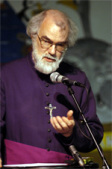
Rowan_WilliamsThe Archbishop of Canterbury sparked controversy today when he said the introduction of sharia law for British Muslims was “unavoidable”. Rowan Williams told BBC Radio 4’s World at One that Muslims should be able to choose whether to have matters such as marital disputes dealt with under sharia law or the British legal system. His comments were strongly criticised by the National Secular Society but welcomed by the Muslim Council of Britain (MCB), which stressed it did not back the introduction of sharia criminal law. Williams said his proposal would only work if sharia law was properly understood, rather than seen through the eyes of biased media reports.
Guardian, 7 February 2008

See also BBC News, 7 February 2008


Meanwhile, over at Harry’s Place, the inimitable David Toube calls for Williams to be sacked. “Isn’t there something particularly pathetic”, he asks, “about a Bishop in a church which – in theory – exists to evangelise, shilling on behalf of the theocratic politics of another religion, which wishes to write their version of ‘god’s will’ into law?”

Damian Thompson agrees: “Williams is lending his support to the establishment of a non-Christian theocracy in Britain. The Church of England must think seriously about his suitability for the ancient office he occupies. And then get rid of him.”

At Dhimmi Watch, Robert Spencer is appalled: “Rowan Williams has utterly forgotten, if he ever knew, that the idea of ‘one law for everybody’ was one of the great achievements of Judeo-Christian civilization…. I wonder if Rowan Williams is aware that if Muslims ever came to power in Britain, they themselves would enforce one law for everybody – a law that would reduce him to dhimmitude.”

Over at Stormfront the fascists take much the same line.

And if “the idea of ‘one law for everybody’ was one of the great achievements of Judeo-Christian civilization”, how does Spencer explain the existence of Beth Din courts?

For the Archbishop’s actual views, see here.

Islamophobia: resisting prejudice

“Most of us do not need to read the many reports coming out of the European Union, government departments and think-tanks to tell us there has been a rise in Islamophobia in Britain since 9/11 and the beginning of the ‘war on terror’…. Islamophobia seems to be replacing antisemitism as the principal Western statement of bigotry against the ‘other’…. This isn’t to say that we didn’t have racism pre 9/11. I’ve been called a ‘Paki’ for as long as I can remember – but now it is about being a Muslim. ‘Polite society’ no longer has to worry about seeming racist, or sounding like the BNP, if they are talking about Muslims.”

Nahella Ashraf in Socialist Worker, 9 February 2008

‘When religion means death’ (according to Maryam Namazie)

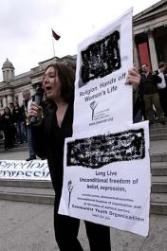
namazie and racist placards 2Maryam Namazie of the Worker-Communist Party of Iran offers her thoughts (we use the word in its loosest possible sense) on the death sentence imposed on Parwiz Kambakhsh in Afghanistan. She writes:

“Many have rightly come to his defence and must keep the pressure on. But to defend Parwiz by saying he did not ‘intend’ to blaspheme misses the entire point. This is exactly what the likes of the Muslim Council of Britain say in order to conceal the responsibility of their political Islamic movement. For example, the MCB ‘greeted’ the release of Gillian Gibbons (the British schoolteacher who was imprisoned in Sudan for allowing her 7 year old students to name their class teddy bear Mohammad) by saying she had not ‘intended to deliberately insult the Islamic faith’.

“What they are basically saying is that victims and their ‘intentions’ are to blame for the injustices and barbarity of Islamic law. Moreover, they are implying that if someone knew they were blaspheming, or if their actions or statements were so clearly blasphemous that they should have known better, then the death penalty or calls for their death are permissible – or at the very least understandable. The smokescreen of ‘intent’ aims to conceal the real issue at hand, which is Islam in power….”

New Statesman blog, 5 February 2008

In fact, the MCB did not merely “greet” the release of Gillian Gibbons but declared that her prosecution was “a disgraceful decision and defies common sense” and called for the charges to be dropped. Like many self-styled defenders of the Enlightenment, Namazie doesn’t allow objective evidence to interfere with her own prejudices.