Police probe Facebook page attacking Wrexham ‘super mosque’

Police are investigating a sick anti-Muslim website set up on Facebook to stir up tensions over fake claims a ‘super-mosque’ was being built in Wrexham.

The site “No to the super mosque in Wrexham” on the social network site wrongly claims permission has been given for a mosque at the Miners Institute in North Wales’s largest town. And the website, which bears the Welsh Defence League logo, is also filled with hateful messages against Muslims, which North Wales Police are now investigating.

The web group has more than 2,800 members and this follows a march by the Welsh Defence League designed to stir up tensions in the town.

Daily Post, 3 March 2010

UAF calls for protest against EDL

Emergency protest against the EDL in London this Friday

Assemble 11am, Friday 5 March
Houses of Parliament, London

The English Defence League (EDL) will be marching in London on Friday 5 March in support of the far right Dutch MP Geert Wilders who is visiting the House of Lords to whip up hatred against Muslims.

The EDL pretends to be a ‘peaceful’ group opposed to ‘Muslim extremism’. In reality it is nothing of the sort. It is a gang of racist thugs and hooligans with links to the Nazi BNP.

EDL thugs spread fear and terror when they rampaged through Luton and Stoke recently. They smashed cars, attacked shops, chanted “BNP! BNP!” and assaulted Asians. When some locals tried to stop them they were called ‘race traitors’ and attacked.

The EDL should not be allowed to march through London. Join the Unite Against Fascism protest to show these racists and fascists that they are not welcome here. Meet Friday 5 March at 11am outside the Houses of Parliament.

UAF news release, 3 March 2010

Poll shows support for ‘burka’ ban

More than half of voters in four other major European states back a push by France’s Nicolas Sarkozy to ban women from wearing the burka, according to an opinion poll for the Financial Times.

As Mr Sarkozy presses ahead with plans to ban the wearing of the burka in public places, the FT’s latest Harris poll shows the move is not just strongly supported in France, but wins enthusiastic backing in the UK, Italy, Spain and Germany.

The poll shows some 70 per cent of respondents in France said they supported plans to forbid the wearing of the garment which covers the female body from head to toe. There was similar sentiment in Spain and Italy, where 65 per cent and 63 per cent respectively favoured a ban.

The strength of feeling in the UK and Germany may seem particularly surprising. Britain has a strong liberal tradition that respects an individual’s right to full expression of religious views. But here, some 57 per cent of people still favoured a ban. In Germany, which is also reluctant to clamp down on minority rights, some 50 per cent favoured a ban.

“This poll shows that the number of people in France opposed to the burka is going up and that is the product of debate on burka and national identity,” said Professor Patrick Weil, an expert on national identity at the University of Paris-Sorbonne. “But the figure is clearly going up in other countries in Europe like the UK as well, and that reflects the growing concern that there is about this issue in some parts of Europe.”

In the US, concerns about the issue are far less strong than in Europe. Just 33 per cent of Americans surveyed by Harris supported a ban, a far lower figure than the 44 per cent who said they supported it.

In Europe, while opposition to the burka was strong, few respondents said they were prepared to support the ban as part of a wider drive towards secularism in their country. Asked if they would support the burka ban if it were accompanied by a clampdown on wearing all religious icons such as the Christian crucifix and the Jewish cappel, only 22 per cent of French people said they supported such a move. In Britain, just 9 per cent of people said they would back such a move.

Financial Times, 1 March 2010

Fascist allowed to address school pupils and call for ban on hijab

bnp-islam-posterA senior official in the British National Party was invited to address a classroom on whether the hijab should be banned, The Times has learnt.

Simon Darby, the BNP’s deputy leader, was phoned by 14-year-old students in Rochdale, Lancashire. The pupils, supervised by a teacher, asked him questions over the phone about the French ban on the hijab. The BNP’s policy is to ban Islamic dress in schools.

Andy Rymer, the head of Matthew Moss High School, told The Times that the students were doing a project on news reporting and had suggested contacting the BNP. He said: “We ask kids to be critically curious. This was something they were interested in and wanted to check out. They did so in a supported way with an intelligent teacher.”

Some Asian parents at the school, in the Castleton area of the town, spoke of their concern at allowing the BNP a voice in the classroom. Jamil Khan, whose daughter wears a headscarf to school, said: “I do not feel comfortable with the presence of the BNP in the classroom. They are extremists, full stop. They can only paint the picture one way.”

On his blog, Mr Darby said: “It was reassuring to think that even in 2010 politically correct Britain there are still teachers who insist on the old adage that if you don’t have access to all the information, you will never come up with the right answer.”

Times, 1 March 2010

ENGAGE replies to Gilligan

AndrewGilligan“If you thought documentaries couldn’t sink lower than the hatchet job by John Ware for BBC Panorama, ‘Who speaks for British Muslims?’, in 2005, the Dispatches programme aired last night is proof to the contrary.

“Using spurious evidence, half-truths  and a ragbag of ‘community leaders’ – none of whom merit a byline demonstrating their ‘leadership’ credentials – Gilligan outdoes even Ware in proving that documentary-makers with an animus against ‘Islamism’ have nothing but conjecture and pure prejudice on their side. ”

ENGAGE, 2 March 2010

See Islamic Forum Europe statement, 1 March 2010

Update:  See also “Watch out: democratic Muslims about” by Inayat Bunglawala at Comment is Free, 3 March 2010

Right-wing press continues witch-hunt of IFE, with the assistance of Jim Fitzpatrick

Under the headline “Extremist Muslims have ‘wormed their way into Labour Party’ minister warns”, the Daily Mail offers a rehash of yesterday’s Sunday Telegraph article, with one accompanying picture suggesting that IFE supports the terrorist acts of Tehrik-e-Taliban Pakistan while another illustrates the mythical “hijab-inspired arch Tower Hamlets council has proposed be built at either end of Brick Lane”.

The Daily Star tells its readers that “Muslim extremists are plotting to take over the Labour Party and turn Britain into an Islamic state…. Extremist groups hope their followers will become councillors and MPs. But their allegiance will be to Jihad, or holy war, and enforcing sharia law across the UK. Sharia imposes punishments including stoning and amputations.”

And this piece comes complete with a picture of the well-known IFE supporter Abu Hamza al-Masri.

Meanwhile, over at the Daily Telegraph, Andrew Gilligan is intent on generating the maximum publicity for his anti-IFE documentary, “Britain’s Islamic Republic“, due to be screened in Channel 4’s Dispatches slot this evening.

Under the headline “Sir Ian Blair’s deal with Islamic radical”, Gilligan reveals that the former Metropolitan Police Commissioner had close contact with Azad Ali through the latter’s leading role in that notorious agency of jihadist terrorism, the Muslim Safety Forum. In fact, relations were so close that “Sir Ian or his deputy committed to meet Mr Ali and the MSF at least twice a year”.

Gilligan’s scaremongering over the MSF is rather undermined by a Metropolitan Police spokesperson who states: “We are currently working with the Muslim Safety Forum to review how it can best represent London’s diverse Muslim Communities so that we can better understand and then act on their concerns about safety and security.”

Update:  Over at the anti-Muslim blog Harry’s Place Tory London Assembly member Andrew Boff  has been receiving some stick because of his backing for the East London Mosque.

Indeed, at last week’s Mayor’s Question Time, Boff put the following question to Boris Johnson: “Would you Mr Mayor along with me support the efforts of the many faith communities especially in East London in the way in which they work together, and I mention in particular the role of the East London Mosque and the London Muslim Centre, which you so kindly visited last year, working with the other faith communities in order to break down the misunderstandings that can exist?” To which Johnson replied “Yeah”.

Boff has responded to Harry’s Place in the following terms: “‘Some in Labour’ may be right to think that there are votes in Islamaphobia. Forgive me if I decline to take up your kind offer of pursuing them too. I don’t want to feel that dirty when I go to bed at night.”

And quite right too. True, Boff’s stand may be motivated in large part by concern for the electoral prospects of his friend Tim Archer, the Tory candidate standing against Jim Fitzpatrick in the Poplar and Limehouse constituency. But at least Boff is taking the right stand, which is more than can be said for Fitzpatrick and others in the Labour Party.

Christian right opposes Methodist campaign against Islamophobia

The founder of Methodism, John Wesley, was a decrier of Islam. He described its followers as “wolves and tigers to all other nations”. Yet 250 years later, his 21st-century followers are pitting their time, energy and money into fighting Islamophobia.

A new project set up by the Methodist district of Sheffield in partnership with the Anglican Diocese of Sheffield aims to “challenge Islamophobia, racism and divisive politics” in the region. It has won a £75,000 grant from the Equality and Human Rights Commission to fight extremism, after recent electoral successes by the BNP and rallies by the English Defence League.

However, the initiative has caused unease in some conservative Christian circles, with some demanding that the two leading Christian denominations should instead be challenging what they describe as the “Christianophobia” of modern-day Britain.

One conservative blog, Cranmer’s Curate, asked: “Is not ‘Christianophobia’ as great – if not a greater – problem now in British society than ‘Islamophobia’, and of more immediate concern to Christian organisations such as the Sheffield Methodist District and the Diocese of Sheffield? What about the situation faced by Christians in the public sector suspended or fired from their employment simply for offering to pray with clients or for saying ‘God bless’?” It goes on to attack the churches for “preaching politically correct morality to the community rather than the gospel”.

Times, 27 February 2010

Defend Jamaat-e-Islami against ‘secularism’

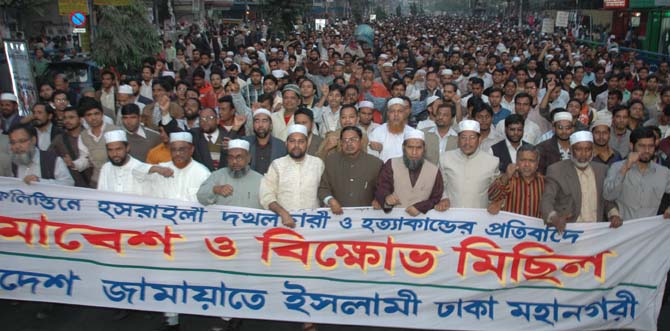
Jamaat Gaza protest
Jamaat-e-Islami demonstration against Israel’s attack on Gaza

Under the heading “Bangladesh set to become again a secular state”, left-wing blogger Andrew Coates has enthusiastically hailed what he claims is a decision by the government of Bangladesh to restore the secular foundations of the country’s constitution.

He bases his post on reports that the Supreme Court in Dhaka has upheld a ruling that the government can reverse amendments made to the constitution in the period following the military coup of 1975. Coates approvingly quotes law minister Shafique Ahmed as saying: “In the light of the verdict, the secular constitution of 1972 already stands to have been revived. Now we don’t have any bar to return to the four state principles of democracy, nationalism, secularism and socialism as had been heralded in the 1972 statute of the state.”

There were indeed amendments made to the 1972 constitution after 1975 that undermined the secular basis of the state. The religious invocation “Bismillah-ar-Rahman-ar-Rahim” (“In the Name of God, the Compassionate, the Merciful”) was added to the preamble of the constitution, and Islam was declared to be the official state religion of Bangladesh. To overturn those amendments would of course be entirely legitimate from the standpoint of establishing a secular state, and if the government of Bangladesh were proposing to change the constitution accordingly there would be no objection.

However, the government has shown little enthusiasm for such a change. Following a meeting last month between the ruling Awami League and its coalition partners, one of whom urged that the constitution should be amended along those lines, prime minister Sheikh Hasina stated firmly that the words “Bismillah-ar-Rahman-ar-Rahim” would be left unchanged in the constitution, as would the declaration that Islam is the state religion.

It is not difficult to identify the motive behind this decision. During the 2008 election campaign the Bangladesh Nationalist Party and its Islamist ally Jamaat-e-Islami accused the Awami League of hostility towards Islam, and Sheikh Hasina no doubt reasons that if her government were to abolish the religious elements in the constitution this would be exploited by the opposition. So an entirely justifiable change that would restore the secular principle to the constitution has been rejected on pragmatic, not to say opportunistic, political grounds.

What, then, are the “secular foundations” of the 1972 constitution that the Bangladesh government wishes to restore? Well, crucially they want to reinstate a provision, subsequently removed, which declared that “no person shall have the right to form, or be a member or otherwise take part in the activities of, any communal or other association or union which in the name or on the basis of any religion has for its object, or pursues, a political purpose”.

Indeed, following the Supreme Court’s verdict, Shafique Ahmed was quoted as saying that all religion-based parties should “drop the name of Islam from their name and stop using religion during campaigning”, and he went on to announce that religion-based parties are going to be “banned”. In short, what the government of Bangladesh is planning to do is to amend the constitution in order to illegalise Jamaat-e-Islami.

What does this have to do with secularism? Nothing whatsoever. If a secular constitution required the suppression of faith-based political parties, then secularism in Germany would require a ban on the Christian Democrats. And nobody, not even a secularist ultra like Andrew Coates, is calling for that.

You can imagine how different the response would be if a government headed by Jamaat-e-Islami were to propose a ban on secular parties in Bangladesh, on the grounds that they conflicted with the Islamic basis of the constitution. Coates, along with the likes of Harry’s Place and the Spittoon, would be furiously denouncing “totalitarian Islamism” and its contempt for democratic principles. But a secular party proposes to ban an Islamist party and you don’t hear a peep from them.

Fitzpatrick joins Torygraph in witch-hunt of IFE

Jim FitzpatrickA Labour minister says his party has been infiltrated by a fundamentalist Muslim group that wants to create an “Islamic social and political order” in Britain.

The Islamic Forum of Europe (IFE) – which believes in jihad and sharia law, and wants to turn Britain and Europe into an Islamic state – has placed sympathisers in elected office and claims, correctly, to be able to achieve “mass mobilisation” of voters. Speaking to The Sunday Telegraph, Jim Fitzpatrick, the Environment Minister, said the IFE had become, in effect, a secret party within Labour and other political parties.

“They are acting almost as an entryist organisation, placing people within the political parties, recruiting members to those political parties, trying to get individuals selected and elected so they can exercise political influence and power, whether it’s at local government level or national level,” he said. “They are completely at odds with Labour’s programme, with our support for secularism.”

Sunday Telegraph, 28 February 2010


See also “Inextricably linked to controversial mosque: the secret world of IFE“, by Andrew Gilligan, in the same issue. Gilligan reveals that IFE “is dedicated, in its own words, to changing the ‘very infrastructure of society, its institutions, its culture, its political order and its creed … from ignorance to Islam’.” That would be as distinct from, say, the Roman Catholic Church, which of course has no intention of transforming society in line with the principles of Christianity.

According to Gilligan, members of IFE are required to read “the key works of the revolutionary political creed known as Islamism, which advocates the overthrow of secular democratic government and its replacement by Islamic government”. Which those of us who reject Gilligan’s Islamophobic hysteria might think is hardly an imminent prospect in the UK, where 97% of the population is non-Muslim.

Not that this concerns the Telegraph. Under the headline “This secretive agenda must be taken seriously“, an editorial warns that “developments in Tower Hamlets are worrying news for British democracy”.