
Anti-terror legislation condemned

Muslim groups have condemned proposed anti-terrorism legislation saying it could lead to the “demonisation” of legitimate Islamic values and beliefs. An Islamic Human Rights Commission statement has 38 signatories, including the Muslim Association of Britain.

See BBC News, 16 August 2005 and Guardian, 16 August 2005

See also IHRC press release, 16 August 2005 and Islam Online, 16 August 2005

Robert Spencer is appalled: “What about wanting to establish the caliphate in the West, replacing Britain’s political system with Islamic law? Is that legitimate political expression?”

Jihad Watch, 16 August 2005

Well, I can’t see why not. Mind you, given that Muslims here number around 1.6 million out of a total population of almost 60 million, the establishment of the caliphate in the UK would appear to be a rather distant prospect.
Latest from Lenin’s Tomb

A couple of relevant posts over at Lenin’s Tomb during the past couple of days. In “Clowns for jihad” (15 August) Meaders expresses scepticism that the absurd Omar Bakri ever represented a serious terrorist threat (“I could be wrong, but one of the things you would not do, if you really fancied restaging 9/11 in London, would be to organise a widely publicised conference in celebration of this fact”). And in “They shall not parse” (16 August) China Miéville takes up Outrage’s false report that Yusuf al-Qaradawi called for the Crown Prince of Qatar to be stoned to death. But remember, folks, you read it here first.

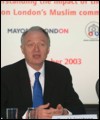
London Mayor rejects attacks on MCB

Mayor“The MCB has been unwavering in urging Muslims to help the police find anyone associated with terrorist attacks. In the past its leadership went to Iraq to try to help free British hostages. Those conducting what I consider a witch-hunt against the MCB are doing great harm to the fight against terrorism. They must ask themselves in what way they are helping the fight against terrorism by waging a campaign of demonisation and spin against this representative body of British Muslim organisations.”

GLA press release, 16 August 2005

UK anti-terror panel says Iraq war fans extremism

A British government anti-terror working group concluded that the Iraq war is “undeniably a factor” in fanning extremism, and proposed forming a media unit to challenge the stereotyped media portrayal of Muslims, reported a leading British daily Friday, September 16. “British foreign policy in the world cannot be left unconsidered as a factor in the motivations of extremists,” the group said in a confidential report leaked to The Independent.

The Working Together to Prevent Extremism: Tackling Extremism and Radicalization report was drawn up after meetings between leading Muslims and government officials, said the daily. The 13-member taskforce, chosen by the Home Office, includes prominent Muslim figures such as famed Swiss scholar Tariq Ramadan, Inayat Bunglawala, the media officer of the Muslim Council of Britain (MCB) and MP Shahid Malik.

Islam Online, 16 September 2005 

MAB Stands firm with MCB and Islamic Foundation

The Muslim Association of Britain rejects Martin Bright’s attack on the Muslim Council of Britain and the Islamic Foundation in a leading article in today’s The Observer.

With this attack on the official umbrella Muslim organisation and one of the most respectable and reputable Muslim educational organisations in the West, Muslims in Britain would be excused for believing that we are witnessing an all-out attack on Muslim organisations.

MAB press release, 14 August 2005

IHRC condemns Observer attack on MCB

“IHRC denounces yesterday’s vitriolic attack by Martin Bright in the Observer on the Muslim Council of Britain and its affiliates Jamiat-ahl-I-Hadith and the Islamic Foundation. IHRC strongly urges all campaigners to contact the Observer to complain about its shocking attack on both the MCB and on Islamic beliefs and values.”

Islamic Human Rights Commission action alert, 15 August 2005

FOSIS expresses confidence in MCB and its leadership

“The Federation of Student Islamic Societies (FOSIS) of UK and Ireland is alarmed at the attempts by some sections of the media to portray the Muslim Council of Britain (MCB) and its leadership as either ‘extremist’ or having links to ‘extremism’. We reject the supposition that MCB is unrepresentative and does not reflect the opinions of the mainstream of the British Muslim community.”

FOSIS press release, 15 August 2005

Anti-terror plans could be counter-productive, warns London Mayor

The Mayor of London, Ken Livingstone, Monday expressed serious reservations about the government’s new anti-terror plans, particularly extending the exclusion and deportation powers of the Home Secretary.

In response to the Home Office’s consultation document on the new proposals, Livingstone also raised concern about the government’s list of ‘unacceptable behaviors’ and called people to be allowed to express their views on issues as the Middle East conflict.

“People such as the founders of the United States, the founder of Israel, opponents of Ian Smith’s regime in ‘Rhodesia’ (Zimbabwe), Nelson Mandela and the Yasser Arafat have all been branded terrorists by someone at one time or another,” the mayor said.

“But nothing would have been gained by us banning either side in those conflicts. Today it would be totally counter-productive as it would reduce the trust, and therefore the information, from the communities whose help is indispensable to the police,” he warned.

IRNA report, 15 August 2005

See also GLA press release, 15 August 2005

Labour MP calls for Hizb ut-Tahrir ban

More than 300 Muslims attended a gathering on Thursday organised by a group which the Government wants banned.

The jam-packed meeting was organised by local members of Muslim group Hizb ut-Tahrir in direct response to Prime Minister Tony Blair’s proposals – announced on August 5 – to review security measures in light of last month’s terrorist attacks.

It was the first Hizb ut-Tahrir meeting since Tony Blair’s announcement. Dozens more meetings are due to take place up and down the country over the next few weeks.

The Hizb ut-Tahrir group has publicly condemned the London bombings of 7/7 and has a policy of non-violence.

All sorts of people were present at the gathering, which took place at the Cygnet Hotel in Dunstable Road, Luton, including Mayor Councillor Haji Abid.

Women and children as well as people from nearby towns including Watford, Hemel Hempsted, Bletchley and Milton Keynes also attended the meeting.

Several people made speeches including businessmen, councillors, solicitors and doctors.

When Luton businessman Meherban Khan was given the chance to speak he said: “I have been present at several Hizb ut-Tahrir meetings and, while I am not a member, I respect its beliefs. But I have to say I think Tony Blair is the Hitler of the 21st century.”

That remark brought cheers – not for the first time at the gathering – from the scores of people present.

Continue reading

Observer accusations ‘preposterous’ says Iqbal Sacranie

Top Muslim group denies extremist roots

Reuters, 14 August 2005

Britain’s leading Muslim lobby group, thrown into the spotlight by last month’s bombings in London, rejected an accusation on Sunday that its roots lay in extremist politics in Pakistan. Iqbal Sacranie, leader of the Muslim Council of Britain (MCB), said the allegation, made in the Observer newspaper, was “absolutely preposterous”.

“I can’t believe that anyone who knows anything about the MCB could take that statement seriously,” he told Reuters. In a lengthy report on the MCB, the Observer alleged the council’s leadership and some of its 400 diverse affiliates had “links with conservative Islamist movements in the Moslem world” and “the extremist politics of Pakistan”. It said the links were particularly strong with Jamaat-e-Islami, Pakistan’s leading mainstream Islamist party.

The MCB has come under close scrutiny since July 7, when four British Muslims – three of them ethnic Pakistanis – blew themselves up on London’s transport system, killing 52 people. The Observer singled out two MCB affiliate organisations – the Islamic Foundation and Jamiat Ahli-Hadith – for criticism, describing the latter as “an extremist sect”. The Islamic Foundation is an educational institution based in central England while Jamiat Ahli-Hadith is a religious group based in Birmingham.

Sacranie defended both groups, saying the MCB was proud to have them as affiliates. Neither of them was involved with extremist politics, he said. He said the MCB was a loose organisation and that the views of the council’s leadership did not always concur with those of its affiliates.

Continue reading