
Respect conference reports

Respect rejects call to oppose Racial and Religious Hatred Bill

An amendment calling for opposition to the Bill was defeated. Ifhat Shaheen from Hackney, east London, spoke against the amendment. She said, “As a Muslim woman I face racial abuse every day – but I can’t even call it racial abuse, because as a Muslim I’m not covered by the Race Relations Act. Sikhs and Jewish people are already covered – if they suffer abuse because of their religion, they are protected under the law. So why, when a bill is put forward that will give Muslims the same protection, does it suddenly become an issue of limiting people’s free speech?”

Socialist Worker, 26 November 2005

Respect conference reaffirms commitment to opposing homophobia

While there was one speech arguing that the organisation had not sufficiently highlighted the issue at the general election, there were three others detailing how clear arguments for lesbian, gay, bisexual and transgender equality were put and won.

Dave Goodfield from Coventry said, “We have just seen the recent appalling murder of a young man, Jody Dobrowski, on Clapham Common.” Dave called for a clear stand against bigotry, wherever it comes from, and rejected the idea that black and Muslim communities are in some way the main source of such attacks.

Delegates were shocked when he read out a quote – “what does a moderate Muslim do, other than excuse the real nutters by adhering to this barmy doctrine?” – and revealed it came not from the far right, but from a gay publication. He told delegates this was an extreme reflection of a “disproportionate focus” by a small number of activists against homophobia on African Caribbeans and Muslims.

Coventry’s amendment was passed unanimously. The overwhelming feeling among delegates was both to campaign against homophobia and also not to allow the issue of lesbian and gay rights to be cynically used as a cover for Islamophobia.

Socialist Worker, 26 November 2005

Imperial College bans veil on campus

Imperial College in London has emulated that reactionary little town in Belgium that banned the Islamic veil on the grounds of security – a policy also advocated in the Netherlands by right-wing politician Rita Verdonk. And the logic of Imperial College’s policy is of course to impose a general public ban. If Muslim women covering their faces are a threat to security on campus, are they not equally a threat in wider society?

See Polly Curtis’s report in the Guardian, 23 November 2005

Sky censured for ‘Muslim wrestler’ show

'Muhammad Hassan'Sky Sports has been censured by a media watchdog for resurrecting a character from the larger than life world of American wrestling who had been “killed off” after being accused of inciting anti-Muslim sentiment among fans.
World Wrestling Entertainment, the successor to the World Wrestling Federation franchise that became popular in the UK during the 1990s, was forced to axe the character of Muhammad Hassan from the ring after complaints in the wake of the July 7 London bombings.

But Sky Sports was yesterday censured by the media regulator Ofcom after the digital channel included the character in a programme which went out just over two weeks later on July 25.

The Great American Bash, a highlight of the WWE calender, brought together characters from its Raw and Smackdown strands of programming.

The character, played by an American, Mark Copani, entered the ring wearing an Arab headdress and surrounded by a phalanx of masked men in combat clothes who were described by the commentators as his “sympathisers”.

There was also use of emotive language, including the words “martyr”, “sacrifice” and “infidel” and footage of a previous clash between him and another wrestler was set to music that sounded like the Muslim call to prayer.

After the programme, Sky approached WWE to ensure the character would be withdrawn, and it ended his contract.

Guardian, 22 November 2005

Mayor launches Islam Awareness Week

A leading Islamic organisation was today kicking off its nationwide awareness week in the capital in an effort to promote better understanding of the religion and its historical links with Britain.

Mayor Ken Livingstone was launching Islam Awareness Week at a ceremony at City Hall with the message “One London”. Guest speakers at the ceremony include author and leading historian Professor Nabil Matar and secretary-general of the Muslim Council of Britain Sir Iqbal Sacranie.

Shafeeq Sadiq, national co-ordinator of Islam Awareness Week, said: “We need to remember the positive spirit that embraced the nation, and especially the capital, after London won the Olympic bid. It is with such optimism and hope that we will defeat terrorism.”

Now in its 12th year, the Islamic Society of Britain’s initiative aims to bring Muslims and non-Muslims together through a host of events and activities being held in towns and cities across the country.

During the week, the capital will see an east London mosque throw open its doors to the public, the staging of Islam-themed exhibitions and lectures and the screening of a film exploring the life of a great Muslim philosopher.

Continue reading

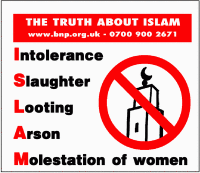
Why Britain needs a religious hatred law

bnp-islam-posterWhy Britain needs a religious hatred law

By Murad Qureshi

Morning Star, 21 November 2005

This month anti-racists celebrated the fortieth anniversary of the introduction of the first race relations legislation in Britain.

Among its other provisions, the ground-breaking 1965 Race Relations Act made it an offence to use threatening, abusive or insulting words with intent to stir up racial hatred. However, while the Act marked an important first step in providing legal protection to minority communities from racism, it proved difficult to secure convictions for this particular offence.

In 1968 four members of a far-right organisation calling itself the Racial Preservation Society were prosecuted under the Act after publishing an anti-immigration newsletter in which they warned against “racial mixing” and accused politicians of encouraging “racial levelling.”

Even though the material plainly had the effect of inciting racial hatred, the prosecution was unable to prove that this was what the defendants intended – as was required by the 1965 Act. The defendants claimed that their intention was not to incite hatred but merely to educate the public about the consequences of immigration. As a result, they were acquitted.

In his inquiry into the death of Kevin Gately at an anti-fascist protest in London’s Red Lion Square in 1974, Lord Scarman argued that the racial hatred law needed “radical amendment to make it an effective sanction, particularly in relation to its formulation of the intent to be proved before an offence can be established.”

Subsequent legislation amended the law along the lines proposed by Lord Scarman. Part 3 of the 1986 Public Order Act improves on the original 1965 law by criminalising words and actions that have, or are likely to have, the objective effect of stirring up racial hatred. The 1986 Act allows the defence that the incitement of hatred was not intended, but, rather than the prosecution being required to prove intent, the onus is now on the defendant to demonstrate the absence of intent.

This is hardly a draconian law and, under the 1986 Act, it is still far from easy to mount a successful prosecution for inciting racial hatred. Earlier this year, the Attorney-General stated that, since 1987, when the Act came into force, only 65 people had been prosecuted for inciting racial hatred, resulting in 44 convictions. Indeed, the Commission for Racial Equality has complained that “the evidential test under the Public Order Act is extremely difficult to satisfy.”

A more fundamental weakness in the existing legislation, however, is that Jews and Sikhs are protected against incitement to racial hatred as members of monoethnic religions while multi-ethnic faith groups such as Muslims and Hindus are not.

Continue reading

Study deflates myths about Euro Muslims

Some key components of Europe’s anti-Muslim rhetoric have been discredited. Take the following:

  • It is alleged that Muslims in Europe are recipients of and hence unduly influenced by foreign funding, a code word for petro-dollars from Saudi Arabia.
  • It is said that radical foreign-born imams (clerics), are a source of militancy and should be deported. Some have been, particularly from France.
  • Given Europe’s large Muslim population of about 15 million, the continent is a battleground of the war between Islam and the West.

All these assertions are alarmist nonsense, says a soft-spoken American political scientist, after extensive research in France, Germany, England, the Netherlands, Denmark and Sweden. In her new book The Islamic Challenge: Politics and Religion in Western Europe (Oxford) Jytte Klausen of Brandeis University has outlined conclusions that puncture popular myths.

Haroon Siddiqui in the Toronto Star, 20 November 2005

Acpo warns that Terrorism Bill will alienate Muslims

The Association of Chief Police Officers (Acpo) privately opposed four of the government’s 14 main proposals announced after the July 7 London bombings. Other proposals could damage community relations, Acpo believes.

The confidential Acpo assessment of the 14 or so measures concludes that all risk alienating Muslims. Senior officers believe they must increase the levels of confidence British Muslims have in the police. According to a document seen by the Guardian, the four measures from which Acpo withheld support were:

  • Amending human rights laws to get round obstacles to new deportation rules.
  • Making the justification or glorification of terrorism anywhere an offence.
  • Automatically refusing asylum to anyone linked to terrorism anywhere.
  • Banning the alleged extremist group Hizb ut-Tahrir and successor groups to al-Muhajiroun. Acpo says it knows of no intelligence to justify a Hizb ut-Tahrir ban.

Guardian, 21 November 2005

And you think our website is sarcastic

“When we saw the title of Paul Akers’ Oct. 30 essay, ‘Why Islam didn’t conquer the world‘, we were pleased to see a too-often-ignored subject such as the early history of Muslim-Christian relations receive space in our community’s newspaper. Mr Akers’ attempt to bring what is clearly a keen interest in European history to the attention of readers is to be commended. His vivid prose style, clearly reminiscent of the comic books that inspired him as a child, retains the reader’s attention.”

Nabil Al-Tikriti, Mehdi Aminrazavi, Ian Campbell, Farhang Rouhani and Ranjit Singh reply to Paul Akers’ article on the horrors that would have befallen the world if Charles Martel had lost the battle of Tours in 732.

Free Lance-Star, 19 November 2005

A Muslim responds to ‘five questions’

In a recent commentary, radio talk show host Dennis Prager posed five questions “that law-abiding Muslims need to answer for Islam’s sake, as well as for the sake of worried non-Muslims”. Prager said his questions were prompted in part by recent rioting in France “by primarily Muslim youths”, despite the fact that neutral experts say the violence had little to do with Islam and it was Muslim leaders who ultimately helped quell the violence.

Hussam Ayloush of CAIR replies to Prager’s questions.

The American Muslim, 19 November 2005