
“The most famous opinions about Jews ascribed to Hizbullah’s leader are: ‘If they [the Jews] all gather in Israel it will save us the trouble of going after them worldwide’ and ‘They [Jews] are a cancer which is liable to spread at any moment’. Charles Glass, the journalist who specialises on Lebanon and was once held hostage by Hizbullah, says both are likely fabrications.”
Category Archives: Resisting Islamophobia
From ‘totalitarianism’ to ‘Islamofascism’
The theory that Communism and fascism were twins was developed to justify the Cold War. Now the right needs a new enemy – and has discovered “Islamofascism”, writes Anindya Bhattacharyya.
Carol Turoff and classic Islamophobia
“Criticizing the problematic elements within the Muslim world is fair game. I personally do it all the time as do many forward-looking Muslim leaders. However, looking at the worst possible case scenarios within the Muslim world in order to insinuate a general point about all Muslims or about Islam itself is as scholastically disingenuous as it is disrespectful to readers. It also constitutes classic Islamophobia.”
Ahmed Rehab replies to Carol Turoff’s ranting article in the Conservative Voice.
Tablet survey of Christian-Muslim relations
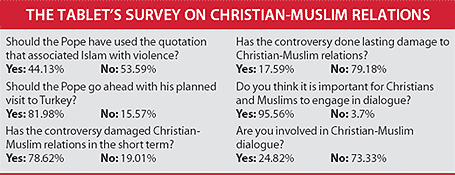
A narrow majority of Christians say that the Pope should not have quoted a derogatory remark about the Prophet Muhammad that sparked protests by Muslims around the world. Just over half the people who took part in a Tablet survey felt that Pope Benedict was wrong in his Regensburg lecture to cite the fourteenth-century Byzantine Emperor Manuel II, who said that Muhammad brought “only evil and inhuman things”.
The picture that emerges is one of Christians who are troubled by the effect Pope Benedict’s remarks will have on relations with Muslims at least in the short term. In spite of fears for the Pope’s safety, a big majority feel he should go ahead with his planned visit to Turkey at the end of November.
They also consider that dialogue between the two faiths is important even if only a quarter are themselves involved in such conversations. More than two-thirds believe that Christians and Muslims should pray together. This finding is striking in the light of Pope Benedict’s own disapproval of the practice. He recently let it be known that interfaith prayer brings with it the risk of relativism. “When we come together for prayer for peace, the prayer must unfold according to the distinct paths that pertain to the various religions,” he said earlier this month, on the twentieth anniversary of the interfaith Assisi gathering arranged by John Paul II.
The most common reasons cited for supporting Christian-Muslim dialogue are that “dialogue is essential to promoting peaceful co-existence between different faiths” and the importance of finding “areas of agreement such as social justice and pro-life issues”. Half agree with the statement that “Muslims need to understand Western values”.
Those most critical of the Pope’s remarks and fearful of the repercussions live in the Middle East, Africa and Asia. Around 63 per cent of these Christians say the Pope should not have used the controversial quotation.
Well over a quarter fear that it will do lasting damage to relations between Christians and Muslims and almost all say it is important for the two faiths to engage in dialogue. More than a third of these respondents are involved in dialogue primarily at their place of work or socially, or at an educational establishment such as school or university.
There is more support for the Pope from Christians in Britain. A narrow majority of these (52 per cent) think Pope Benedict was right to cite the controversial quotation about Muhammad. They feel Christian-Muslim relations will be damaged in the short term (82 per cent) but will recover. The British Christians are also a little less enthusiastic than the rest about praying with Muslims. Just under 59 per cent support the idea.
Extremist bullies
“We will not be browbeaten by bullies,” Home Secretary John Reid told Labour conference, vowing to have the “courage and character to stand shoulder to shoulder” with Britain’s Muslim communities to stand up to “extremist bullies.”
Taking his cue from Tony Blair, he posed new Labour as a kindly knight in shining armour prepared to defend Muslims against the evil in their midst.
Like the Prime Minister – but unlike the security services in the US and Britain – he makes no link between the danger of domestic terrorism and the blood-soaked state terrorism launched by Washington and London against Iraq and Afghanistan.
Both Mr Blair and George W Bush claim that incidences of terrorism across the globe break out because “these people hate our way of life.”
This is childish nonsense. Even the most extreme expressions of Islamist terror justify their acts as a response to military attacks on and occupations of Muslim lands, which long predate September 11 2001.
But US Republican and new Labour neoconservatives cannot accept that global insecurity is a direct result of their own propensity for war and subjugation.
That’s why Mr Reid resorts to pompous claptrap that blames Britain’s Muslim communities for the small groups of misguided people who seek to combat state terrorism with individual terrorism.
For him and his boss, everyone who condemns imperialism’s crimes in Iraq, Afghanistan and Palestine or who identifies the link between those crimes and the bombs in Britain and elsewhere is dabbling in an extremism that provides a milieu within which terrorists can thrive.
How dare they try to blame others for the mess that their policies have created?
New Labour’s belief that it has a right to define Muslims as either “moderate” or “extremist” on the basis of whether they back the government’s criminal policies is a disgrace.
It is also a confirmation that, when it comes to bullying the poor and powerless, government ministers are past masters.
Morning Star editorial, 29 September 2006
Open season for attacking Islam
“There have been regular attacks to demonise Islam for many years, but until recent weeks, it has been expressed either in the form of gutter language by bigots, racists and extremist elements or voiced more discretely and subtly by more presentable sectors of society. Whenever political or religious leaders wanted to revile Islam they often have often used phrases like Islamic terrorists, Islamic extremists, Islamic radicals, etc. They often add such anti-Islamic provisos to say that though Islam does not teach and support terrorism, phrases like terrorists are using a ‘twisted form of Islam’ (Prime Minister, Tony Blair, after July 7 terrorist atrocities) or that terrorists subscribe to ‘a branch of Islam that condones violence’ (The Times, September 30, 2001) or ‘Muslims have to look at why their religion breeds so many violent militant strains’ (The Guardian, October 6, 2001) are deemed acceptable.
“However, in the last few months the discourse has changed and it became an open season to demonise Islam. The watershed was US President George W Bush’s intemperate language last month when he described terrorists as ‘Islamic fascists’ – provocatively evoking, comparisons between Islam and the tyrannical fascist regimes of the past, effectively demonstrating that the war against terror is in reality a war against Islam and Muslims. The new series of attacks on Islam reached new heights with the tactless comments made by Pope Benedict XVI during a visit to Germany earlier this month. Previously it had been inconceivable that the spiritual head of one billion Catholics could make such an outspoken attack on Islam.”
‘Islam is NOT a religion of peace’ – US Republican backs Pope
The Campaign on American-Islamic Relations is encouraging its supporters to respond to a piece by Frank Lasee, a Republican representative on the Wisconsin State Assembly, who wrote:
“The Pope’s comments were right on the mark. Islam is NOT a religion of peace. It doesn’t have a peaceful history of co-existence. And has created empires whose main goal was to convert or destroy all non-believers. Islam IS a religion intent on conquering the world. This global domination is preached and encouraged by Imams in mosques. And it is a central theme in the Koran, the Islamic Bible, and is an important part of their history.”
Bush and Islam: words versus deeds
 “The wide gap between U.S. President George W. Bush’s words and deeds vis-à-vis Islam and Muslims doomed to failure his speech at the United Nations on September 19, which could neither appease Muslims nor pacify the ever growing Islamophobia.
“President Bush has denied that the West is engaged in a war against Islam as a ‘false propaganda’, but confirmed his country’s determination to carry on with its ‘war on terror’ and its ‘great ideological struggle’ at the start of the 21st century exclusively against Muslims and Muslim countries.
“Bush is also on record as saying that ‘Islam is a religion of peace’ and praising Islam’s ‘commitment to religious freedom’, statements that were criticized by the popular U.S. televangelist Pat Robertson.
“These rare expressions of respect to Islam would have been welcomed by Muslims were they not swept to utter oblivion in the collective memory of the American public by his incessantly flowing anti-Muslim terminology: Islamic radicalism, Islamic fascism, Islamic extremism and extremists, Islamic or Islamist terrorism and terrorists, radical Islamists or Islamist and Islamic radicals, etc.
“His September 19 speech was almost exclusively confined to the Middle East, an overwhelmingly Muslim region. The absence of even a reference to the North Korean pillar of his so-called ‘axis of evil’ was revealing enough that his WWIII ‘on terror’ has shrunk to focus exclusively on the Muslim Middle East.”
Nicola Nasser at Global Research, 28 September 2006
Muslim family values produced 7/7 bombers – Muriel Gray
“John Reid telling devout Muslims to watch out in case their children become, oops, even more devout Muslims was bordering on the ridiculous….
“These brainwashed young men threatening us are not coming from liberal, Westernised homes full of moral relativism and then suddenly turning psycho. If they come from observant Muslim families – which the 7/7 bombers all did despite all the nonsense about them being ‘ordinary Westernised boys’ – then the priming started long ago. They would have been brought up to genuinely believe that Allah intended women to have a single purpose in life as subservient wives and mothers; gay people are perverts; freedom of speech does not apply to any kind of criticism of their belief; democracy is a man-made sham; and the values of the West are inferior….
“The leap to ‘radicalism’ from such a narrow background is not exactly over a chasm…. since many devout, law-abiding Muslims have publicly expressed agreement with a great deal of the bombers’ philosophy – except the killing part – what possible help can they be in this war? It would be of more practical help to try and reasonably persuade devout Muslim parents to let their children absorb a far wider cultural agenda….”
Muriel Gray does her Melanie Phillips impression in the Sunday Herald, 24 September 2006
See Osama Saeed’s reply at Rolled Up Trousers, 26 September 2006
Redrawing the battle lines
 “To the eyes of many across the Muslim world, the anti-war movement has unveiled another west, different from Bush’s and Blair’s west of carpet bombs, Abu Ghraib and Guantanamo Bay. To these, New York, London, Madrid, and Rome are no longer the command centres of armies and war fleets only, but great capitals of protest and popular mobilisation against aggression and expansionism.
“The battle lines have been redrawn within, not between, cultures and civilisations. This is not a civilisational clash. Above all, it is a conflict over the shape of the world order, the structures of international relations and the right of nations to sovereignty and self-determination.”
Another excellent piece by Soumaya Ghannoushi.