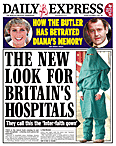
 The Express reports on plans to offer “burka-style” gowns to Muslim women hospital patients:
“Last night Conservative MP Philip Davies, who has campaigned against political correctness, said the dress would stir up resentment on wards because patients would believe others were getting special treatment…. ‘It is another example of political correctness because it is the sort of thing that has been brought in because the words “faith” and “race” have been mentioned. The average patient on a ward will look at this and be resentful because they will say to themselves: “This has been brought in because it is a Muslim request”. They themselves may have other requests, like more visiting hours, more flexible meal times or a brighter lamp for their bedside table, but they know they’ve got less chance of achieving this. A burka-style hospital gown is only high on the priority list because of the politically correct world we live in.’ … The burka is the latest move to stir debate on priorities in the hard-pressed NHS.”
Of course, the garment in question has nothing in common with a burka, but the term is presumably chosen because it has associations with Afghanistan and the Taliban.
 “Is there anything inherently wrong in placing multiculturalism under the spotlight to critically examine it and assess its ills and virtues? The obvious answer is no. The problem is not with the question itself, but with its context, assumptions and terms.
 Molly’s case holds lessons for us all
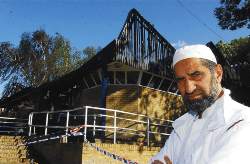 Basildon’s Islamic Centre has been almost destroyed in a suspected arson attack.
 “More than 30 Muslim groups, along with Muslim MPs and peers, demanded that the Government change its foreign policy in order to placate terrorists. This blackmail was followed by a demand from other representatives [in fact, just one representative – ed.] that a pair of Islamic religious festivals should become official holidays and that Islamic laws relating to marriage and family life be applied in Britain. These were not moderate attitudes.