
Canadian Federation of Students releases report on needs of Muslim students

The Canadian Federation of Students released a report examining college and university responsiveness to Muslim students today. The Federation’s Task Force on the Needs of Muslim Students compiled the report based on participation of nearly 1,000 Muslim students at 17 on-campus hearings over a seven month period.

“The goal was to develop a better understanding of the needs of Muslim students and to determine how well Ontario universities and colleges are addressing those needs,” said Jesse Greener, Ontario Chairperson of the Canadian Federation of Students. “It’s clear that every day Muslim students face both overt and subtle forms of Islamophobic discrimination on Ontario campuses.”

Islamophobia, as defined in the Ontario Human Rights Commission, is the use of stereotypes, biased or hostile acts towards individual Muslims or followers of Islam in general. The Ontario Human Rights Code sets out standards of religious accommodation for the beliefs and practices of racialised individuals or groups within workplaces and learning environments.

“A general ‘failure to accommodate’ was the most frequently identified problem by Muslim students in many facets of campus life,” said Ausma Malik, Task Force member and student at the University of Toronto. “From a lack of appropriate foods on campus and inadequate prayer space to inflexible academic policies that are often at odds with religious obligations, Ontario’s Muslim students often face a fundamentally different learning environment than other students.”

Continue reading

Lack of contact linked to intolerance

Quebecers have the least personal contact with Jews or Muslims of any Canadians, and less contact means more intolerance, an analysis of poll data suggests.

The findings help explain why “reasonable accommodation” of orthodox Jews and Muslims is so controversial in this province, the Montreal research group that crunched the numbers says.

The Environics poll also reveals that, when it comes to Arabs and Jews, a small minority of Canadians are equal-opportunity bigots – they dislike both.

Montreal Gazette, 21 March 2007

Danish editor who published Prophet cartoons wins prize

The Danish newspaper editor who published controversial cartoons of the Prophet Mohammed in 2005 was awarded on Monday a free press prize for his “determination and courage.” The Danish-based Free Press Society awarded Flemming Rose the inaugural international Sappho Prize, worth $3,568 (€2,685).

The publication of the 12 cartoons in the daily Jyllands-Posten in September 2005 prompted an international dispute.

Lars Hedegaard of the Free Press Society said the prize honoured a “journalist who combines excellence in his work with courage and a refusal to compromise.” Hedegaard compared the pressure placed on Rose and his newspaper to apologise for publishing the cartoons to those voices calling for the appeasement of Nazi Germany at the dawn of World War II.

“Decisive to our decision was Rose’s courage to print the cartoons and to stand his ground under the worst storm any journalist has ever endured,” Hedegaard said.

Today’s Zaman, 20 March 2007

Peterborough schools say no to girls’ veils

The city’s newest schools have backed Government plans to ban pupils wearing full-face Islamic veils. Despite being still under construction, the Voyager School, in Walton, and the Thomas Deacon Academy, in Eastfield, have said they will ban youngsters from adopting religious full-face coverings.

New Government guidelines on school uniforms were announced yesterday and the report stated: “Schools must act reasonably in accommodating religious requirements, providing they do not pose a threat to security, safety and learning, or compromise the well-being of the whole school community.”

Peterborough City Council’s cabinet member for education Geoff Ridgway said he believed the banning of full-face veils was the right decision. He added:

“The facial reaction to anything which is being discussed is very, very important and by not having a veil it also takes away that feature of secrecy. Of course people are entitled to their own religion, but they have also got to be conscious of the society they live in. The society we live in is one where we want openness and transparency and eye-to-eye contact.”

Peterborough Evening Telegraph, 21 March 2007

And how exactly does the niqab prevent eye-to-eye contact, you might wonder. It sounds like a better argument for banning sunglasses in Peterborough schools.

Religious moderates just provide cover for fanatics, says NSS president

Terry Sanderson (2)“There’s an argument in religious circles that goes: in order to undermine the fanatics we have to encourage the liberal elements of religion. If you want to stop suicide bombers, you have to encourage the more moderate voices in Islam to speak up…. It’s a seductive argument and I used to subscribe to it myself. But I’ve changed my mind….
“Just as the terrorists of the Middle East will hide out in schools and hospitals to avoid being targeted by enemy bombs, so the ideological terrorists hide behind the liberals and the good-natured in order to spread their doctrine of intimidation and terror….

“The liberals pave the way, open the doors and give succour to the very people they say bring their faith into disrepute. But it’s no good the liberals trying to dissociate themselves from their wilder compatriots in faith. They promote and praise the same holy books that the fanatics use as justification for their murderous activities.”

Terry Sanderson of the National Secular Society at Comment is Free, 20 March 2007

Or, as Sanderson’s friend George Broadhead of GALHA has put it: “What does a moderate Muslim do, other than excuse the real nutters by adhering to this barmy doctrine?

Has the veil been banned?

Inayat Bunglawala of the Muslim Council of Britain argues, that while “there does appear to be a shift in the advice the government is giving to our schools and while a signal is being sent that those schools which, following a consultation with parents and governors, decide to forbid the niqab will be supported, the Sun is wrong to suggest that there will be a blanket ban.”

Inayat continues: “The fact is, however, there are fewer than a dozen schoolgirls who actually wear the niqab out of half a million state school pupils. Still, it will no doubt have helped Mr Johnson – a contender for the post of deputy leader of the Labour party – to look as if he was being just as tough on this issue as his rival, Jack Straw.”

Comment is Free, 20 March 2007

Sun backs Johnson over niqab

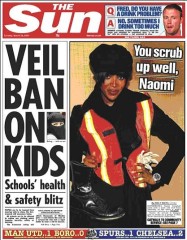
Veil Ban on KidsVeils will be banned in schools to help pupils learn and to keep them safe, Education Secretary Alan Johnson has ruled.

His decision will affect thousands of Muslim girls who wear clothing like the full niqab. He will publish details of his guidance to headteachers in the Commons today. The wearing of full-length robes may also be affected.

A source said: “Veils mean teachers can’t see the face. It’s a problem for security and it’s also a problem for learning because the teacher can’t see whether or not a child is understanding what’s being taught. A full face veil means you can’t see who the person is.”

Ministers will say it is also dangerous under health and safety regulations. A Bunsen burner could easily set light to a face veil in a science lab, Mr Johnson will point out.

School heads will be told to consult parents before going ahead with the ban. They will tell parents they CAN uphold religious traditions provided they do not put security and learning in jeopardy. The rules will also apply to faith schools.

But Mr Johnson is convinced there will be no serious opposition to the move.

Sun, 20 March 2007


In an editorial comment the paper welcomes a ban, asserting that the niqab is “divisive” and “provocative”.

The Guardian reports that this news was “leaked in advance to the Sun by Mr Johnson” – which gives you some indication of the audience he hopes his policy will appeal to, and how he wants to spin it. He’s certainly won the admiration of one BNP blogger, who hails Johnson’s proposals as “Some good news for once!

See also the BBC poll on whether the veil should be banned in schools.

Conferences to look at ‘threat’ of Islam in New Zealand

The time is ripe for the Church to face up to the threat of Islam in our country, to understand Islam’s agenda and to respond with the love of Christ, says Middle East Overseas Outreach New Zealand director Murray Dillner.

That organisation, Open Doors NZ, Interserve and Asian Outreach are combining to host Mosque and Miracles conferences for the first time in New Zealand. They will be held in Christchurch, Wellington and Auckland in July, and are endorsed by Vision Network and Missions Interlink.

“Those who work with Muslims estimate there are about 40,000 of them here,” said Mr Dillner. “The politicians estimate about 20,000 but others believe there are many more. Islam is having an impact.”

Mr Dillner said he has become very aware that time is short before the pressure of ideologies such as radical Islam will “take away the freedoms we have in New Zealand and we will no longer have freedom of speech”.

“The politicians will tell you Islam is a peaceful religion, but any former Muslim will tell you otherwise,” he said. “Wherever in the world Muslims have taken over, democracy no longer exists.”

Mr Dillner said many Muslims came to New Zealand to find a better life, but many others came with a “missionary zeal” to take over the country. Muslims may in future, for example, promote the idea of instituting the call to Islamic prayer in their neighbourhoods.

In many freezing works halal killing had become standard and a group of South Island farmers was considering starting up their own freezing works to avoid that religious practice. “They are saying, ‘Why should New Zealanders bow to Islam?’ Islam has an agenda which is subtle and behind the scenes.”

Challenge Weekly, 19 March 2007

Hizb ut-Tahrir ‘a threat’ in Australia

HizbThe Muslim group Hizb ut-Tahrir – banned in Europe, China and Saudi Arabia but legal in Australia – has been identified as a potential threat to the nation.

Research has found it takes advantage of Australian tolerance to launch propaganda attacks on the country and that its adherents are primed to take the next step up to jihad, if called upon to do so.

The propaganda of the religious group, which is legal in Australia, encourages a level of religious hatred that could convince its followers to carry out terrorist acts, says the Australian Strategic Policy Institute. A paper by the think tank’s Anthony Bergin and Jacob Townsend says while Hizb ut-Tahrir does not advocate the use of terror – indeed forbids its members from engaging in terrorist acts – it uses the same radical terminology as al-Qa’ida.

The paper warns the group’s Australian operations need to be closely monitored, even though it defers the use of terror until a “caliphate”, or order to militant jihad, by a religious leader.

“Hizb ut-Tahrir may well act as a warm-up track for violent radicals”, it says. “Hizb ut-Tahrir advocates a revolutionary change to our social and political system. It encourages indirectly and sometimes more directly political violence by its inciting propaganda. It uses Australian tolerance to promote radical propaganda even against Australia itself.”

The Australian, 19 March 2007

Ruth Kelly on tackling terrorism

Ruth KellySecretary of state for communities Ruth Kelly has an article in the Observer justifying the government’s decision to shift resources away from the genuinely representative Muslim Council of Britain to organisations that will be less vocal in criticising the role British foreign policy in inciting terrorism.

Significantly, the Sufi Muslim Council – which Kelly was enthusiastically promoting only last year – doesn’t rate a mention, and now appears to have been rejected in favour of the British Muslim Forum (or the “Muslim British Forum”, as Kelly prefers to call it) as the government’s favoured partner in the Muslim community.

This procedure bears more than a passing resemblance to the practice of colonial governors within the British Empire, who would appoint their favoured individuals to represent the “natives”.