
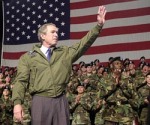
 President Bush in recent days has recast the global war on terror into a “war against Islamic fascism”. Fascism, in fact, seems to be the new buzz word for Republicans in an election season dominated by an unpopular war in Iraq.
Bush used the term earlier this month in talking about the arrest of suspected terrorists in Britain, and spoke of “Islamic fascists” in a later speech in Green Bay, Wis. Spokesman Tony Snow has used variations on the phrase at White House press briefings. Sen. Rick Santorum, R-Pa., in a tough re-election fight, drew parallels on Monday between World War II and the current war against ‘‘Islamic fascism,” saying they both require fighting a common foe in multiple countries. It’s a phrase Santorum has been using for months. And Defense Secretary Donald H. Rumsfeld on Tuesday took it a step further in a speech to an American Legion convention in Salt Lake City, accusing critics of the administration’s Iraq and anti-terrorism policies of trying to appease “a new type of fascism”.
The White House on Wednesday announced Bush would elaborate on this theme in a series of speeches beginning Thursday at the American Legion convention in Salt Lake City and running through his address to the U.N. General Assembly on Sept. 19. “The key is that all of this violence and all of the threats are part of one single ideological struggle, a struggle between the forces of freedom and moderation, and the forces of tyranny and extremism”, White House spokeswoman Dana Perino told reporters traveling with Bush aboard Air Force One.
Conservative commentators have long talked about “Islamo-fascism”, and Bush’s phrase was a slightly toned-down variation on that theme.
 “The argument of the government goes roughly as follows. Asians have lived parallel lives in this country for too many years, and because of this segregation, they care nothing at all for white people and are thus quite willing to blow them up on public transport.
 The Government reacts tetchily to suggestions that British foreign policy has anything to do with the rise in radicalism among young Muslims.
 “At the beginning of his tenure, Blair embarked on a privatisation spree that saw much of our public service sector shift from state ownership and control to those of a cluster of private businesses. Going further than Thatcher herself, he set about privatising schools, hospitals, transport and the mail, scrapping the university grant and breaking the backs of countless students with ever rising tuition fees. Seizing, like his Hobbesian allies across the Atlantic, 9/11’s immense opportunities, he then turned to Britain’s legal corpus with a vengeance, waging endless battles against judges and civil liberties associations.