
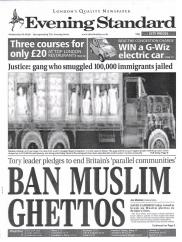
‘Ban Muslim ghettos, says Cameron’

Ban Muslim GhettosDavid Cameron today vowed to break up Muslim ghettos in Britain’s cities. In the most frank comments on the issue by a major party leader, he used his keynote party conference speech to say Britain had made an error by allowing ghettos to develop.

“It worries me that we have allowed communities to grow up which live ‘parallel lives’,” he said in an extract of today’s speech obtained in advance by the Evening Standard. “Communities where people from different backgrounds never meet, never talk, never go into each others’ homes,” said the Tory leader.

He said migrants should learn English because contact between people would overcome differences and “the most basic contact comes from talking to each other”. Mr Cameron said that children should be taught “the core components of British identity – our history, our language, our institutions”.

He went on: “We need to have contact. In many of our towns and cities, we have allowed ghettoes to develop. Whole neighbourhoods cut off from the rest of society. Immigrant families who only ever meet people with the same country of origin. We need to find ways to avoid this.”

Evening Standard, 4 October 2006

Significant that, of all the issues dealt with in Cameron’s speech, this is the one the Standard has seized on and advertised with a banner headline.
Community pledge on mosque attack

Community leaders in Preston are vowing to work together to avoid a repeat of disturbances in which an Asian teenager was stabbed outside a mosque. The pledge came after a three-hour meeting in Avenham involving police, politicians and community leaders.

About 200 people were involved in trouble on Sunday night after what police said were racially motivated attacks on cars parked at a mosque. Lancashire Police said bricks and concrete blocks were thrown at cars of people attending the Jamia Masjid mosque on Clarendon Street Sunday night.

Extra patrols have been mounted in the area. There were no problems overnight.

Ch Supt Mike Barton, of Lancashire Constabulary, met with local residents on Monday along with community leaders and councillors from Preston Council.

After the meeting, council chief executive Jim Carr read out a short statement which blamed the trouble on a “minority of criminals”.

He said: “Following the recent incidents in the Avenham area of the city, instigated by a small minority of individuals linked to criminal activity, we the wider community of Preston resolve to work closely together to tackle those individuals and make Avenham safe.”

Lancashire Police said bricks and concrete blocks were thrown at cars of people attending the Jamia Masjid mosque on Clarendon Street Sunday night.

About 100 officers were called to the scene after disorder broke out, though there were no arrests. A 16-year-old boy was stabbed in the arm but was not seriously injured.

BBC News, 3 October 2006

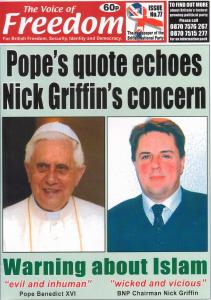
Pope’s attack on Islam vindicates BNP, fascists claim

Pope's QuoteUnder the headline “Pope’s quote echoes Nick Griffin’s concern”, the British National Party claims, not entirely unreasonably, that Pope Benedict’s attack on Islam bears a certain similarity to that made by BNP leader Nick Griffin:

“The Department of Public Prosecutions must be cursing the Pope after his remarks on Islam appeared to echo those of the British National Party chairman.

“In a speech to BNP members, Nick Griffin warned those present that Islam was a ‘wicked and vicious’ faith. These words and his chillingly correct prediction that 2nd generations Muslims living in Britain would become Britain’s first suicide bombers, led to him being arrested and charged with inciting racial hatred.

But now Pope Benedict XVI, in a lecture at a German University, has quoted a Byzantine emperor who characterized the Prophet Mohammed as introducing ‘things only evil and inhuman’ to the world and spreading Islam by the sword. As if to prove him correct, Muslims responded by burning down churches and killing a nun.”

Freedom, October 2006

‘Let’s have an open and honest discussion about white people’

Gary Younge“Any candid discussion of race, immigration and asylum that was not racist would not just acknowledge fear and prejudice but challenge them both. Since ministers are not able to do that about ethnic minorities, maybe they should start off with a subject with which they are more familiar. Let’s have an open and honest discussion about white people.
“Let’s start by talking about how they don’t want to integrate. The stubborn rump of around 10% of whites who, according to a 2002 Mori poll, are hostile to racial equality and antagonistic to the very existence of non-white people in this country. Given a percentage point either way, that is the consistent figure who believe that to be truly British you must be white and who do not believe it is important to respect the rights of minority groups.

“Let’s discuss their inability to choose moderate leaders and the propensity of the leaders they do choose to murder innocent civilians abroad by their thousands. Let’s analyse their vulnerability to extremists such as the British National party, not to mention elsewhere in Europe, where fascism is once again a mainstream ideology.

“Let’s talk about the religious intolerance that rages in Scotland and Northern Ireland, and can be found in the highest levels of the state, where only Protestants can marry into royalty. And let’s not forget the terrorists white people have been rearing at home for years, whether they are bombing Brick Lane, parliament or shopping centres in Manchester, and the no-go areas in housing estates, football terraces and boardrooms.

“Only then perhaps will it become sufficiently apparent for those with insufficient imagination just how crude and crass the framing of the debate about Muslims has been. Any group of people will rightly bristle at the demand to answer collectively for the acts of individuals with whom they share an identity but over whom they have no control.

“The tolerant, secular, liberal society into which Muslims are being asked to integrate lies somewhere between mythology and a work in progress and, the responsibility for transforming it into a lived reality lies with all of us.”

Gary Younge in the Guardian, 2 October 2006

Teenager stabbed in mosque attack

A 16-year-old Asian youth was stabbed in the arm as disturbances involving 200 people flared following attacks on cars parked at a mosque. Police said the attacks were racially motivated, and extra officers were patrolling the Avenham area of Preston.

Bricks and concrete blocks were thrown at cars of people attending the mosque. Chief Supt Mike Barton said: “These problems are being caused by a small group of criminals in the area intent on intimidating the local community.”

The stabbed youth was not seriously injured and there were no arrests, police said.

The disturbance follows the death of an Asian student in July after a fight between up to 40 Asian and white youths nearby, which police described as a “suspected race attack”.

About 100 officers were called to the Jamia Masjid mosque when disorder broke out on Sunday evening on Clarendon Street.

Ch Supt Barton said there was a growing element of criminal, anti-social behaviour in the area and those responsible needed ridding from the community.

He said: “This incident of stone throwing is an example of that, and as you can expect, people are unhappy with being victimised.”[On Sunday] a number of cars were damaged outside the mosque and people who were worshipping inside came out to see what was going on. Not surprisingly, they have been very angry.”

He said because of the large number of people on the streets, police decided to deploy more officers to offer reassurance and prevent disorder.

Patrols are being boosted and police are using video cameras to gather evidence. They are warning that people who launch reprisals will be arrested.

In July Shezan Umarji, 20, was killed on the Callon Estate, one and a half miles away from Avenham.

BBC News, 2 October 2006

‘Crude stereotyping’ – Osama Saeed replies to Muriel Gray

Muriel Gray doesn’t let the facts get in the way of a good rant against Islam and Muslims (Comment, September 24). The 7/7 bombers were not all, in fact, from devout Muslim families. Jamal Lindsay, for one, was a convert, as indeed was Richard Reid, the previous shoebomber.

But the main point is yet again we see Gray adopt the most extreme formulation of Islam to advance her argument, and then paint the whole Muslim community with it. Bin Laden would be proud of her. I regard myself as a pretty devout Muslim, but don’t recognise the views she ascribes to me about women, homosexuals, freedom of speech, democracy and the West.

What she is guilty of is exactly what she accuses Muslims of when it comes to the West – caricaturing and stereotyping with the “kaleidoscopic richness and beauty of the country’s (in this case “religion’s”) culture erased”.

It would be easy to debunk her argument that practising Islam leads to bombing by making a similarly stupid argument that anyone that drinks alcohol, doesn’t pray, has sex outside marriage, and indeed writes foaming-at-the-mouth articles against Muslims in newspapers, is just a stone’s throw away from waging military war on the Muslim world.

Osama Saeed
Scottish spokesman
Muslim Association of Britain

Sunday Herald, 1 October 2006

Nasrallah misrepresented

“The most famous opinions about Jews ascribed to Hizbullah’s leader are: ‘If they [the Jews] all gather in Israel it will save us the trouble of going after them worldwide’ and ‘They [Jews] are a cancer which is liable to spread at any moment’. Charles Glass, the journalist who specialises on Lebanon and was once held hostage by Hizbullah, says both are likely fabrications.”

Rolled Up Trousers, 30 September 2006

See also Jews Sans Frontieres, 29 September 2006

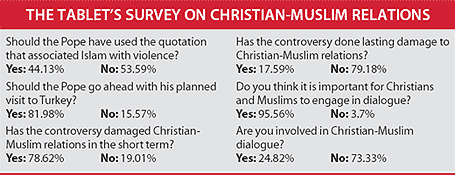
Tablet survey of Christian-Muslim relations

Tablet survey

A narrow majority of Christians say that the Pope should not have quoted a derogatory remark about the Prophet Muhammad that sparked protests by Muslims around the world. Just over half the people who took part in a Tablet survey felt that Pope Benedict was wrong in his Regensburg lecture to cite the fourteenth-century Byzantine Emperor Manuel II, who said that Muhammad brought “only evil and inhuman things”.

The picture that emerges is one of Christians who are troubled by the effect Pope Benedict’s remarks will have on relations with Muslims at least in the short term. In spite of fears for the Pope’s safety, a big majority feel he should go ahead with his planned visit to Turkey at the end of November.

They also consider that dialogue between the two faiths is important even if only a quarter are themselves involved in such conversations. More than two-thirds believe that Christians and Muslims should pray together. This finding is striking in the light of Pope Benedict’s own disapproval of the practice. He recently let it be known that interfaith prayer brings with it the risk of relativism. “When we come together for prayer for peace, the prayer must unfold according to the distinct paths that pertain to the various religions,” he said earlier this month, on the twentieth  anniversary of the interfaith Assisi gathering arranged by John Paul II.

The most common reasons cited for supporting Christian-Muslim dialogue are that “dialogue is essential to promoting peaceful co-existence between different faiths” and the importance of finding “areas of agreement such as social justice and pro-life issues”. Half agree with the statement that “Muslims need to understand Western values”.

Those most critical of the Pope’s remarks and fearful of the repercussions live in the Middle East, Africa and Asia. Around 63 per cent of these Christians say the Pope should not have used the controversial quotation.

Well over a quarter fear that it will do lasting damage to relations between Christians and Muslims and almost all say it is important for the two faiths to engage in dialogue. More than a third of these respondents are involved in dialogue primarily at their place of work or socially, or at an educational establishment such as school or university.

There is more support for the Pope from Christians in Britain. A narrow majority of these (52 per cent) think Pope Benedict was right to cite the controversial quotation about Muhammad. They feel Christian-Muslim relations will be damaged in the short term (82 per cent) but will recover. The British Christians are also a little less enthusiastic than the rest about praying with Muslims. Just under 59 per cent support the idea.

The Tablet, 30 September 2006