
Policy Exchange publishes another futile report

MCB banner

The Muslim Council of Britain (MCB) views the Policy Exchange’s latest offering as another divisive attempt to drive a wedge between British Muslims and the rest of society.

Today’s report from Policy Exchange entitled ‘The Hijacking of British Islam‘ plumbs new depths in the ongoing and transparent attempts to try and delegitimise popular mainstream Islamic institutions in the UK and replace them with those who are subservient to neo-conservative aims.

The report cultivates an insidious programme of generating sectarianism amongst British Muslims by preferring some traditions of Islam over others. From its inception, the MCB has been a pioneer in creating a space for the many rich traditions of Islam. The authors of this report would do well to learn from the MCB’s good practice. The MCB reasserts its commitment to seek the common good and point to its record in encouraging all British Muslims to enthuse the Islamic value of reaching out and seeking common cause with all, of all faiths and none. The MCB does not tolerate any messages of hate, whatever its source – and the law should take its course.

“Today’s report lists extracts from a number of books on sale in some Muslim bookshops which they deem to be unacceptable. The plain fact is that if you deliberately go looking for controversial material then you will be guaranteed to find it somewhere in a bookshop. Muslim bookshops are no exception. Yet tellingly, it is only Muslim bookshops and institutions that Policy Exchange calls to be regulated. British Muslims will not be intimidated by these futile and irresponsible recommendations,” said Dr Muhammad Abdul Bari, Secretary-General of the Muslim Council of Britain.

He added: “I would urge everyone to guard against the shrill hysteria generated by divisive organisations such as the Policy Exchange who provide succour to the far right. Sources of hope can be found elsewhere – yesterday’s launch of the Mosques and Imams National Advisory Board (MINAB) will complement, continue and strengthen the on-going work of the MCB in ensuring that mosques are welcoming and equipped for the twenty-first century.
Muslim Council of Britain news release, 30 October 2007

‘Agenda of hate in British mosques’

Extremist literature calling for the execution of gays and the oppression of women is being distributed in British mosques. Researchers found radical or hate-filled books and pamphlets at a quarter of the 100 Islamic religious institutions they visited.

The material found in the mosques urges Muslims to lead separate lives from “nonbelievers” and makes repeated calls for gays to be killed. Women should be subjugated and are warned not to pluck their eyebrows or wear perfume.

In the alarming report, drawn up by the Policy Exchange thinktank, the Saudis were accused of having a “powerful and malign” influence.

Hardline material was found at the East London Mosque which has been visited by Prince Charles and is closely linked to the Muslim Council of Britain. The think-tank said separatist or hateful material was also found at the former Finsbury Park Mosque in North London – made infamous by hook-handed cleric Abu Hamza – and institutions in Wycombe, Manchester, Birmingham, Edinburgh, Blackburn, Bradford, Rochdale and Oxford.

Anthony Browne, Policy Exchange’s director, said: “It is clearly intolerable that hate literature is peddled at some British mosques.”

The report, The Hijacking of British Islam: How extremist literature is subverting Britain’s mosques, was written by Denis MacEoin, an Islamic studies expert at Newcastle University. Dr MacEoin said the radical material was found by Muslim research teams working in 2006 and 2007. He added: “What is more worrying is that these are among the best-funded and most dynamic institutions in Muslim Britain – some of which are held up as mainstream bodies. Many of the institutions have been endowed with official recognition.”

Daily Mail, 30 October 2007

Continue reading

Indian Islamic group attacks BBC film for Bin Laden link

Darul UloomA BBC documentary shown last night came under attack from one of India’s largest Islamic groups for linking their movement to Osama bin Laden and “extremist” Muslim groups around the world.

The Deoband school, whose main madrassa Darul Uloom (House of Knowledge) lies 90 miles north-east of Delhi, said it had allowed a television crew making a three-part documentary called Clash of Worlds into its grounds to explain its “message of peace and historic role in Indian affairs”.

The seminary is a global centre of Muslim learning with 15,000 schools worldwide adopting its sparse and dogmatic version of Islam. One report last month said almost 600 of Britain’s nearly 1,400 mosques are run by Deobandi-affiliated clerics.

However, Muslim scholars in Delhi became alarmed to hear the programme’s presenters talk of their part in the anti-British uprising in the nineteenth century being similar to “the role played by Osama bin Laden today”. Mohammad Anwer, a spokesman for the Deoband school, said he had protested to the film’s producers about the link with Bin Laden and “many other mistakes”. “We protested at the time but it made no difference. We do not advocate violence nor are we asking others to do violence,” said Mr Anwer.

“We did fight against the British in the nineteenth century but so did Hindus. Deoband has a long, proud history of being part of the independence struggle. But this is not comparable to Osama bin Laden.” Clerics in Delhi have also been incensed that their creed has been termed an Indian version of Saudi Arabia’s Wahhabi school, seen as a hardline, revivalist form of Islam.

Guardian, 29 October 2007

US protesters shout down Nick Griffin

BNP dustbinEAST LANSING – When British Nationalist Nick Griffin took the podium at a Friday night Michigan State University event, he tried to explain how Islam is a threat to Western civilization.
Protesters wouldn’t have it. Hurling obscenities and using chants to interrupt his address, rambunctious student organizations forced Griffin to abandon his speech and allow an informal question and answer session.

“We have all come from different backgrounds,” said Authra Khreis, 17, a pre-med student and a protester. “We should accept one another. I don’t think he should be allowed to speak. You can use free speech until you hurt another person.”

Griffin was invited to campus by a conservative student organization called Young Americans for Freedom, or YAF. Kyle Bristow, chairman of YAF, said his organization invited Griffin to promote intellectual debate.

Bristow said he doesn’t believe in many of the ideas Griffin has preached, particularly his alleged denial of the Holocaust, but does agree that the Islamic faith is a threat to America.

“I’ll stop saying their religion is terrible when they stop flying planes into buildings,” he said. “Islam is horrible. The extreme in Christianity is ‘love thy neighbor,’ with Islam it is violence.”

One student who engaged in a particularly long debate with Griffin was Junaid Mattu, a finance junior from India. “I am a supporter of free speech, but at the same time there has to be a benchmark,” he said. “Why does MSU time and time again show its insensitivity to minorities by inviting racists?”

Lansing State Journal, 27 October 2007

See also Indigo Jo Blogs, 27 October 2007 and CAIR press release, 26 October 2007

Melanie Phillips advocates war with Iran

“The consequences for the Jews of a strike on Iran are therefore fearsome. But the alternative, a nuclear Iran, is worse – not just for Israel but for the world, which from that time forth would be held hostage to nuclear blackmail by an Iran hell-bent on regional and global Islamic domination. This is not a choice between a good outcome and a bad outcome. This is a choice between a terrible outcome and a cataclysmic one. It is the choice between a rock and a very hard place; and those who now advise that there is no alternative but war with Iran do so with the heaviest of hearts.”

Spectator, 28th October 2007

Increased mosque attendance is evidence of terrorist associations say police

A hard core of 20 Islamic extremists with links to foreign terror groups is operating north of the Border and poses a “significant” risk to public safety, Scotland on Sunday can reveal. Senior intelligence insiders have revealed the suspects – many of them born and brought up in Scotland – pose a similar threat to that of Mohammed Atif Siddique, the Scottish Asian who was last week given an eight-year prison sentence for terrorist offences.

Scotland on Sunday can also reveal that concern at the terror threat is now so great that up to 1,000 Scottish Asians will be placed under surveillance in coming months because they associate with known radicals. Special Branch, backed by MI5 officers, will carry out checks on the individuals looking for evidence of radicalisation such as changes in clothing and increased mosque attendance.

Scotland on Sunday, 28 October 2007

Racial and religious attacks up 12 per cent

Racially and religiously motivated attacks have risen 12% in the past year, according to government figures to be released this week.

The Ministry of Justice statistics show there were 41,000 racially or religiously aggravated offences in 2005-06, the latest year for which figures are available. Experts are likely to link the increase to fears related to terrorism and immigration.

Following the attack on Glasgow airport in June, racist incidents across Scotland have soared, with sharp rises in violent attacks, abuse and harassment in the four weeks after the car bombing. The worst cases included attempts to blow up an Asian shop and a mosque.

The statistics showed the proportion of Asians killed by “sharp instruments” had risen from 4.5% to 8.5%. There was a surge around the time of 9/11, with such killings doubling to 30 between April 2001 and March 2002.

The rise in Islamophobia in Britain after 9/11 was charted in a report by the European Monitoring Centre on Racism and Xenophobia, which found increases in assault, verbal abuse, damage to property and Muslim women being spat at.

Times, 28 October 2007

15 lonely fascists protest in central London

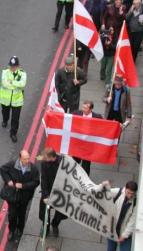
SIOE London demoThat’s how Indymedia reported the Stop the Islamisation of Europe (SIOE) “Stop Kuffarphobia” demonstration in London yesterday. So few people turned up for the protest march from Whitehall Place to Temple tube station that the police refused to allow them to march along the road and insisted that they walk on the pavement.

Strictly speaking, SIOE England is more accurately described as a hard-right anti-Muslim racist – rather than fascist – organisation. And our information is that fully 30 SIOE supporters attended the closing rally at Temple Place to hear SIOE head Stephen Gash (of the tiny English Democrats party) warn against the Islamist plot to impose sharia law on Europe.

Admittedly, the attendance was slightly down on the thousand demonstrators Gash had told the police he was expecting.

It would be easy to mock Gash as a sad little man afflicted by organisational incompetence and delusions of grandeur – and we have no hesitation in doing so. But the humiliating failure of the “Stop Kuffarphobia” demo should not blind us to the fact that, as Soumaya Ghannoushi recently pointed out at Comment is Free, SIOE’s message of anti-Muslim hatred and paranoia has a much wider resonance.

Let people wear cross or veil, says Archbishop

The Archbishop of Canterbury today warns politicians not to interfere with a Muslim woman’s right to wear the veil in public and cautions against a march towards secularism in British society.

In a dramatic intervention Dr Rowan Williams, who is backed by other senior church leaders, said that the Government must not become a “licensing authority” that decides which religious symbols are acceptable.

Writing in The Times he adds that any ban on the veil would be “politically dangerous”. His comments reflect concern within the Church that some members of the Government want to see Britain follow the same route as France, where secularism is close to being a national religion.

“The ideal of a society where no visible public signs of religion would be seen – no crosses round necks, no sidelocks, turbans or veils – is a politically dangerous one,” he writes. “It assumes that what comes first in society is the central political ‘licensing authority’, which has all the resource it needs to create a workable public morality.”

But secularists said that the Archbishop was misguided. Terry Sanderson, of the National Secular Society, said: “The way we are going in this country with the rise of Islam, the churches should look at secularism as their best friend.”

Times, 27 October 2006


Sanderson’s comment is of course entirely in line with the Islamophobic approach of the NSS, who happily formed an alliance with the evangelical Christian right in a campaign against the Racial and Religious Hatred Bill, the primary purpose of which was to defend Muslims against incitement to hatred.

In January 2004, in the NSS Newsline, Sanderson wrote: “Secularism is under sustained threat from a resurgent Islam – and not just in France. In this country, too, it is becoming difficult to even discuss minority religions in critical terms without landing in trouble. We need to resist.”