Muslim students are not being influenced by extremists

“A Guardian Education article sought to attribute the increased participation of Muslim students within the National Union of Students to a rising trend of ‘extremism’ (Adding their voice to the debate, April 4). In the post-7/7 age, it is unfortunate that such accusations are levied at the Muslim community all too easily.

“The allegations stem from the Federation of Student Islamic Societies’ (Fosis) support for the removal of Hizb ut-Tahrir from the NUS’s No-Platform for Racists policy. When the decision to ban Hizb ut-Tahrir was taken in 2004, Muslim students were under-represented in the NUS and there was a lack of proper debate. Many unsubstantiated accusations have been levied against Hizb ut-Tahrir in the past, but in reality the organisation works to advance the Muslim world by engaging in political work. It uses non-violent means and is opposed to terrorism, having condemned the terrorist activities of 9/11 and 7/7. Many Muslims may have disagreements with the organisation, but they unanimously assert that this does not render it extremist; and they defend its right to free speech.”

Wakkas Khan of FOSIS writes in the Guardian, 21 April 2006

No doubt Muslim students’ right to free speech will be high up the agenda when the “March for Free Expression” holds its policy meeting tomorrow in London. Another contribution to this question that the MFE might like to consider is the paper presented last month to the All Party Parliamentary University Group by Abdurrahman Jafar of the MCB (see here and here). Such issues as the disciplining of Nasser Amin for expressing his views on the Palestine-Israel conflict in a SOAS student magazine will of course be of particular concern to these doughty defenders of free speech.
TV skewing Americans’ view of peaceful Islam, Muslim leaders say

American Muslim leaders say they are facing an increasingly tough public relations battle as they fight to portray their faith as non-violent. Some Muslims say conveying a peaceful image of Islam is tougher now than it was after the Sept. 11 attacks, and they blame a daily barrage of negative media images.

Imam Hassan Qazwini heads the largest mosque in the USA, the Islamic Center of America, based in Dearborn, Mich. Qazwini said he and other imams have grown weary of being made to answer for every violent act committed in the name of Mohammed. “This has become a daily nightmare for Muslims,” Qazwini said. “We’re upset. We’re frustrated. We cannot control every Muslim. We cannot be held responsible for everything.”

Qazwini said he is confounded when Islam as a whole is blamed for the actions of individuals, while other religions are not. “How is it that when Pat Robertson calls for the murder of the president of a sovereign country that nobody said Christianity is promoting violence and murder?” Qazwini said, referring to Robertson’s call last August for the assassination Venezuelan President Hugo Chávez.

USA Today, 17 April 2006

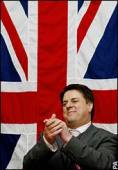
Fascists’ election lies exposed

fascist and flagFascists’ election lies exposed

By Nick West

Tribune, 14 April 2006

The attempted flooding of the London Underground by Islamist terrorists is just one of many lies being peddled by fascist British National Party candidates at the forthcoming local elections. Claiming to have a confidential Metropolitan Police source who revealed the plot to bomb the London tube, the BNP says the threat from Islamic terrorists is far worse than imagined, as its members step up their attempt to demonise the Islamic community.

The party’s publications are decribing the local elections as a “Referendum on Islam” and claiming the government’s “slack” asylum and immigration policies and the war in Iraq are responsible for Islamic terrosrism. A BNP leaflet, distributed only days after the bombings last July, said: “If only they had listened to the BNP”.

This approach has led certain sections of the BNP to hand out copies of the Danish cartoons lampooning the Prophet Mohammed, leading to one BNP canvasser being hospitalised. An even more controversial approach has been taken in Leeds, where the latest edition of the BNP’s Morley Patriot called for the banning of the burka and the removal of Muslims from any job that involves chemicals or electronics. Other tactics have seen BNP canvassers presenting themselves as “old Labour”. A recent BNP leaflet in Sandwell in the West Midlands proudly announced this was “the Labour Party your grandfathers voted for”.

Target areas for the BNP, which is standing a record 357 candidates, are where it has contested previous by-elections, thrown regional or national resources at a campaign and collected voter data. Target councils are Thurrock, Barking and Dagenham, Epping, Bexley, Stoke-on-Trent, Dudley, Oldham, Manchester, Burnley, Bradford, Kirklees, Calderdale and Amber Valley.

Islamaphobia on the rise in schools, teachers warn

Teachers’ leaders have warned of a rising tide of Islamaphobia in schools in the wake of last year’s bomb attacks on London.

Delegates at the National Union of Teachers’ conference in Torquay said that many Muslims felt under increasing pressure from racial intolerance. They also warned that groups such as the British National Party and the National Front had been exploiting the tensions and spreading a message of racial hatred. “We note that such fascist and racist organisations have announced their intention to stand in seats across the country in order to profit from such an atmosphere,” the union said.

Steve Sinnott, the general secretary of the NUT, said the union had had increased incidents of name-calling against Muslim students reported to it. “There have been other instances of a more extreme nature where people have been attacked or spat at because they may appear to be Muslim,” he added. The union has issued guidelines to all members insisting they should tackle racial incidents in schools and make it clear that there is no excuse for racist behaviour.

Independent, 17 April 2006

See also Islam Online, 17 April 2006

US barring of Muslim is still a puzzle

Tariq_RamadanUS government lawyers clarified some mysteries and deepened others in the case of Tariq Ramadan, a Swiss Muslim scholar and leading European theologian of Islam who has been barred by the Bush administration from traveling to the United States since July 2004.

Papers the government presented at a hearing in a US court Thursday in New York revealed that, contrary to officials’ statements, a clause in the USA Patriot Act that bans any foreigner who “endorses or espouses terrorist activity” was not the reason Ramadan’s US visa was revoked. The government said it did not intend to bar Ramadan in the future based on that clause, sometimes called the ideological exclusion provision.

But the government also said Ramadan’s case had been and remained a national security matter, and that statements he made in recent interviews with US consular officials in Switzerland had raised new “serious questions” about whether he should be allowed to come to the United States. Neither the government’s documents nor its lawyer, David Jones, an assistant US attorney, explained why Ramadan was banned or provided any detail about the administration’s new concerns in his case.

The hearing, before Judge Paul Crotty in US District Court in New York, came in a lawsuit by the American Civil Liberties Union on behalf of three academic and writers’ organizations who had invited Ramadan to speak at conferences. The groups claim their constitutional rights have been violated because they cannot meet with Ramadan in the United States.

New York Times, 14 April 2006

See also Islam Online, 14 April 2006

EU lexicon to shun term ‘Islamic terrorism’

The European Union, tiptoeing through a minefield of religious and cultural sensitivities, is discreetly reviewing the language it uses to describe terrorists who claim to act in the name of Islam.

EU officials are working on what they call a “lexicon” for public communication on terrorism and Islam, designed to make clear that there is nothing in the religion to justify outrages like the September 11 attacks or the bombings of Madrid and London. The lexicon would set down guidelines for EU officials and politicians.

“Certainly ‘Islamic terrorism’ is something we will not use … we talk about ‘terrorists who abusively invoke Islam’,” an EU official told Reuters. Other terms being considered by the review include “Islamist”, “fundamentalist” and “jihad”.

The latter, for example, is often used by al Qaeda and some other groups to mean warfare against infidels, but for most Muslims indicates a spiritual struggle. “Jihad means something for you and me, it means something else for a Muslim. Jihad is a perfectly positive concept of trying to fight evil within yourself,” said the official, speaking anonymously because the review is an internal one that is not expected to be made public.

EU counter-terrorism chief Gijs de Vries told Reuters that terrorism was not inherent to any religion, and praised moderate Muslims for opposing attempts to hijack Islam.

“They have been increasingly active in isolating the radicals who abuse Islam for political purposes, and they deserve everyone’s support. And that includes the choice of language that makes clear that we are talking about a murderous fringe that is abusing a religion and does not represent it.”

Reuters, 11 April 2006

This is the sort of thing that reduces Robert Spencer to apoplexy.

Update:  Yes, predictably, Spencer is not pleased, particularly with the stuff about the concept of jihad encompassing spiritual struggle when, as he never ceases to tell us, “the word in the Qur’an is clear, and it means warfare”.

Dhimmi Watch, 11 April 2006

Giraldus Cambrensis also takes exception to the EU position on jihad: “I should here remind readers that the title of Hitler’s book Mein Kampf also meant ‘my struggle’.”

Western Resistance, 11 April 2006