Britain faces ‘the threat of two million home-grown Islamic terrorists’

The Torygraph interviews Dr Bari, secretary-general of the Muslim Council of Britain. The article begins: “Britain could face the threat of two million home-grown Islamic terrorists, says a senior Muslim leader.”

Sunday Telegraph, 10 September 2006

See also Daily Mail, 11 September 2006

Update:  See “Sunday Telegraph’s unfair distortion”, MCB news release, 11 September 2007

TUC General Council statement jointly with the Muslim Council of Britain

The TUC and the Muslim Council of Britain (MCB) have today (Monday) published a joint statement pledging to work together to encourage more Muslims to join trade unions, encourage better community relations and combat Islamophobia, both within workplaces and in society at large.

Commenting on the statement and on his speech to the 138th TUC Congress in Brighton, Secretary General of the MCB, Dr Muhammad Abdul Bari said:

“The MCB and the TUC have a shared belief in justice, equality and opposition to prejudice. We seek to work in partnership with the TUC and through its networks to enhance an awareness of Islam and counter widespread misunderstandings of how the religion relates to modern society. We will also be using our own networks to raise awareness within the Muslim community of the values of union membership and the very important role which unions have in seeking justice and fair treatment in the workplace and in wider society.”

TUC General Secretary Brendan Barber said:

“The TUC looks forward to working with the MCB to encourage more Muslim employees to become union members. Belonging to a union is the best protection an individual can have against prejudice and exploitation at work. We will also be looking at ways of promoting a greater understanding of Islam and to do all we can to combat the hatred currently being stirred up by extremists who are seeking to drive a wedge between the UK’s many communities.”

TUC press release, 11 September 2006

See also MCB press release, 11 September 2006

Maligning Muslims

Yusuf Smith replies to an article by Ben MacIntyre in the Times claiming that, despite the occasional talk of a Muslim “fifth column” in Britain, there has been no scare remotely comparable to those surrounding German spies in the early years of World War II and the “Red Scares” of the 1950s:

“As a Muslim who has been paying close attention to the media since Sept 11, I’d beg to differ that society has moved on much since then. The key difference is that Britain is not facing an invasion from a regular or well-equipped army, as Britain did from Germany or the Spanish Republic did from the Nationalists who first coined the term ‘fifth column’. The situation is more of a small, international criminal syndicate capable only of occasional, but devastating, acts of terrorism. Most British people know, whatever the media is telling them, that most Muslims couldn’t possibly support such a thing.

“While ‘official pronouncements on the threat of Islamic extremism have been deliberately nuanced, and carefully measured’, the same cannot be said for the media treatment of the situation, which has been marked by ignorance and by sensationalism across the board. Newspapers have routinely given space for bigoted and inaccurate articles written by people with an agenda, notably Amir Taheri and Patrick Sookhdeo, who have often used the space to lay into ordinary Muslims, not just the extremists…. the fact is that it has become fashionable, and acceptable, to malign an entire religious community in the press.”

Indigo Jo Blogs, 9 September 2006

Martin Amis on Islamism

martin amis“Until recently it was being said that what we are confronted with, here, is ‘a civil war’ within Islam. That’s what all this was supposed to be: not a clash of civilisations or anything like that, but a civil war within Islam. Well, the civil war appears to be over. And Islamism won it. The loser, moderate Islam, is always deceptively well-represented on the level of the op-ed page and the public debate; elsewhere, it is supine and inaudible. We are not hearing from moderate Islam. Whereas Islamism, as a mover and shaper of world events, is pretty well all there is…. we respect Islam – the donor of countless benefits to mankind, and the possessor of a thrilling history. But Islamism? No, we can hardly be asked to respect a creedal wave that calls for our own elimination…. Islam, in the end, proved responsive to European influence: the influence of Hitler and Stalin. And one hardly needs to labour the similarities between Islamism and the totalitarian cults of the last century. Anti-semitic, anti-liberal, anti-individualist, anti-democratic, and, most crucially, anti-rational, they too were cults of death, death-driven and death-fuelled.”

Martin Amis in the Observer, 10 September 2006

Here, “Islamism” is ignorantly conflated with terrorism. Judging by the article, Amis’s sources of information on this question are Paul Berman’s book Terrorism and Liberalism and Sam Harris’s The End of Faith. Perhaps he should read a little more widely on the subject. He would discover that, to quote Soumaya Ghannoushi, “Islamism, like socialism, is not a uniform entity. It is a colourful sociopolitical phenomenon with many strategies and discourses. This enormously diverse movement ranges from liberal to conservative, from modern to traditional, from moderate to radical, from democratic to theocratic, and from peaceful to violent. What these trends have in common is that they derive their source of legitimacy from Islam….”

Richard Seymour describes Amis’s piece as “an utterly clueless essay that casually asserts this and that idiocy about the West and Islam with evidently no more thought than the average Sun leader writer”.

Update:  See Pankaj Mishra, “The politics of paranoia”, Observer, 17 September 2006

Former Iranian president urges US Muslims to fight Islamophobia

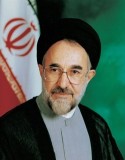
KhatamiIran’s former president decried a wave of “Islamophobia” that he said is being spread in the United States by fear and hatred of Islam in response to terror perpetrated by Muslims. “In the crime of 9/11, two crimes were committed,” Mohammad Khatami said. “One was killing innocent people. The second crime was masking this crime in the name of Islam.”

Under smothering security, with dozens of uniformed police and plainclothes American security personnel provided by the State Department, Khatami spoke Friday night at an event sponsored by the Council on American-Islamic Relations called “The Dialogue of Civilizations: Five Years After 9/11.”

Associated Press, 8 September 2006

See also interview with Mohammad Khatami, Washington Post 5 September 2006

US conservative says right-wing Islamophobes discredit conservatism

“The most repugnant trend in the American shouting match that passes for a debate on the struggle with Islamist terrorism isn’t the irresponsible nonsense on the left – destructive though that is. The really ugly ‘domestic insurgency’ is among right-wing extremists bent on discrediting honorable conservatism. How? By insisting that Islam can never reform, that the violent conquest and subjugation of unbelievers is the faith’s primary agenda – and, when you read between the lines, that all Muslims are evil and subhuman.

“I’ve received no end of e-mails and letters seeking to ‘enlighten’ me about the insidious nature of Islam. Convinced that I’m naive because I defend American Muslims and refuse to ‘see’ that Islam is 100 percent evil, the writers warn that I’m a foolish ‘dhimmi’, blind to the conspiratorial nature of Islam. Web sites list no end of extracts from historical documents and Islamic jurisprudence ‘proving’ that holy war against Christians and Jews is the alpha and omega of the Muslim faith. The message between the lines: Muslims are Untermenschen.”

California Republic, 8 September 2006

Media is warned over its coverage of Islam

The British media needs to be more balanced in its coverage of Islam, according to members of Christian-Muslim dialogue groups.

On the fifth anniversary of the atrocities of 9/11 in New York, suspicion of Islam in the UK is higher than ever, as shown in a recent YouGov poll in which 53 per cent of respondents felt they thought Islam was a threat to Western liberal democracy. Meanwhile 65 per cent of those surveyed said security services should focus anti-terrorism intelligence on Muslims.

Ibrahim Mogra, chair of the interfaith relations committee of the Muslim Council of Britain, said the media in the UK too often presented a distorted view of the religion. He said:

“Not all of the media is bad but some sections present Islam in a very negative way which is not practised by the majority of Muslims in this country. The media should be going out and talking to mainstream and ordinary Muslims and presenting that to the nation, rather than a perverted view. How many Imams have we see on the front pages talking about compassion and love, there are hundreds of them.”

Mr Mogra added that he felt that 9/11 had led to the wars in Afghanistan and Iraq and that the media needed to ask more questions about British foreign policy, which he feels motivated the 7/7 bombers.

Continue reading

The problem with ‘critics of Islam’

“I can accept criticism of my faith and religious beliefs. Muslims do have the moral and intellectual resources, across the religious, political and social spectrum to be able to meet any such challenges that might be posed. Tough questions have been asked in the past and it is no different today…. However, what some critics of Islam engage in is something else altogether. It is not criticism, to which at least Muslims might be able to respond, but an attempt to portray Muslims as Untermenschen. This is especially true of those who set their sights on Europe’s Muslim minorities. Everything, from a lack of housing to rising rape statistics are attributed to the Muslim presence in Europe. If someone commits a crime or struggles at school then the broader questions are asked. If a Muslim does the same, the problems are reduced to the person’s faith (which may only be nominal). If Muslims aren’t terrorists then they’re practising dissimulation.

“The biggest myth pushed by some of these critics is attributing vast political power to Muslim minorities. Laws and policies, foreign and domestic, are said to have been created just to placate the ‘angry hordes’ of Muslims from London to Rome. I notice this delusion is pushed most heavily by the array of pseudo-conservative commentators across the pond, backed up by bigots on this side of the geographic divide. Even the most harshest critic of Islam should stop and think at this point: Can it really be that marginalised, underachieving, politically weak, socially divided sets of communities, who routinely receive negative media coverage (whether this is their fault or not is besides the point), are in a position to influence the agendas of governments that rule some of the most powerful, stable and prosperous nations in the world today? Well, can it be true?

“It is said that violence is a problem Muslims are faced with. Similarly, it could be said that racism is still a problem for Europe, which it has failed to fully address.”

Under Progress, 6 September 2006

Muslims are trying to integrate, despite New Labour’s best efforts

“The latest Government proposals to resolve the problems of extremism by encouraging integration into British society are flawed and disingenuous. Not only are they predicated on a wrong understanding on the sources of extremism, repeating Blair’s view that Muslims have no legitimate grievances against the West, they also are not ultimately geared towards the promotion and enhancement of civic-mindedness amongst Muslims….

“In spite of the actions of New Labour, whose participation in foreign crusades and targeting of the domestic Muslim community has led to the dissatisfaction that we have heard and seen so much of, Muslims have taken a lead role in civil society groups and institutions. Muslims have helped establish and participated in voluntary organisations, anti imperialist associations such as the Stop the War coalition, media monitoring and pressure groups like the Muslim Public Affairs Committee, and charitable bodies which help the needy at home and abroad.”

An interesting and wide-ranging article by Nasser Amin, on the BLINK website, 5 September 2006