Veil hang-ups may pass

“For years I worked in a school where a number of memorable parents wore the niqab, a full veil. These women taught me a lot about Islam. They also challenged my understanding of inclusion. However strange I felt in our first encounters, I now remember their faces with fondness. Aisha Azmi’s tribunal, coming in the wake of Jack Straw’s discomfort over veil-wearing, challenges our society from the top down.

“When government minister Phil Woolas calls for her sacking, saying she ‘can’t do her job’ I have to ask whether he’s taken any time out of publicity-seeking to explore alternatives. If not, can I call for his sacking?

“When Mr Straw clumsily complains that veils make him ‘uncomfortable’, I can’t help but wonder if the key to community relations really is to keep men like him comfy. Would he like us to fetch his slippers as well? … And when the Prime Minister refers to the veil as ‘a mark of separation’, I have to point out that he usually wears a tie. If ever a silly piece of clothing reinforced separatism it’s that absurd, class-bound strip of silk.”

Huw Thomas in the TES, 27 October 2006

Australian media blamed for Islam bias

Australian Federal Police Commissioner Mick Keelty believes the media is fuelling a growing bias against Islamic Australians, warning that increased vilification of Muslims is fomenting home-grown terrorism.

In a speech delivered in Adelaide, Mr Keelty played down Sheik Taj Din al-Hilali’s inflammatory comments on women, asserting that “many in the community also say offensive things and many of them are white Caucasian Australians”.

He said rising vilification of Muslims was being fuelled by irresponsible media outlets which sensationalised terrorism-related stories with little basis in fact. And he called on Australians to teach the values of democracy and multiculturalism to the younger generation so that “our future is not worse than our past”.

Mr Keelty – who clashed with Foreign Minister Alexander Downer in 2004 after the commissioner blamed the suicide attacks on Madrid train system on the war in Iraq – said he met privately with Muslim groups in Adelaide yesterday.

“You hear more and more stories of treatment of the Islamic community that really is substandard by members of our own wider community,” he said at a lunch hosted by the South Australian Press Club. “It is vilification, picking them out of the crowd because they dress differently or they speak differently. If we are not careful we risk raising a generation of Australians who will have a bias against Islam.”

The Australian, 27 October 2006

See also “Australia’s Muslims fear backlash”, BBC News, 26 October 2006

Fascists applaud result of Danish cartoons court case

“Denmark continues to lead in the way in defending the long cherished European concept of free speech after a court ruled yesterday (26th) that a Danish newspaper did not libel Muslims by printing cartoons of the Prophet Mohammed that unleashed a storm of protests in the Islamic world. Seven Danish Muslim organisations brought the case against the Jyllands-Posten, saying the paper had libelled the world’s one billion Muslims with the images, which included one depicting the Prophet with a bomb in his turban, by implying Muslims were terrorists.”

BNP news article, 27 October 2006

Why this fear of Islam?

“It’s fashionable nowadays for Britain’s politicians to complain about immigrants who refuse to assimilate. The more right wing among them infer that the presence of a large Muslim community threatens ‘our way of life’ without going into details as to what that way of life actually entails. Not surprising when Britain has become such an eclectic multiethnic melting pot. There no longer is a stereotypical British way of life other than in the pages of an Agatha Christie or a P.G. Wodehouse novel.

“It’s interesting, too, that those who feel intimidated or threatened in the presence of a woman wearing the veil don’t appear to be concerned by the sight of a nun’s habit, Hassidic garb or side locks, Sikh turbans or the shaved heads and orange robes of Hare Krishna devotees.

“Moreover the current ministerial focus on Muslim assimilation is having the opposite effect. Moderate Muslim leaders resented being told by John Reid, the home secretary, to monitor their children for signs of hate. And reports state that since Jack Straw’s comments on the veil, more and more young women are adopting the niqab in protest – a predictable reaction.

“Indeed, the British government appears to be going out of its way to foment an enemy within in keeping with Blair’s struggle against what he calls an evil ideology. It’s no wonder that British Muslims are beginning to feel demonized and marginalized when their own government calls for mosques, faith schools, community centers and Islamic bookshops to be monitored.

“If British Muslims tend to live in close proximity to one another it isn’t the only community to do so. London’s Stamford Hill was and is more reminiscent of Mea Sharim in Israel than a British city suburb. Brick Lane resembles a corner of Bangladesh while Soho is predominantly Chinese. These ghettoized areas aren’t new. They’ve existed for more than half-a-century in some cases and nobody seemed to mind.

“The governmental message is further having an effect on the attitudes of ordinary people. Reports of Muslim women wearing the hijab being insulted in the streets or suffering the indignity of having their head scarves pulled from their heads are rife. In short, Muslims have become fair game for racists and bigots.”

Linda Heard in iViews, 25 October 2006

‘My years in a habit taught me the paradox of veiling’

Karen Armstrong (3)“I spent seven years of my girlhood heavily veiled – not in a Muslim niqab but in a nun’s habit. We wore voluminous black robes, large rosaries and crucifixes, and an elaborate headdress: you could see a small slice of my face from the front, but from the side I was entirely shielded from view. We must have looked very odd indeed, walking dourly through the colourful carnival of London during the swinging 60s, but nobody ever asked us to exchange our habits for more conventional attire.
“When my order was founded in the 1840s, not long after Catholic emancipation, people were so enraged to see nuns brazenly wearing their habits in the streets that they pelted them with rotten fruit and horse dung. Nuns had been banned from Britain since the Reformation; their return seemed to herald the resurgence of barbarism. Two hundred and fifty years after the gunpowder plot, Catholicism was still feared as unassimilable, irredeemably alien to the British ethos, fanatically opposed to democracy and freedom, and a fifth column allied to dangerous enemies abroad.

“Today the veiled Muslim woman appears to symbolise the perceived Islamic threat, as nuns once epitomised the evils of popery.”

Karen Armstrong in the Guardian, 26 October 2006

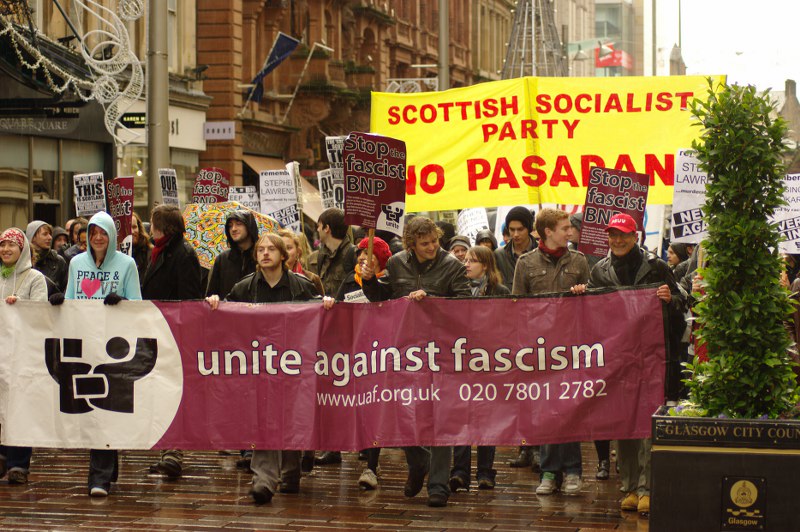
Unite against Islamophobia in Glasgow

Glasgow demoAround 300 people rallied in Glasgow’s George Square last Saturday to unite against Islamophobia and protest at the wave of racist attacks on Muslims since Jack Straw’s comments about the veil earlier this month.
Glasgow Stop the War Coalition and the Muslim Association of Britain organised the protest at short notice following a brutal assault on an imam at a Glasgow mosque.

It attracted a broad turnout, including many young Muslim women and families. Syma Ismail and her friend Nailah Din are students at Dundee University who had travelled down for the protest. “We’re standing against Islamophobia,” said Nailah. “Jack Straw started this. We’re supposed to have freedom of speech and freedom of expression. If Muslim women want to wear the veil, why shouldn’t they be allowed to?”

Many non-Muslims were also at the rally to show solidarity. “The issue is racism,” said Barrie Levine from Scottish Jews for a Just Peace. “It is important that Muslims and non-Muslims stand shoulder to shoulder against Islamophobia.”

Socialist Worker, 28 October 2006

Birmingham University dons apologised to the Muslim students who were elected to the students union but prevented from taking office. The 1990 Trust were among those supporting the campaign.

The majority of students voted into leadership positions in 2004 were victims of religious discrimination after the university annulled the vote. All 14 Muslims students were accused of benefiting from election fraud, allegations the university now admit were untrue.

The university made the apology as part of a legal settlement. The higher education institution accepted that there had been no slating or intimidation ahead of the vote.

Continue reading

Birmingham University apologises to Muslim students

Birmingham University dons apologised to the Muslim students who were elected to the students union but prevented from taking office. The 1990 Trust were among those supporting the campaign.

The majority of students voted into leadership positions in 2004 were victims of religious discrimination after the university annulled the vote. All 14 Muslims students were accused of benefiting from election fraud, allegations the university now admit were untrue.

The university made the apology as part of a legal settlement. The higher education institution accepted that there had been no slating or intimidation ahead of the vote.

Continue reading

From demonisation to empowerment

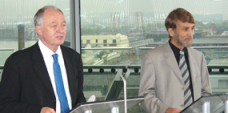
Livingstone and Bari“A bold attempt to shift the ‘Muslim debate’ away from media demonisation was made today. The London Mayor Ken Livingstone launched a new report aimed at dismantling barriers of discrimination faced by Muslims. Standing alongside Dr Muhammad Bari, leader of the Muslim Council of Britain, Livingstone attacked the ‘breathtaking verbiage’ being pumped out daily by the national press.

“The report made grim reading. Muslims suffer the worst education failure rates, huge barriers to employment, bad housing and chronic political under-representation. Livingstone said the real problem was not Muslims wanting to be separate, but instead unprecedented levels of discrimination preventing them from getting on in society.”

BLINK news report, 24 October 2006

See also Guardian, 24 October 2006 and  GLA press release, 24 October 2006