
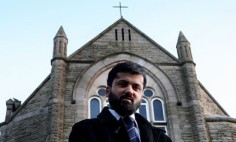
The ‘clash of civilisations’ comes to Clitheroe

Clitheroe mosqueCLITHEROE, England – On a chilly night this winter, this pristine town in some of most Britain’s untouched countryside voted to allow a former Christian church to become a mosque.

The narrow vote by the municipal authorities marked the end of a bitter struggle by the tiny Muslim population to establish a place of worship, one that will put a mosque in an imposing stone Methodist church that had been used as a factory since its congregation dwindled away 40 years ago.

In Clitheroe, the tussle involved a passionate young professional of Pakistani descent coming up against the raw nerves of tradition-bound local residents. “We’ve been trying to get a place of worship for 30 years,” said Sheraz Arshad, 31, the Muslim leader here, his voice rattling around the empty old Mount Zion Methodist Church that will house his mosque.

In all, Mr Arshad and his father made eight applications for a mosque, and even proposed buying a modest terrace house on the edge of town to be used for worship. Mr Arshad said he tried to buy land from the council but was rebuffed. Often there was booing at council meetings, and, he said, cries of “Go home, Paki!”

The authorities’ official reasoning for the rejections was generally that a mosque would attract outsiders – a veiled reference to Muslims – to Clitheroe. Letters to the local newspaper, The Clitheroe Advertiser and Times, warned that what had happened in Blackburn and Preston, two bigger nearby industrial towns with substantial Muslim populations, would happen to Clitheroe.

But the fight is hardly over. Beneath the official vote lies a river of resentment among those who fear that the broader patterns in Britain will emerge here. In one sign of the tensions, some of the church’s windows have been smashed.

In the nearby town of Kendal, an Anglican vicar, Alan Billings, has written a book, “Secular Lives, Sacred Hearts: The Role of the Church in a Time of No Religion.” He says the growing opposition to new mosques among the white population reflects an anxiety in Britain that has become more exposed since the London suicide bombings in July 2005.

“Often it’s expressed as low objections, more cars, more people,” said Mr Billings, who is also a frequent contributor to the BBC’s religious programs. “But it is really a deeper anxiety about what is happening in society. It is the fear of what will happen to the culture and feel of Britain.”

At a Saturday gathering of about 50 believers, almost all of them white-haired, Mr Billings warned that the church was under pressure. Islam could now be seen as an alternative to Christianity, he said.

New York Times, 2 April 2007

Yusuf Islam’s manager refutes ‘veil’ allegations

Yusuf Islam’s manager Marc Marot has refuted allegations that his client refused to speak to non-veiled women at the Echo Awards in Germany on the night of Sunday 25 March as reported by some media. He describes the allegations surfacing on the internet as “baseless and stupid” – especially as millions of people have seen Yusuf being interviewed by women on television during the course of the last decade.

Yusuf Islam (formerly known as Cat Stevens) received the prestigious Lifetime Achievement award at the German “Echo” awards for his “lifework as a musician and as an ambassador between cultures” at the ceremony which was recorded in Berlin and broadcast on RTL that evening. He also performed his single “Maybe There’s A World”.

Marot says: “The accusation that Yusuf doesn’t speak or interact with women who are not veiled is an absurdity. He plainly has no issues with working and interacting with women and did so in a perfectly normal manner over the awards weekend, even signing autographs and posing for photographs with many of the legion of men and women who had queued for hours at both the airport and hotel.

“In his normal daily life women feature amongst some of the most influential people in his core team, including the joint President of US record label: Atlantic records, the marketing directors of both Polydor and Atlantic records, his set designer, his TV promotions manager and his video commissioner, all of whom are in almost daily contact with Yusuf. At the moment he’s in a London edit suite with BBC TV director Janet Fraser Crook and producer Serena Cross working on the edit of the BBC Sessions concert recently filmed in London. These are not the actions of a misogynist.

“It would seem that certain sections of the media feel that for every good news story featuring a Muslim, a balancing bad news story must be invented to maintain the level of ignorance that surrounds the Islamic faith.”

PR Newswire, 2 April 2007

Hicks case exposes ‘war on terror’ sham

“After five years of solitary confinement in a small metal cell, David Hicks pleaded guilty on March 26 to one of the two charges brought against him by US military prosecutors on March 1, to finally get out of the notoriously brutal US military prison at Guantanamo Bay. Hicks’s case has revealed just what a sham the US-led ‘war on terror’ really is.

“For five years Washington, backed to the hilt by Canberra, has claimed that Hicks was one of the most dangerous ‘terrorists’ being held at Guantanamo. He was charged with offences that carrying life sentences. Now, under the plea bargaining deal, his US military prosecutors are talking about him being able to be ‘home before the end the year’. Indeed, on March 31, Hicks was sentenced to seven years’ imprisonment, with all but nine months of the sentence suspended. He will serve most of this in an Australian civilian prison.”

Green Left Weekly, 30 March 2007

Call that humiliation?

“I share the outrage expressed in the British press over the treatment of our naval personnel accused by Iran of illegally entering their waters. It is a disgrace. We would never dream of treating captives like this – allowing them to smoke cigarettes, for example, even though it has been proven that smoking kills. And as for compelling poor servicewoman Faye Turney to wear a black headscarf, and then allowing the picture to be posted around the world – have the Iranians no concept of civilised behaviour? For God’s sake, what’s wrong with putting a bag over her head? That’s what we do with the Muslims we capture: we put bags over their heads, so it’s hard to breathe. Then it’s perfectly acceptable to take photographs of them and circulate them to the press because the captives can’t be recognised and humiliated in the way these unfortunate British service people are.”

Terry Jones in the Guardian, 31 March 2007

Don’t confuse terrorism with Islam, says EU

The European Union has drawn up guidelines advising government spokesmen to refrain from linking Islam and terrorism in their statements. Brussels officials have confirmed the existence of a classified handbook which offers “non-offensive” phrases to use when announcing anti-terrorist operations or dealing with terrorist attacks. Banned terms are said to include “jihad”, “Islamic” or “fundamentalist”.

The word “jihad” is to be avoided altogether, according to some sources, because for Muslims the word can mean a personal struggle to live a moral life. One alternative, suggested publicly last year, is for the term “Islamic terrorism” to be replaced by “terrorists who abusively invoke Islam”. An EU official said that the secret guidebook, or, “common lexicon”, is aimed at preventing the distortion of the Muslim faith and the alienation of Muslims in Europe.

Conservative MEP Syed Kamall hit out at the lexicon. “It is this kind of political correctness and secrecy that creates resentment among both the mainstream in Europe and in Islam,” he said. Meanwhile, UK Independence Party MEP Gerard Batten claimed that the EU was in denial over the true roots of terrorism. “This type of newspeak shows that the EU refuses to face reality,” he said. “The major world terrorist threat is one posed by ideology and that ideology is inspired by fundamentalist jihadi Islam.”

Daily Telegraph, 30 March 2007

UN Human Rights Council concerned over stigmatising Muslim, Arab minorities

The Human Rights Council adopted a resolution Friday that expressed concern at laws or administrative measures specifically designed to “control” and “monitor” Muslim and Arab minorities, thereby stigmatizing them further and legitimating the discrimination they experienced. The resolution was passed with 24 votees for, 14 against, and 9 abstentions. The council also expressed deep concern over attempts to identify Islam with terrorism, violence and human rights violations.

Kuwait News Agency, 30 March 2007

School assistant loses veil appeal

A Muslim teaching assistant has lost her appeal against an employment tribunal’s decision that not being allowed to wear a veil in the classroom was not discrimination.

Aishah Azmi, 24, was suspended on full pay after staff at Headfield Church of England junior school in Dewsbury, West Yorkshire, said pupils found it harder to understand her. A Leeds employment tribunal dismissed three of Mrs Azmi’s claims of discrimination and harassment, but found that she was victimised and awarded her £1,000 for “injury to feelings”. A month later, the local education authority sacked her from her post as a bilingual support worker. Mrs Azmi, of Thornhill Lees, Dewsbury, said she was willing to remove her veil in front of children but not when male colleagues were present.

Her lawyer Nick Whittingham said: “The EAT (Employment Appeal Tribunal) has not upheld the appeal.” But Mr Whittingham, of the Kirklees Law Centre, said the EAT accepted that it was possible for direct discrimination to occur in respect of a manifestation of a religious belief such as the wearing of the veil. He said it was an “important test case”.

Press Association, 30 March 2007

Stop bigots, voters urged

Voters have been urged by religious leaders to use the ballot box to help tackle racism. Representatives from the Christian, Muslim, Hindu and Jewish communities signed a declaration asking Greater Manchester people to reject all political parties that advocate racism in May’s local elections. The document was signed at Trinity United Church in Cheetham Hill Road, Manchester, which is used as drop-in centre for refugees and asylum seekers.

The statement reads: “We stand for a society of mutual respect and care where the hearts of all are heard and met through good neighbourliness at every level and in every circumstance. In particular, we regret that the British National Party now has 49 seats on local authorities in this country. Those who advocate racist policies cannot do so in the name of any of our faith communities.”

The community leaders were inspired by the similarities of their different faiths when they devised the statement. Dr Muhammad Junejo, Muslim representative for Greater Manchester, said: “We meet fairly regularly to discuss the important issues affecting our communities. One thing our religions all have in common is the commandment to love your neighbour. Racism is strongly at odds with this idea and we need to stand against it.”

Manchester Evening News, 29 March 2007