

Trial under way in Muslim charity case

Holy_Land_FoundationDALLAS — A group that was once the nation’s largest Muslim charity went on trial on terrorism-support charges Tuesday, with federal prosecutors saying it hoped to destroy Israel and the defense claiming leaders sought advice on staying true to their humanitarian mission.

The trial of the Holy Land Foundation for Relief and Development is expected to last several months and caps an FBI investigation that lasted more than a decade. The organization and five of its top officials are charged with aiding terrorists, conspiracy and money laundering.

Prosecutor James T. Jacks said in his opening statement that the foundation was created to raise money for the Palestinian militant group Hamas. The charity’s leaders lied about their purpose “because to tell the truth is to reveal what they were all about – the destruction of the state of Israel and replacing it with a Palestinian Islamic state,” he said. Some of the money went to support the families of suicide bombers, according to authorities.

Defense attorneys say Holy Land supported humanitarian efforts in Palestinian neighborhoods and did not knowingly aid Hamas. “Holy Land had nothing to do with politics. Its focus was on children in need,” Nancy Hollander, lawyer for Holy Land chief executive Shukri Abu Baker, said in her opening statement.
Associated Press, 24 July 2007

Muslim workers at Nebraska meatpacking plant suffer religious harassment

OMAHA, Neb. —  Supervisors at a meatpacking plant have fired or harassed dozens of Somali Muslim employees for trying to pray at sunset, violating civil rights laws, the workers and their advocates say. The five- to 10-minute prayer, known as the maghrib, must be done within a 45-minute window around sunset, according to Muslim rules. The workers at the Swift & Co. plant in Grand Island say they quit, were fired or were verbally and physically harassed over the issue.

The Council on American-Islamic Relations has drafted a complaint to be filed with the federal Equal Employment Opportunity Commission. The petition compiles testimony from at least 44 workers.

Jama Mohamed, 28, said he was fired in June for leaving a production line to pray. Supervisors would not allow him a break, he said. “Some of them took the (prayer) mat from me; they started shouting, they started telling me to stop it, and one of them grabbed me by the collar of my shirt,” Mohamed said through an interpreter. Mohamed said he was then called to an office, where a supervisor fired him.

Associated Press, 22 July 2007

Middle East myopia

“The Middle East is at the heart of world politics, a strategically sensitive region plagued by much unrest, war, and a never-ending chain of foreign interventions. That it should be the subject of ongoing comment, analysis and argument is understandable. Yet a cursory look at what gets said and written about it reveals a worrying pattern of simplification, generalisation and reductionism.

“Nowhere is this trio more manifest than in analyses of the region’s intellectual and political map. This is largely read through an arsenal of readymade terms and concepts – ‘terrorism’, ‘fundamentalism’, ‘extremism’, ‘Islamism’, and all the other ‘isms’ – legitimised by a daily staple of images of shouting mobs, angry bearded men, burning books and pairs of terrified eyes peering from behind black veils.

“The trouble is that the terms through which we approach this complex landscape perpetuate a state of ignorance; misleading instead of guiding, and distorting instead of explaining. What they paint is a desert of intellectual aridity and a swamp of political stagnation. The Middle East thus appears as a sea of ‘fundamentalist’ darkness, with a few glimmers of ‘secular’ enlightenment, a shrinking ‘liberal’ minority besieged by an ever-expanding ‘Islamist’ majority.”

Soumaya Ghannoushi at Comment is Free, 23 July 2007

Victim of US bloggers’ cartoon hits back

Shakeel BhatWith his clenched fists, wild eyes and gnashing teeth he has become the face of Muslim fury, protesting against the enemies of Islam. Shakeel Ahmad Bhat has been on the frontline of political activism in Srinagar, India, for more than a decade. His constant presence, captured by photographers and beamed across the world, has caught the imagination of rightwing bloggers who have dubbed him Islamic Rage Boy and turned him into an internet phenomenon.
But the 30-year-old Kashmiri activist is puzzled, not angered, by his overseas fame. In his first interview with a British newspaper, he says he is carrying out Allah’s wishes. From his home in Fateh Kadal, Malik Angan, he says: “I am not happy with people joking about me or making me into a cartoon, but I have more important things to think about. My protests are for those Muslims who cannot go out onto the streets to cry out against injustice. This is my duty and I believe Allah has decided this for me.”

A spokesman for the Council on American-Islamic Relations, Ibrahim Hooper, says: “I find the term Islamic Rage Boy offensive, as would anyone who applied the term to their own faith. It’s an Islamophobic product by Muslim-bashers on internet hate sites.” He compares the cartoon to the anti-semitic imagery of 1930s Nazi Germany. “The cartoon is part of an overall growth of anti-Muslim rhetoric in this country. Someone is trying to link Islam with violence and anger and profiting from it.”

He quotes a recent Newsweek poll, which paints a complicated portrait of US attitudes towards Muslims: 63% of Americans surveyed believe most Muslims do not condone violence and 40% believe the Koran does not condone violence, but 28% believe it does and 41% felt Muslim culture glorifies suicide. Mr Hooper says: “While the majority is not hostile towards Muslims, there is a minority who are, and cartoons like this do not help. You cannot combat one form of extremism with another.”

Guardian, 23 July 2007

Salmond response to airport attack ‘boost for radical Islam’ says academic

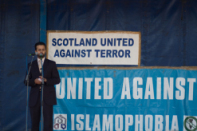
Scotland UnitedAlex Salmond has boosted the cause of radical Islam in Scotland in his response to the Glasgow Airport attack, a leading Scots academic on religious affairs has claimed.

In a fiercely controversial commentary, Tom Gallagher, the chair of Peace Studies at Bradford University, said that Salmond had courted “radical voices” in the Muslim community following the attempted bombings, lending them a false layer of legitimacy. He also accuses Salmond of deliberately setting out to exploit the attack to win favour with Muslims in Scotland, comparing the First Minister’s style at one point to former Egyptian dictator Gamal Abdel Nasser.

The comments triggered a furious backlash last night, with claims they amounted to Islamophobia. Salmond’s aides meanwhile described them as “ridiculous”.

Gallagher’s attack, published on the website Open Democracy, was aimed primarily at the Scottish leader of the Muslim Association of Britain, Osama Saeed, who was also an SNP candidate in this year’s Scottish elections. Saeed was among the most prominent figures to speak for the Muslim community following the bombings, which he unreservedly condemned. However, Gallagher accuses Saeed of being an “unapologetic advocate of the hardline Islamism” and accuses him of deceiving Scots following the attack by hiding his real agenda. He attacks Salmond for giving Saeed a platform.

He said: “The Muslim community has been done a great disservice by the SNP which has courted the more radical voices in the community and the result is that it will alter the balance of power in the Muslim community. I’m all for Muslims playing a full role in Scottish life but I think we need to do all we can to question those who just want Muslims to be oppositional and to have international loyalties.”

Saeed has now accused Gallagher of Islamophobia, saying there was no basis for the academic’s attack. He added: “What he is arguing is that everyone who believes in Islam needs to have some kind of witch-hunt placed over them.”

Scotland on Sunday, 22 July 2007


Predictably, Gallagher finds support at the virulently anti-Muslim US website Jihad Watch.

For Osama Saeed’s comments, see Rolled Up Trousers, 22 July 2007

An inability to tolerate Islam contradicts western values

“For Muslims to protest against the Danish cartoonists’ depiction of the prophet as a terrorist, while carrying placards that threatened another 7/7 atrocity on London, represented a nihilistic failure of integrity. But equally the cartoonists and their publishers, who seemed impervious to Muslim sensibilities, failed to live up to their own liberal values, since the principle of free speech implies respect for the opinions of others. Islamophobia should be as unacceptable as any other form of prejudice.

“When 255,000 members of the so-called ‘Christian community’ signed a petition to prevent the building of a large mosque in Abbey Mills, east London, they sent a grim message to the Muslim world: western freedom of worship did not, apparently, apply to Islam. There were similar protests by some in the Jewish community, who, as Seth Freedman pointed out in his Commentisfree piece, should be the first to protest against discrimination.”

Karen Armstrong in the Guardian, 21 July 2007