
Sandra Dick interviews Sohaib Saeed and other Scottish Muslims at the Edinburgh Central Mosque, which was accused of distributing hate literature by the notorious Policy Exchange report.
Category Archives: Resisting Islamophobia
An attack on liberty
The case of the “Lyrical Terrorist” shows how far our freedom has been eroded by recent legislation, argues Inayat Bunglawala. He writes:
“There would appear to be something preposterously wrong with our criminal justice system if nearly five years after the Iraq war was launched and hundreds of thousands of wholly unnecessary deaths later, Tony Blair is able to just walk away from his responsibility for the ongoing carnage and unbelievably emerge as a Peace Envoy to the region, while a foolish young woman who did not harm anyone now faces a maximum 10-year term in prison for what can only be described as a thought crime.”
‘Thought crime has come to Britain’
“Thought crime has come to Britain. We knew that in principle, as wave after wave of legislation has pushed the scope of anti-terror laws from deeds and plans to words. The case of Samina Malik, the Heathrow airport worker and jihadi fantasist convicted on Thursday under the Terrorism Act, confirms it beyond reasonable doubt.”
Boyd Tonkin in the Independent, 12 November 2007
Tonkin draws attention to the existence “an inflammatory anthem crammed with sanguinary images of ‘scarlet standards’ and the ‘martyred dead’, sung by a British political conspiracy once dedicated to overturning the entire economic order of society. After a spine-chilling evocation of ‘martyrs’ who died in ideological battle, the sinister ditty (‘The Red Flag’) explains why this movement’s symbol is ‘deepest red’: ‘ere their limbs grew stiff and cold/ Their hearts’ blood dyed its every fold’. Truly chilling stuff. Surely, the leader of an organisation who sanctioned the singing of such a grotesque hymn to sacrificial death should at least have his hard drive examined by our Thought Police?”
UK terror tactics ‘create unease’
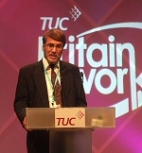 The head of the Muslim Council of Britain has said the government’s approach to terrorism is creating an atmosphere of suspicion and unease.
In a wide-ranging interview with the Daily Telegraph, Muhammad Abdul Bari said the amount of discussion relating to Muslims was disproportionate. He cited Nazi Germany in the 1930s as an example of how people’s minds could be poisoned against a whole community.
Dr Bari also called for more emphasis on positive aspects of Muslim culture. Scaring the community “If your community is perceived in a very negative manner, and poll after poll says that we are alienated, then Muslims begin to feel very vulnerable,” he said. “We are seen as creating problems, not as bringing anything and that is not good for society.”
Update: See “Comparisions with the 1930s”, MCB press release, 15 November 2007
The MCB points out that Dr Bari said nothing about Nazi Germany in his interview. This was an interpolation by the Telegraph.
Potterrow mosque in terror row
Muslim student leaders have condemned a report published last week which insinuated links between an Edinburgh mosque and hate-literature. The Federation of Student Islamic Societies (FOSIS) branded the report by the right of centre think tank The Policy Exchange as a “PR stunt” which could undermine ongoing efforts to advance interfaith dialogue and community cohesion across Edinburgh.
The report was published after a culmination of a year-long project in which researchers visited 100 mosques across Britain. It claimed that a pamphlet found at the Islamic Centre of Edinburgh, which is linked to the Edinburgh Central Mosque on Potterrow, advocated the killing of Muslims who have turned their back on their religion.
Faisal Hanjra, spokesman for FOSIS condemned the think tank’s report stating: “The Policy Exchange document does nothing more than present single sentences, from often large documents, out of context. The report also fails to adequately define the term ‘extremist literature’ instead applying this label to anything outside of the authors’ own personal realm of social acceptability. Finally, the report arrives at the illogical conclusion that this literature is in part responsible for terrorism, something not supported by the actual contents of the report.”
The Islamic Centre of Edinburgh refused to comment on the allegations but a senior source branded the report as a “smear campaign” which damaged the reputation of the Edinburgh Mosque, widely renowned as being at the forefront of building bridges between the Muslim community and the wider British society. Secular schemes run at the Centre such as the Mosque Kitchen are particularly popular with students.
Hairdresser sued over Muslim headscarf ban
 A hair salon owner is being sued for religious discrimination after refusing a Muslim teenager a job as a stylist because she wore a headscarf.
Sarah Desrosiers said she refused 19-year-old Bushra Noah the position because it was an “absolutely basic” requirement that customers could see their stylist’s hair. The 32-year-old, whose “alternative” salon in London specialises in “urban, funky punky” cuts, has already spent £1,000 fighting the case. Miss Noah wants £15,000 for injury to her feelings plus an unspecified amount for lost earnings. She maintains that her headscarf is an integral part of her religious beliefs.
Miss Desrosiers, who denies any discrimination, said: “The essence of my line of work is the display of hair. To me, it’s absolutely basic that people should be able to see the stylist’s hair. It has nothing to do with religion. It is just unfortunate that for her covering her hair symbolises religion.”
Daily Telegraph, 9 November 2007
See also Evening Standard, 8 November 2007
Defend Aamer Anwar – public meeting
Aamer Anwar and Asif Siddique (brother of Mohammed Atif Siddique) will be speaking at a public meeting on Tuesday 13 November
7.30 pm, Mitchell Theatre, Granville Street, Glasgow
Other speakers include Alasdair Gray (author), Doug Jewell (CAMPACC), Carlo Morelli (UCU), Noman Tahir (IWitness), Jonathan Shafi (Glasgow Stop The War Coalition)
Admission Free – All welcome. Doors open 7pm
Sponsored by SACC and Glasgow Stop The War Coalition
LAPD to build data on Muslim areas
An extensive mapping program launched by the LAPD’s anti-terrorism bureau to identify Muslim enclaves across the city sparked outrage Thursday from some Islamic groups and civil libertarians, who denounced the effort as an exercise in racial and religious profiling.
Los Angeles Police Department Deputy Chief Michael P. Downing, who heads the bureau, defended the undertaking as a way to help Muslim communities avoid the influence of those who would radicalize Islamic residents and advocate “violent, ideologically-based extremism.”
“We certainly reject this idea completely,” said Shakeel Syed, executive director of the Islamic Shura Council of Southern California. “This stems basically from this presumption that there is homogenized Muslim terrorism that exists among us.” Syed said he is a member of Police Chief William J. Bratton’s forum of religious advisors, but had not been told of the community mapping program. “This came as a jolt to me,” Syed said.
Hussam Ayloush, who leads the Los Angeles chapter of the Council on American-Islamic Relations, said the mapping “basically turns the LAPD officers into religious political analysts, while their role is to fight crime and enforce the laws.”
Los Angeles Times, 9 November 2007
See also Associated Press, 9 November 2007
A pointless attack on liberty that fuels the terror threat
Ministers set on locking people up without charge should listen to the Muslim mainstream, not the neocon fringe, argues Seumas Milne.
Terror detention ‘a kind of modern torture’
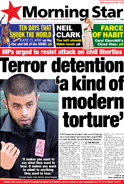 Terror detention ‘a kind of modern torture’
By Tom Mellen
Morning Star, 8 November 2007
TWO innocent brothers who were locked up for a week under anti-terror laws urged MPs to resist the attack on civil liberties on Wednesday. In a passionate appeal to backbenchers, they described government plans to double the amount of time suspects can be detained as amounting to “modernised torture.”
Mohammed Abdul Kahar, who was shot in the chest during the infamous Forest Gate raid in June last year, urged MPs not to back plans to extend the maximum amount of time that terror suspects can be held from 28 to 58 days. Giving evidence to the home affairs select committee, Mr Kahar told them: “If you give the police more time, they do everything slower. It is just prolonging the time, it’s more modernised torture,” he warned.
His brother Abul Koyair said of his seven days of questioning in Paddington Green high-security police station in west London: “It makes you want to admit to anything they want to hear.”
Mr Kahar said that he did not regard Britain differently after his experiences but he had lost faith in the police. “The police have a difficult job, but they are putting innocent people’s lives at risk. It’s not only Muslims,” Mr Kahar said, noting that Jean Charles de Menezes wasn’t a Muslim. The threat is not only to Muslims – it’s a threat to the whole public.”
Mr Kahar warned that, “if I wasn’t as strong as I was, I could have been turned against this country. I have so much hatred towards the system, someone else could have used it in a bad way.”