

Hijab and soccer: another red card

Safaa MenhamThe family of a 14-year-old girl is demanding an apology from a referee who refused to allow her to play indoor soccer while wearing a religious head scarf. But the head of referee development for Alberta’s governing soccer body says wearing hijabs can pose a threat to player safety.

Safaa Menhem arrived late in the first half of her game with the Chinook Phantom under-16 girls team at the Calgary Soccer Centre Saturday. After her first shift in the game, the referee told the coach she couldn’t play if she wore her hijab.

At half time, the rest of the team – with the support of parents in the stands – threatened to forfeit the game in protest, but Menhem urged them to keep playing. “She walked off the field with her head down in tears thinking she’d done something wrong, which she hadn’t,” said her eldest brother Hekmet Menhem, 27, who may face disciplinary action for confronting the referee on the field. “The look I saw on her face when she came off killed me. That’s when I snapped.”
Montreal Gazette, 25 November 2007

It is proper to challenge Islam, but not to demonise Muslims

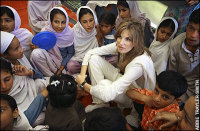
Jemima Khan“I recently attended a debate entitled ‘Is Islam good for London? … It wasn’t just me who found the title, tone and content of the debate disturbing. The liberal rabbi, Pete Tobias, described it as a ‘damaging and hurtful exercise’, sinisterly reminiscent of the campaign a century ago to alert the population to ‘the Problem of the Alien’ – namely the Eastern Jews fleeing persecution who had found refuge in the capital.
“My view is that it was symptomatic of a much wider and deeper hostility to Islam and, contrary to the claims of the panellists, to Muslims too…. On the subject of Muslims, liberal intellectuals like Amis find themselves uncomfortably in bed with the neocons. They even sound alike. British Muslims that I know feel overwhelmed in the face of such hostility.

“… although Muslims increasingly feel like a demonised minority, even by liberals, it is also true that Islam is an ideology. As such it must expect to be challenged in an open society, no matter how uncomfortable or personal that debate becomes…. But it would help greatly if critics of Islam would give as much attention to the moderate Muslims engaged in that vital internal debate as they do to the hook-handed, effigy-burning few.”

Jemima Khan in the Sunday Telegraph, 25 November 2007

Tories accused of ‘bare-faced lies’ over schools’ HT links

A political row has broken out over claims public money was given to two schools which, the Tories say, have links to Islamist group Hizb ut-Tahrir. Tory leader David Cameron suggested money from an “anti-extremist fund” had been given to “extremists”. But Schools Secretary Ed Balls accused the Conservatives of “playing politics” and making “untrue” allegations. Hizb ut-Tahrir said it did not run any school and accused Mr Cameron of “bare-faced lies”.

BBC News, 25 November 2009

See also Hizb ut-Tahrir press release, 25 November 2009 and “Tories admit David Cameron Islamic schools claim ‘had mistakes'”, Times, 26 November 2009

Amis and McEwan – reinforcing stereotypes

Letter in today’s Guardian:

“Ian McEwan’s defence of his friend Martin Amis (Letters, November 21) rests on two arguments, which are conflated. The first is the freedom of speech argument. But just because one has the right to express an opinion does not mean it is right to express it. In any case, Ronan Bennett’s article (G2, November 19) did not argue that one should not criticise Islam or Muslims per se; rather, it was the manner of the criticism – sweeping generalisations and stereotypes, holding all Muslims responsible for the opinions and actions of just some – that he found objectionable, and rightly so…. McEwan’s logic would have us believe that a non-religious or secularised Muslim is an impossibility for fear of the repercussions – an Orwellian vision of a totalitarian Islam that is itself a stereotype. In defending his friend, he merely confirms that both of them do not really know what they are talking about.”

Dr Anshuman Mondal
Brunel University

The politics of the veil

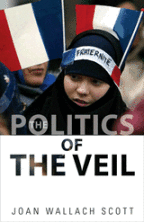
Politics of the Veil“‘A kind of aggression’. ‘successor to the Berlin Wall’. ‘lever in the long power struggle between democratic values and fundamentalism’. ‘An insult to education’. ‘A terrorist operation’. These descriptions – by former French President Jacques Chirac; economist Jacques Attali; and philosophers Bernard-Henri Lévy, Alain Finkielkraut and André Glucksmann – do not refer to the next great menace to human civilization but rather to the Muslim woman’s headscarf, which covers the hair and neck, or, as it is known in France, the foulard islamique.”

Laila Lalami reviews Joan Wallach Scott’s recently published book The Politics of the Veil.

The Nation, 21 November 2007

Amis and McEwan – reinforcing stereotypes

Letter in today’s Guardian, by Dr Anshuman Mondal of Brunel University:

“Ian McEwan’s defence of his friend Martin Amis (Letters, November 21) rests on two arguments, which are conflated. The first is the freedom of speech argument. But just because one has the right to express an opinion does not mean it is right to express it. In any case, Ronan Bennett’s article (G2, November 19) did not argue that one should not criticise Islam or Muslims per se; rather, it was the manner of the criticism – sweeping generalisations and stereotypes, holding all Muslims responsible for the opinions and actions of just some – that he found objectionable, and rightly so…. McEwan’s logic would have us believe that a non-religious or secularised Muslim is an impossibility for fear of the repercussions – an Orwellian vision of a totalitarian Islam that is itself a stereotype. In defending his friend, he merely confirms that both of them do not really know what they are talking about.”

Islamophobia and the media: no common ground with Brendan O’Neill

“As someone who recently defended media freedom in spiked and is co-chair of the Campaign for Press and Broadcasting Freedom, I was somewhat taken aback to find Brendan O’Neill last week including me (albeit implicitly) amongst the ranks of those mounting ‘an intolerable attack on media freedom’, wanting to ‘turn the press into an offshoot of Ken Livingstone’s political fiefdom’ and making ‘explicit demands for increased government intervention in the press’.”

Julian Petley, one of the contributors to The Search for Common Ground: Muslims, non-Muslims and the UK Media, replies to O’Neill’s piece “London’s PC despot“.

Spiked, 22 November 2007