

‘We need a thoughtful discourse, not hysterical discord’ says MCB

MCB bannerThe Muslim Council of Britain is grateful for the thoughtful intervention of the Archbishop of Canterbury on the discussion of the place of Islam and Muslims in Britain today.

The MCB observes, with some sadness, the hysterical misrepresentations of his speech which serves only to drive a wedge between British people.

“The Archbishop is not advocating implementation of the Islamic penal system in Britain. His recommendation is confined to the civil system of Shariah Law and that only in accordance with English law and agreeable to established notions of human rights”, said Dr Muhammad Abdul Bari, Secretary General of the MCB.

British Muslims are not calling for creation of different legal systems, nor is the Archbishop. We do not wish to see a parallel system or a separate system of judiciary for Muslims. The Archbishop sought in his speech to explore the possibilities of an accommodation between English law and some aspects of Islamic personal law.

British Muslims would wish to seek parity with other faiths in particular the followers of the Jewish faith in the United Kingdom in facilitating choices for those who wish, as Muslims, for their personal relationships to be governed by a Shariah civil code. This legitimate aspiration requires full discussion in an atmosphere of understanding and tolerance. It is worthy of note that already enshrined in English law are provisions for Islamic Shariah compliant finance which have become very popular and now enable billions of pounds of fresh investment to come into the UK.

“Our common mission to live in cohesion and harmony is better served when men of conscience and authority speak out for justice and equal opportunity. Silence is much more likely to engender prejudice, injustice and inequality. On the issue of giving individuals choice of law but only in private and personal matters, we call, as does the Archbishop, for a mature debate in an environment that reflects mutual respect.” said Dr Bari.
Muslim Council of Britain press release, 8 February 2008

Government bans Qaradawi

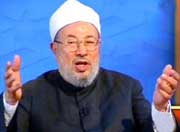
YusufalQaradawiThe government has been criticised by moderate Muslim groups for banning a controversial Muslim scholar from entering Britain and branding him an extremist.
The government confirmed to the Guardian that Yusuf al-Qaradawi had applied to come to the UK but had been refused.

The decision could hand the Tories a small political victory as the Conservative leader, David Cameron, last week called for his exclusion from the UK, saying Qaradawi was a “dangerous and divisive” preacher of hate.

But moderate British Muslim groups, including the Muslim Council of Britain (MCB), are upset with the ban. Muhammad Abdul Bari, the secretary-general of the MCB, condemned the ban. He said the UK government had bowed to Zionist and neo-con pressure and pointed out that a Tory government had allowed Qaradawi to enter Britain several times.

Bari said Qaradawi was respected as a scholar throughout the Muslim world: “It is regrettable that the government has finally given way to these unreasonable demands spearheaded by the Tory leader whose government had, in fact, allowed Dr Qaradawi to visit the UK five times between 1995-97.

“I am afraid this decision will send the wrong message to Muslims everywhere about the state of British society and culture. Britain has had a long and established tradition of free speech, debate and intellectual pursuit. These principles are worth defending, especially if we would like to see them spread throughout the world.”

The Home Office said: “We can confirm that Al-Qaradawi has been refused a visa to visit the UK. The UK will not tolerate the presence of those who seek to justify any acts of terrorist violence or express views that could foster inter-community violence.”

Guardian, 7 February 2008


The Sun, on the other hand goes with “PM bans hate cleric’s UK visit“.

See also MCB press release, 6 February 2008 and Inayat Bunglawala’s piece at Comment is Free

And for Tim Montgomerie’s response see Tory Diary, 7 February 2008

Imaan opposes ban on Qaradawi

LGBT Muslims concerned that ban on scholar could contribute to Islamophobia

Imaan, the LGBT Muslim support group, joins those in the Muslim community who are concerned at the Home Office decision to ban Sheikh Yusuf Al-Qaradawi. The Home Office is reported to have refused a visa for medical treatment on the grounds that: “the UK will not tolerate the presence of those who seek to justify any acts of terrorist violence or express views that could foster inter-community violence.”

This flies in the face of advice from the Foreign and Commonwealth Office which states that acting “against Qaradawi would alienate significant and influential members of the global Muslim community … (and) give grist to Al-Qaeda propaganda of a western vendetta against Muslims…”

This advice, given in 2005 by its Islamic Affairs Advisor, clearly outlines that Qaradawi has made authoritative statements condemning the London bombings, the 9-11 attacks and other acts of terrorism, which he has stated are against the beliefs of Islam (see editor’s notes below for link).

Regarding his views on homosexuality, Imaan makes clear its disagreements with all faiths that are regressive on this issue.

However, we believe that all religious leaders should be treated equally and just as we would not support a ban on the Pope, so we are concerned that by banning Qaradawi, the Home Office is contributing to a climate of Islamophobia, which impacts on all Muslims, including our LGBT members.

Continue reading

Archbishop backs sharia law for British Muslims

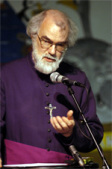
Rowan_WilliamsThe Archbishop of Canterbury sparked controversy today when he said the introduction of sharia law for British Muslims was “unavoidable”. Rowan Williams told BBC Radio 4’s World at One that Muslims should be able to choose whether to have matters such as marital disputes dealt with under sharia law or the British legal system. His comments were strongly criticised by the National Secular Society but welcomed by the Muslim Council of Britain (MCB), which stressed it did not back the introduction of sharia criminal law. Williams said his proposal would only work if sharia law was properly understood, rather than seen through the eyes of biased media reports.

Guardian, 7 February 2008

See also BBC News, 7 February 2008


Meanwhile, over at Harry’s Place, the inimitable David Toube calls for Williams to be sacked. “Isn’t there something particularly pathetic”, he asks, “about a Bishop in a church which – in theory – exists to evangelise, shilling on behalf of the theocratic politics of another religion, which wishes to write their version of ‘god’s will’ into law?”

Damian Thompson agrees: “Williams is lending his support to the establishment of a non-Christian theocracy in Britain. The Church of England must think seriously about his suitability for the ancient office he occupies. And then get rid of him.”

At Dhimmi Watch, Robert Spencer is appalled: “Rowan Williams has utterly forgotten, if he ever knew, that the idea of ‘one law for everybody’ was one of the great achievements of Judeo-Christian civilization…. I wonder if Rowan Williams is aware that if Muslims ever came to power in Britain, they themselves would enforce one law for everybody – a law that would reduce him to dhimmitude.”

Over at Stormfront the fascists take much the same line.

And if “the idea of ‘one law for everybody’ was one of the great achievements of Judeo-Christian civilization”, how does Spencer explain the existence of Beth Din courts?

For the Archbishop’s actual views, see here.

Islamophobia: resisting prejudice

“Most of us do not need to read the many reports coming out of the European Union, government departments and think-tanks to tell us there has been a rise in Islamophobia in Britain since 9/11 and the beginning of the ‘war on terror’…. Islamophobia seems to be replacing antisemitism as the principal Western statement of bigotry against the ‘other’…. This isn’t to say that we didn’t have racism pre 9/11. I’ve been called a ‘Paki’ for as long as I can remember – but now it is about being a Muslim. ‘Polite society’ no longer has to worry about seeming racist, or sounding like the BNP, if they are talking about Muslims.”

Nahella Ashraf in Socialist Worker, 9 February 2008

UK government acts on hoax e-mail

The UK government is taking the unprecedented step of writing to every embassy to stop a false e-mail rumour about Holocaust teaching being banned. A widely-circulated e-mail has falsely claimed that schools in the UK will stop teaching the Holocaust because it might cause offence to Muslims. Schools Secretary Ed Balls says he wants to “put an end once and for all to the myth” spread by the e-mail.

BBC News, 4 February 2008

This email has been circulating for months now. See here.

Stop playing silly buggers

Stop Playing Silly BuggersPeace and justice campaigners told the police to stop playing “silly buggers” on Monday following revelations that the anti-terrorism squad phone-tapped a senior Muslim MP while visiting a constituent in prison.

Justice Secretary Jack Straw told the Commons that a “fact-finding” investigation into the alleged police surveillance of Labour whip Sadiq Khan would report back within two weeks. Critics demanded to know who authorised the alleged bugging of the Tooting MP – an act banned under the so-called Wilson doctrine. Mr Straw replied that this was a matter for the inquiry, but he insisted that “no ministers played any part in these authorisations.”

According to BBC sources, a Thames Valley police officer made the decision to bug private conversations between Mr Khan and Babar Ahmad at Woodhill Prison, Milton Keynes, in 2005 and 2006, using a microphone hidden in a table.

Mr Ahmad, who has never been charged with a crime, is awaiting extradition to the US for trial over allegedly running a website to raise funds for Chechen separatists and Afghanistan’s Taliban.

In a strongly worded statement, Mr Ahmad’s family condemned the alleged affair but they insisted that they were not surprised. “After Babar’s abuse at the hands of the police and the subsequent cover-up by the authorities, it does not surprise us that ‘dirty dealings’ like this were being authorised in the prison,” it said. “It seems as though they were clutching at straws and desperate to find something to pin on him as they have been unsuccessful in doing so.”

Stop the War Coalition convener Lindsey German said that it was a “frightening state of affairs that the surveillance of an MP was authorised by one Thames Valley police officer and no elected politicians knew about it.

“It raises questions about the issue of surveillance and the state of our democracy,” she insisted. “I have had many conversations with Mr Ahamad’s family. Does this mean that those meetings were bugged? This kind of police control will make any grass-roots campaign very difficult and threaten democracy.” Ms German added: “The government and the police should stop playing silly buggers and get to the bottom of this.”

Morning Star, 5 February 2008

See also Star Comment: “Risk of a police state“.

Muslims in the Torygraph

Julaybib Ayoub has examined coverage of Islam and Muslims in the Daily and Sunday Telegraph over the past month. He writes:

“What can be said about these lists? First of all, Muslims are generally represented as a ‘problem’, whether it be regarding the war on terror, extremism, shariah law, schools, dress, education, youth, crime, other religions and culture. In other words, in almost every aspect of media interest, there is a ‘Muslim’ angle. Pretty much the same kind of stories come up again and again in each area – the threat of extremist youth; halal food in schools; the veil; alleged Muslim intolerance and over-sensitivity; and also the ‘injustice’ of Muslims being granted ‘special’ provision, although those kinds of stories (new racism stories) are more often found in the tabloids.

“However, some topics associated with Muslims by the media actually having nothing to do with Islam at all, notably forced marriages and honour killings. Honour refers to a cultural phenomenon found in both Muslim and non-Muslim cultures in South Asia and also in the Arab world. Yet the media not infrequently insinuates an Islamic association, especially when some tenuous relationship can be contrived linking Muslim leaders and such practices.”

Writing Muslim Culture, 4 February 2008

ABC tricked us, say Muslim women

Two Muslim women say their participation in an ABC documentary pitched as a “bridge-building” exercise between Islam and the wider community has left them fearful for their safety.

Raisah bint Alan Douglas and 54-year-old Rabiah Hutchinson, the so-called “matriarch” of radical Islam in Australia, have accused the makers of an ABC documentary, Jihadi Sheilas, of deceitful and unethical conduct, saying they were tricked into participating in what they fear will be a misleading documentary.

Yesterday, the women delivered a formal letter of protest to the ABC’s Sydney headquarters.

The two women told The Australian that they were approached separately by an ABC documentary crew last year and invited to participate.

They said they were explicitly and repeatedly told the material would be used on the ABC’s long-running Australian Story, a show Ms Douglas described as “patriotic (and) sympathetic”. She said she was told the focus of the program would be the women’s conversion to Islam, not their alleged links to extremists.

“They said, ‘We’re going to put you on Australian Story’,” Ms Douglas told The Australian. “‘We’d like to because there’s a lot of negative publicity around Muslims and it seems to be getting worse. We, as a community channel, want to do something about it … It will be a bridge-building exercise between the Muslim community and the Australian general public.”‘

The women – neither of whom has seen the program – are concerned the final product portrays them as traitors.

Ms Hutchinson said she had already been verbally abused after being recognised from a promo for the show. She said in one incident, which occurred at Bankstown shopping centre on Sunday, a man yelled at her to “go back where you came from”.

“They actually mentioned the television program,” she said.

The Australian, 5 February 2008