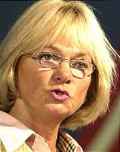
 COPENHAGEN, Denmark — Raving xenophobe or fearless defender of Danish values? Nationalist leader Pia Kjaersgaard’s anti-Muslim outbursts have earned her many labels — and many votes.
Despite predictions of her populist Danish People’s Party’s demise, Kjaersgaard remains a powerful force in domestic politics after winning 14 percent of the vote in last week’s election.
“The most important thing for the Danish People’s Party is to maintain the Danish identity,” Kjaersgaard, 60, told The Associated Press in an interview. “I am convinced that the Islamists want to sneak Sharia (Islamic law) through the back door, that they want to combat Western society and they want Islam to become the main religion,” she said.
Her party — Denmark’s third biggest — has held the role of kingmaker since 2001, giving the center-right government the backing it needs for a majority in Parliament. In return, Kjaersgaard has been able to press the government to adopt some of Europe’s strictest immigration laws, which she says have been instrumental in stemming the inflow of Muslims with radical views.
There are an estimated 200,000 Muslims among Denmark’s 5.4 million residents.
“The individual Muslim has never been a problem for Danish society. But their number has,” Kjaersgaard told AP in her office, decorated with Danish flags and paintings depicting Danish landscapes. To emphasize her point, she said she shops at a grocery store owned by a Turkish Kurd who respects Danish laws and culture. “He has a lot of great stuff — fruits, vegetables — and he’s a good friend of mine,” Kjaersgaard said.
The flow of asylum-seekers has dropped by 84 percent since Denmark tightened its immigration laws in 2001. There is now broad agreement across party lines to maintain the system.
But critics say the Danish People’s Party has polarized Danish society by bashing Islam and stereotyping immigrants as welfare cheats. “She is a scare-mongering populist and opportunist,” said Holger K. Nielsen of the left-wing opposition Socialist People’s Party. He added Kjaersgaard was a skillful politician who has tapped into undercurrents of nationalism and worries over immigration among Danes.
During last year’s uproar over Danish caricatures of the Prophet Muhammad, Kjaersgaard and other leading party members took turns blasting Islam as incompatible with Danish traditions including free speech. Ahead of the Nov. 13 election, one of the party’s campaign posters showed an artist’s hand drawing a picture of Muhammad, with the text “Freedom of speech is Danish, censorship is not.”
Continue reading →
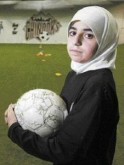 The family of a 14-year-old girl is demanding an apology from a referee who refused to allow her to play indoor soccer while wearing a religious head scarf. But the head of referee development for Alberta’s governing soccer body says wearing hijabs can pose a threat to player safety.
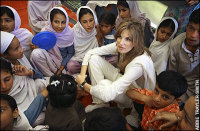 “I recently attended a debate entitled ‘Is Islam good for London? … It wasn’t just me who found the title, tone and content of the debate disturbing. The liberal rabbi, Pete Tobias, described it as a ‘damaging and hurtful exercise’, sinisterly reminiscent of the campaign a century ago to alert the population to ‘the Problem of the Alien’ – namely the Eastern Jews fleeing persecution who had found refuge in the capital.
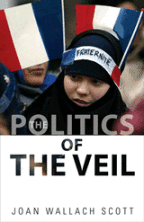 “‘A kind of aggression’. ‘successor to the Berlin Wall’. ‘lever in the long power struggle between democratic values and fundamentalism’. ‘An insult to education’. ‘A terrorist operation’. These descriptions – by former French President Jacques Chirac; economist Jacques Attali; and philosophers Bernard-Henri Lévy, Alain Finkielkraut and André Glucksmann – do not refer to the next great menace to human civilization but rather to the Muslim woman’s headscarf, which covers the hair and neck, or, as it is known in France, the foulard islamique.”