
Excellent news from ENGAGE.
Author Archives: Bob Pitt
Row over Islamic dress opens bitter divisions in France
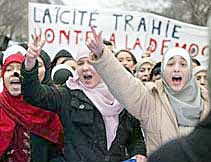 In the northern Paris suburb of Saint-Denis, with its busy market, fast-food joints and bargain clothes shops, Angelica Winterstein only goes out once a week – and only if she really has to.
“I feel like I’m being judged walking down the street. People tut or spit. In a smart area west of Paris, one man stopped his car and shouted: ‘Why don’t you go back to where you came from?’ But I’m French, I couldn’t be more French,” said the 23-year-old, who was born and raised in bourgeois Versailles.
Once a fervent Catholic, Winterstein converted to Islam at 18. Six months ago she began wearing a loose, floor-length black jilbab, showing only her expertly made-up face from eyebrows to chin. She now wants to add the final piece, and wear full niqab, covering her face and leaving just her eyes visible.
“But this week, after Sarkozy announced that full veils weren’t welcome in France, things have got really difficult,” she said. “As it is, people sometimes shout ‘Ninja’ at me. It’s impossible to find a job – I’m a qualified childminder and get plenty of interviews because of my CV, but when people see me in person, they don’t call back. It’s difficult in this country, there’s a certain mood in the air. I don’t feel comfortable walking around.”
Human rights groups warned this week that the row over niqabs risks exacerbating the growing problem of discrimination against women wearing standard Muslim headscarves. Five years on from the heated national debate over France’s 2004 law banning headscarves and all conspicuous religious symbols from state schools, there has been an increase in general discrimination against adult women who cover their heads.
“Women in standard headscarves have been refused access to voting booths, driving lessons, barred from their own wedding ceremonies at town halls, ejected from university classes and in one case, a woman in a bank was not allowed to withdraw cash from her own account at the counter. This is clear discrimination by people who wrongly use the school law to claim that France is a secular state that doesn’t allow headscarves in public places. It’s utterly illegal and the courts rule in our favour,” said Renee Le Mignot, co-president of the Movement Against Racism and for Friendship Between Peoples. “Our fear is that the current niqab debate is going to make this general discrimination worse.”
Samy Debah, a history teacher who heads France’s Collective against Islamophobia, said 80% of discrimination cases reported to his group involved women wearing standard headscarves. He had rarely seen any instances of women wearing niqabs, even in the ethnically mixed north Paris suburb where he lives. “From our figures, the biggest discriminator against Muslim women is the state and state officials,” he said. “What people have to understand is that the concept of French secularism is not anti-religion per se, it is supposed to be about respecting all religions.”
Horia Demiati, 30, a French financier who wears a standard headscarf with her business suits, said: “I really fear an increase in hatred.” She recently won a discrimination case after she and her family, including a six-month baby, were refused access to a rural holiday apartment they had booked in the Vosges. The woman who refused them argued that she was a secular feminist and didn’t want to see the headscarf, “an instrument of women’s submission and oppression”, in her establishment.
France: towards banning niqab and burqa
Amara Bamba examines the background to the current campaign in France against the veil and draws attention to an online petition against a ban.
‘Veiled threat’
“Among European liberals the burka is seen as a symbol of female subservience. And the freedom to opt for such deplorable status runs counter to other liberties regarded as more important in the hierarchy of freedoms: openness, transparency, equality and opportunity. Within Western society, the covering of the face negates all such fundamental rights….
“Tolerance of the practice is also a licence for intolerance. Too often extremists try to exploit this bogus symbol of Islamic piety to create Muslim ghettos where they assert their own personal power. Too often the issue is a deliberate provocation to challenge the values and mores of Western society. An absolute ban on the burka is unnecessary and unenforceable. But civic education and religious debate – here, in France and in the Muslim world – are the best way to consign to the dark ages this symbol of darkness.”
Editorial in the Times, 26 June 2009
Canada: government drops plans to ban veiled voting
The federal government has no plans to move forward with proposed legislation to force veiled women to show their faces when voting, the minister of state for democratic reform said Thursday.
Dmitri Soudas, a spokesperson for Prime Minister Stephen Harper, confirmed the government still supports the idea of forcing voters to reveal their faces, but said the bill doesn’t have opposition support. “The bottom line is even if we were to proceed with legislation, it would be voted down immediately,” Soudas said.
The government introduced the bill in October 2007, a month after an Elections Canada ruling allowed Muslim women to vote with their faces covered by burkas or niqabs during three Quebec byelections. That decision infuriated the government, and Harper accused Elections Canada of subverting the will of Parliament, which several months earlier had unanimously adopted legislation beefing up voter identification requirements.
MCB misrepresented
Letter in the Jewish Chronicle, 26 June 2009:
Your article reporting a claim that the Muslim Council of Britain and Muslims “snubbed” a briefing of a multi-faith initiative designed to formulate a co-ordinated response to the BNP (Muslims snub drive against BNP, JC June 19) is incorrect and misleading.
No formal invitation was received from Fiyaz Mughal or his company, Faith Matters. If it had been, the MCB would have considered it.
It is extraordinary that the MCB has been wrongly characterised in this light, given the work we have done to challenge the common threat we face from the far right.
We have worked with anti-fascist groups and we ourselves launched a campaign in British mosques to raise awareness of the need to fight fascism.
Moreover, we have long been advocating a co-ordinated strategy of all faiths. In fact, days before the June 4 European and local elections, the MCB invited faith leaders, including the newly elected President of the Board of Deputies, Vivian Wineman, to be part of a joint statement that called for unity of all faith communities in condemning all those who seek to divide our society.
May I assure your readers that the Muslim Council of Britain and British Muslims are ever ready to work with British Jews, our cousins in faith, to seek the common good, and foster greater understanding between our two communities.
We can start by tackling the weekly drip-feed of misrepresentation and suspicion of Muslims and the MCB that is presented in your paper.
Murtaza Shibli,
Public Affairs and Media Officer,
Muslim Council of Britain
PO Box 57330, London E1
West must respect the Muslim veil
“Modernity should not be defined solely from a Western, liberal, secular-centred point of view. Our world today is one of multiple modernities, in which societies are increasingly multicultural and religiously and non-religiously pluralistic. Western societies should respect the rights of Muslim women who choose to wear the veil.”
John Esposito in the Gulf Times, 25 June 2009
Muslim Pc’s boss ‘accused him of looking like Osama Bin Laden’
A Muslim police officer was told he looked like the terrorist leader Osama Bin Laden by his boss because of his long beard, an employment tribunal has heard. Pc Tariq Dost has taken West Midlands Police and the police authority to a tribunal for racial and religious discrimination and victimisation following the remarks made to him from 2007.
Pc Dost, from Small Heath, Birmingham was working as a recruitment officer for the force when his manager Darren Yates is alleged to have made several discriminatory comments to him based on his race, beliefs and religion. The tribunal heard how Mr Yates made remarks about the length of his beard on several occasions and also questioned why he tucked his trousers into his boots.
Giving evidence, Pc Dost said: “I believe he felt uncomfortable with me because of my appearance. I found them (his comments) to be discriminatory and ignorant and embarrassing.” Pc Dost, 42, also claimed Mr Yates referred to Muslim prayer as “shouting and wailing” when he asked to go to afternoon prayer while at a recruitment fair at Birmingham’s NEC.
Mr Yates is alleged to have laughed at him as he turned up to the fair in Islamic clothing and robes as he was off duty. “I found it to be highly offensive and demeaning and discriminatory towards myself and Muslims as a whole,” Pc Dost said. “His actions were racist and Islamaphobic.”
Update: See “Muslim policeman awarded damages from West Midlands force”, Birmingham Post, 26 June 2009
Harry’s Place debates the ‘burka ban’

We’ve rather given up responding to the appalling Harry’s Place over the past couple of years, mainly because keeping up with the Islamophobic posts on that particular blog would be a full-time job in itself.
However, if anyone needs convincing of the culture of anti-Muslim bigotry that pervades that obnoxious site, it’s worth scrolling through the comments on their recent “Berks and Burqas” thread.
Express links veil to terrorism, calls for ban
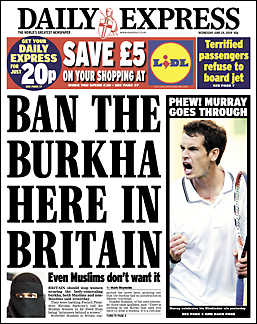 It is a city that has found itself at the heart of the debate about Muslim extremism after providing a home to three suicide bombers who brought devastation to London in the July 7 2005 attacks. And in Leeds yesterday the number of women clad head-to-foot in burkhas provoked anger among growing numbers who believe they should be banned.
Groups of Muslim women dressed in the restrictive robes refused to comment on their personal reasons for wearing the garment which continues to cause controversy. And even though they were walking along a busy street among shoppers and workers, most refused to be seen engaging with a non-Muslim man in public.
Leeds has a fast-growing Muslim population of at least 40,000 – double the number of 10 years ago. Locals say that since the 7/7 attacks in July 2005 – three of the gang hailed from Leeds – there has also been a increase in the number of Islamic women choosing to wear the burkha, much to the anger of many of the city’s inhabitants.
German-born au-pair Chantal Manzal, 23, has been living in Leeds for a year but returns home next month. She said yesterday: “I cannot believe what I have seen in Britain. In Germany the burkha is hardly ever seen but here I see women wearing them whenever I go out. I find them really scary.”
Hairdresser Sarah-Jane Martin, 21, said: “There is no doubt these terrible things should be banned immediately. It is a sign of oppression against women and on those grounds alone, in this day and age, they should be outlawed.”
Businesswoman Marcia Booth, 37, said: “There is no more prominent sign of female oppression by men than the burkha. I find it so demeaning and whenever I see these women hiding themselves away my blood reaches boiling point and I just want to scream at them.”
See also ENGAGE, 24 June 2009